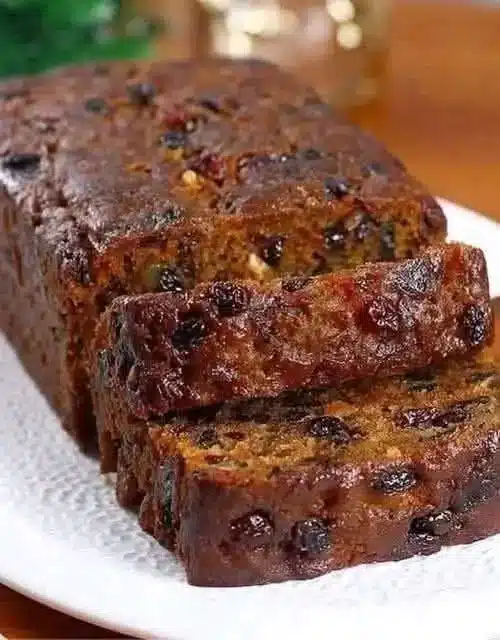
This Old-Fashioned Moist Fruitcake Loaf Recipe is everything a traditional holiday fruitcake should be: rich, deeply flavored, packed with plump dried fruit, and moist enough to stay tender for days. Dark brown sugar, butter, fresh orange, warm spices, and optional molasses give the loaf its beautiful deep color, while raisins and other dried fruits create a naturally sweet, chewy texture in every slice.
Inspired by the loaf in the photo, this version focuses heavily on raisins and dark dried fruit so that every slice has the old-fashioned appearance of a classic homemade Christmas fruitcake. The exterior bakes to a glossy, deeply browned finish while the center remains dense, tender, and packed with fruit.
Fruitcake has a reputation for being dry, but that usually happens when the fruit is added without being properly hydrated or the loaf is baked too aggressively. Soaking the dried fruit first and baking the cake slowly at a moderate temperature makes a dramatic difference.
This recipe can be prepared completely alcohol-free using orange juice or apple juice. If you prefer a traditional holiday version, you can use brandy or dark rum for part of the soaking liquid.
It is perfect for Christmas, Thanksgiving, holiday brunches, afternoon tea, dessert trays, potlucks, homemade gifts, winter gatherings, and family celebrations. It is also one of the best cakes to make ahead because the flavor often becomes even better after resting overnight.
Recipe Overview
| Recipe Details | Information |
|---|---|
| Recipe Name | Old-Fashioned Moist Fruitcake Loaf |
| Focus Keyword | Old-Fashioned Moist Fruitcake Loaf Recipe |
| Prep Time | 25 minutes |
| Fruit Soaking Time | 30 minutes to overnight |
| Bake Time | 75–90 minutes |
| Cooling Time | 1–2 hours |
| Total Time | About 3 hours |
| Servings | 10–12 slices |
| Course | Dessert |
| Cuisine | Traditional Holiday Baking |
| Difficulty | Easy to Intermediate |
| Texture | Moist, dense, tender and fruit-filled |
| Main Flavor | Raisins, orange, brown sugar and warm spices |
| Best For | Christmas, Thanksgiving, gifting and tea time |
| Make-Ahead Friendly | Yes |
| Freezer Friendly | Yes |
Why You’ll Love This Fruitcake
This recipe is designed to produce a fruitcake that is dense without being dry. The soaked fruit contributes moisture, while butter, eggs, dark brown sugar, and orange juice keep the cake tender.
It is also much easier than many traditional fruitcakes. You do not need complicated aging techniques, special molds, or elaborate decorations.
The dried fruit mixture can be customized according to what you enjoy. If you want a loaf that looks especially similar to the image, use a larger proportion of dark raisins and currants.
The recipe works beautifully as one large loaf, but it can also be divided among mini loaf pans. Mini fruitcakes are excellent for holiday gift baskets because they travel well and do not require frosting.
Another advantage is that the loaf freezes extremely well. You can bake it weeks ahead, freeze it tightly wrapped, and thaw it before your holiday gathering.
Complete Ingredient Guide
| Ingredient | Amount | Purpose |
|---|---|---|
| Dark raisins | 1 1/4 cups | Traditional fruitcake flavor |
| Golden raisins | 1/2 cup | Softer sweetness |
| Dried cranberries | 1/2 cup | Tart contrast |
| Chopped dates | 1/2 cup | Moisture and caramel flavor |
| Currants | 1/3 cup | Small concentrated fruit flavor |
| Candied cherries | 1/3 cup, optional | Color and sweetness |
| Orange juice | 1 cup total | Soaking and batter moisture |
| Orange zest | 1 tbsp | Fresh citrus aroma |
| All-purpose flour | 1 3/4 cups | Cake structure |
| Butter | 3/4 cup | Richness and tenderness |
| Dark brown sugar | 3/4 cup | Moisture and deep flavor |
| Eggs | 3 large | Structure |
| Molasses | 2 tbsp | Dark color and richness |
| Vanilla extract | 2 tsp | Flavor |
| Cinnamon | 1 tsp | Warm spice |
| Nutmeg | 1/2 tsp | Holiday aroma |
| Cloves | 1/4 tsp | Traditional spice |
| Baking powder | 1 tsp | Gentle lift |
| Baking soda | 1/2 tsp | Browning and texture |
| Salt | 1/2 tsp | Balances sweetness |
| Pecans or walnuts | 3/4–1 cup, optional | Crunch |
Ingredients
For the Soaked Fruit
- 1 1/4 cups dark raisins
- 1/2 cup golden raisins
- 1/2 cup dried cranberries
- 1/2 cup chopped dates
- 1/3 cup dried currants
- 1/3 cup chopped candied cherries, optional
- 3/4 cup orange juice or apple juice
- 1 tablespoon finely grated orange zest
For a traditional variation, replace some or all of the juice with brandy or dark rum.
For the Fruitcake Batter
- 1 3/4 cups all-purpose flour
- 1 teaspoon baking powder
- 1/2 teaspoon baking soda
- 1 teaspoon ground cinnamon
- 1/2 teaspoon ground nutmeg
- 1/4 teaspoon ground cloves
- 1/4 teaspoon ground allspice, optional
- 1/2 teaspoon salt
- 3/4 cup unsalted butter, softened
- 3/4 cup packed dark brown sugar
- 3 large eggs, room temperature
- 2 teaspoons vanilla extract
- 2 tablespoons unsulphured molasses
- 1/4 cup orange juice
- 3/4 to 1 cup chopped pecans or walnuts, optional
Optional Glossy Finish
- 2 tablespoons orange marmalade or apricot preserves
- 1 teaspoon warm water
Best Dried Fruit for Homemade Fruitcake
The best fruitcakes usually contain a mixture of fruits rather than only one variety. Mixing different textures creates a loaf that tastes more complex while remaining moist.
| Dried Fruit | Flavor | Texture |
|---|---|---|
| Dark raisins | Rich and sweet | Chewy |
| Golden raisins | Mild and fruity | Soft |
| Currants | Slightly tart | Small and chewy |
| Cranberries | Sweet-tart | Firm |
| Dates | Caramel-like | Soft and sticky |
| Cherries | Sweet | Chewy |
| Apricots | Tangy | Firm |
| Figs | Deep and honey-like | Chewy |
If you want the finished loaf to resemble the picture closely, increase the dark raisins and currants while using fewer colorful candied fruits.
Why Soaking the Fruit Matters
Soaking the dried fruit is one of the most important steps in this entire recipe. Dried raisins, currants, and dates naturally absorb moisture, so adding them directly to the batter can leave the final cake drier.
When soaked first, the fruit absorbs liquid before entering the oven. The raisins become plump, the dates soften, and the fruit releases some of its flavor into the surrounding cake.
Orange juice is especially good for an alcohol-free fruitcake because it adds both sweetness and acidity. The citrus cuts through the heavier molasses and brown sugar flavors.
Thirty minutes is enough when you are in a hurry, but soaking for several hours or overnight gives an even better texture. If soaking overnight in juice, keep the covered bowl refrigerated.
Kitchen Equipment
| Equipment | Purpose |
|---|---|
| 9×5-inch loaf pan | Baking the cake |
| Parchment paper | Easy removal |
| Large mixing bowl | Batter |
| Medium bowl | Soaking fruit |
| Electric mixer | Creaming butter and sugar |
| Rubber spatula | Folding fruit |
| Whisk | Dry ingredients |
| Citrus zester | Orange zest |
| Measuring cups and spoons | Ingredient accuracy |
| Wire rack | Cooling |
| Long skewer | Checking doneness |
Step-by-Step Instructions
Step 1: Soak the Dried Fruit
Place the dark raisins, golden raisins, dried cranberries, dates, currants, and candied cherries in a medium bowl.
Pour the orange juice over the fruit and add the orange zest. Stir well until everything is coated.
Allow the fruit to soak for at least 30 minutes. For an especially moist fruitcake, cover the bowl and refrigerate for several hours or overnight.
Step 2: Preheat the Oven
Preheat your oven to 325°F / 165°C.
Fruitcake is dense and contains plenty of sugar and dried fruit, so a lower oven temperature gives the center enough time to bake without burning the outside.
Step 3: Prepare the Loaf Pan
Lightly grease a 9×5-inch loaf pan and line it with parchment paper.
Leave some parchment extending above the two longer sides. These parchment handles make the heavy loaf easier to remove after baking.
Step 4: Prepare the Soaked Fruit
If a large amount of liquid remains after soaking, drain away the excess. The fruit should be plump and moist but not dripping.
Remove approximately 1 tablespoon from the measured flour and toss it lightly with the soaked fruit. This helps reduce sinking while the loaf bakes.
Step 5: Mix the Dry Ingredients
Whisk together the flour, baking powder, baking soda, cinnamon, nutmeg, cloves, optional allspice, and salt.
Mix for about 30 seconds so the leavening and spices are distributed evenly.
Step 6: Cream the Butter and Brown Sugar
Place the softened butter and dark brown sugar in a large bowl.
Beat with an electric mixer for approximately 3 to 4 minutes, until creamy and slightly lighter.
This step adds a little air to what is otherwise a dense batter and gives the loaf a better texture.
Step 7: Add the Eggs
Add the eggs one at a time, beating briefly after each addition.
Scrape down the sides and bottom of the bowl whenever necessary.
If the mixture looks slightly curdled after the eggs are added, that is usually fine. It will become smoother after the flour is incorporated.
Step 8: Add Vanilla, Molasses and Orange Juice
Add the vanilla extract, molasses, and remaining 1/4 cup orange juice.
Mix until just combined.
The molasses gives the cake its darker color and contributes the deep old-fashioned flavor associated with traditional fruitcake.
Step 9: Add the Dry Ingredients
Add the flour mixture gradually.
Mix on low speed only until you can no longer see dry flour.
Avoid beating excessively because overmixing can make the final loaf tougher.
Step 10: Fold in the Soaked Fruit
Add the soaked fruit and chopped nuts if using.
Fold gently with a rubber spatula until the fruit is distributed throughout the batter.
The mixture will look much thicker than ordinary cake batter. This is exactly what you want because the batter needs enough structure to support the heavy dried fruit.
Step 11: Fill the Loaf Pan
Transfer the batter to the prepared loaf pan.
Press it gently into the corners and smooth the top with a spatula.
Tap the pan lightly on the counter once or twice to remove any large air pockets.
You can decorate the surface with a few additional raisins, cherries, pecans, or walnuts if desired.
How to Bake Fruitcake Without Drying It Out
Bake at 325°F / 165°C for 75 to 90 minutes.
Start checking the loaf around 65 to 70 minutes.
If the surface becomes very dark but the center is not yet done, cover the cake loosely with foil and continue baking.
Insert a long wooden skewer into the center. It should come out without wet cake batter.
Because there are so many raisins and dates inside, test the loaf in two or three places. A skewer that passes directly through soft fruit may look wet even when the surrounding cake is fully baked.
Baking Time Guide
| Pan Size | Temperature | Approximate Time |
|---|---|---|
| 9×5-inch loaf | 325°F / 165°C | 75–90 minutes |
| 8×4-inch loaf | 325°F / 165°C | 80–100 minutes |
| Mini loaves | 325°F / 165°C | 35–50 minutes |
| Muffin-size cakes | 325°F / 165°C | 22–30 minutes |
Baking times are estimates because fruit quantity, pan material, and individual ovens can all affect the result.
How to Know When Fruitcake Is Done
The center should feel set when gently pressed, and the surface should be a rich dark brown.
The edges may begin pulling very slightly away from the loaf pan.
A skewer inserted through a section of cake rather than directly through a raisin should come out clean or with a few moist crumbs.
If obvious raw batter appears on the skewer, return the loaf to the oven for another 8 to 10 minutes before checking again.
Cooling the Fruitcake Correctly
Allow the loaf to cool inside the pan for approximately 20 minutes.
Then use the parchment handles to carefully lift it from the pan and transfer it to a wire cooling rack.
Let the fruitcake cool completely before cutting.
Warm fruitcake is softer and can crumble when sliced. If you have enough time, wrap the fully cooled loaf and let it rest overnight before serving.
How to Give Fruitcake a Glossy Finish
A thin layer of marmalade or preserves gives the loaf a beautiful bakery-style shine.
Combine the orange marmalade or apricot preserves with approximately one teaspoon warm water.
Warm briefly until spreadable, then brush a thin layer over the completely cooled fruitcake.
Orange marmalade reinforces the citrus flavor, while apricot preserves create a more neutral glossy finish.
How to Make Fruitcake Extra Moist
The first important step is soaking the fruit. Properly hydrated dried fruit stays softer and absorbs less moisture from the cake during baking.
The second important factor is brown sugar. Dark brown sugar contains molasses, which contributes moisture as well as flavor.
Butter and egg yolks also enrich the cake and help create a tender crumb.
Finally, avoid overbaking. Even a heavily fruited loaf can become dry if left in the oven much longer than necessary.
Why Fruitcake Tastes Better the Next Day
Fruitcake is one of those desserts that often improves after resting.
As the loaf sits, moisture redistributes between the dried fruit and cake crumb. The flavors of cinnamon, nutmeg, orange, brown sugar, vanilla, and molasses also have time to blend together.
The result is usually a softer, more harmonious loaf on the second day.
That makes this recipe extremely useful for holiday entertaining because you can finish your baking before the day of the event.
How to Keep the Fruit from Sinking
Large pieces of wet fruit are more likely to fall toward the bottom during baking.
Drain excessive soaking liquid before folding the fruit into the batter.
Lightly coating the fruit with flour creates additional friction that helps it remain suspended.
The batter itself should also be thick. A thin batter has difficulty holding heavy fruit in place.
Pro Tips for the Best Fruitcake
Use softened butter rather than melted butter because creamed butter gives the cake more structure.
Bring the eggs closer to room temperature before mixing so they combine more smoothly with the butter.
Soak the dried fruit for at least 30 minutes, and overnight whenever possible.
Use dark brown sugar and molasses if you want the deepest old-fashioned color.
Do not overmix after adding the flour.
Bake slowly rather than increasing the temperature to save time.
Cover the top with foil if it starts becoming too dark.
Allow the cake to cool completely before wrapping or slicing.
Rest the loaf overnight for the best flavor and slicing texture.
Delicious Variations and Substitutions
Raisin-Heavy Fruitcake
Increase the dark raisins to about 2 cups and reduce some of the cranberries and candied cherries.
This variation closely resembles the fruitcake in the image, where raisins are the dominant fruit.
Orange Raisin Fruitcake
Use dark and golden raisins as the main fruit and increase the orange zest to about 2 tablespoons.
The citrus fragrance gives the loaf a cleaner, brighter flavor.
Rum Fruitcake
Replace some or all of the soaking juice with dark rum.
The rich flavor of rum pairs naturally with molasses, raisins, orange zest, cinnamon, and pecans.
Brandy Fruitcake
Soak the fruit in brandy and include chopped dried apricots.
This gives the cake a slightly brighter fruit profile.
Nut-Free Fruitcake
Leave out the nuts completely.
Increase the dried fruit slightly if you want the loaf to remain heavily packed.
Cherry Almond Fruitcake
Add extra cherries and a small amount of almond extract.
Top with sliced almonds before baking.
Chocolate Fruitcake
Fold dark chocolate chunks or chocolate chips into the finished batter.
Dark chocolate pairs especially well with dried cherries, raisins, dates, orange, and nuts.
Apple Cinnamon Fruitcake
Soak the fruit in apple juice and add chopped dried apples.
Increase the cinnamon slightly for an autumn-inspired variation.
How to Make Mini Fruitcake Loaves
Mini fruitcake loaves are perfect for Christmas gifts, cookie boxes, or holiday baskets.
Prepare the same batter and divide it among mini loaf pans, filling each approximately three-quarters full.
Bake at 325°F / 165°C and begin checking around the 35-minute mark.
Allow the loaves to cool completely before wrapping.
You can brush each one with a little warmed orange marmalade for a professional finish.
What to Serve with Fruitcake
| Serving Idea | Why It Works |
|---|---|
| Hot coffee | Balances the rich sweetness |
| Black tea | Classic combination |
| Earl Grey tea | Citrus notes pair with orange |
| Butter | Simple traditional option |
| Cream cheese | Adds tang |
| Vanilla ice cream | Makes it a plated dessert |
| Whipped cream | Adds lightness |
| Orange marmalade | Reinforces citrus flavor |
| Fresh berries | Adds freshness |
| Caramel sauce | Extra indulgence |
How to Serve Fruitcake for Christmas
Fruitcake is rich, so relatively thin slices are often ideal.
Arrange slices on a large serving platter alongside Christmas cookies, fudge, gingerbread, chocolates, and nuts.
Coffee and tea pair especially well with this loaf because their slightly bitter flavors balance the sweet dried fruit.
For a more elegant dessert, serve one slice with lightly whipped cream, a little orange zest, and a few fresh berries.
Make-Ahead Instructions
The dried fruit can be soaked one or two days before baking. Keep it covered in the refrigerator if using juice.
The complete fruitcake can also be prepared several days before serving.
Once completely cool, wrap the loaf tightly so it retains moisture.
The cake is often at its best after resting overnight, making it ideal for a busy holiday schedule.
Storage
Store the completely cooled fruitcake inside an airtight container or wrap it tightly.
At cool room temperature, an alcohol-free loaf is best enjoyed within approximately 3 to 4 days.
For longer storage, refrigerate it for about one week.
Bring refrigerated slices closer to room temperature before serving. This allows the butter to soften and the flavors to become more aromatic.
Reheating
Fruitcake does not need reheating, but a slightly warm slice can be delicious.
Microwave an individual slice for about 8 to 12 seconds.
For several pieces, warm them briefly in a 300°F / 150°C oven.
Avoid overheating because raisins and other dried fruits can become extremely hot.
Freezing Instructions
Fruitcake is an excellent freezer-friendly dessert.
Allow the loaf to cool completely before wrapping.
Wrap tightly in plastic wrap, then add foil or place it inside a freezer-safe container.
Freeze for up to approximately 3 months for best quality.
Individual slices can also be frozen with parchment between them, allowing you to thaw only what you need.
Ways to Use Leftover Fruitcake
Fruitcake can be used in more ways than simply serving another slice.
Lightly toast slices and spread them with butter or cream cheese for breakfast.
Cube leftover fruitcake and layer it with vanilla custard and whipped cream to make a holiday trifle.
You can also serve warmed pieces with vanilla ice cream or transform slightly dry leftovers into a bread-pudding-style dessert.
Common Mistakes and How to Avoid Them
Skipping the Fruit Soak
Dry fruit can pull moisture from the batter and become tougher during baking.
Always soak the fruit first whenever possible.
Leaving Too Much Liquid on the Fruit
The fruit should be plump, not dripping.
Drain substantial excess liquid before adding it to the batter.
Baking at Too High a Temperature
Dense fruitcake needs slow heat.
A very hot oven can burn the exterior before the center is fully baked.
Overmixing
Once the flour is added, mix only until everything is combined.
Too much mixing can make the crumb tougher.
Cutting While Warm
A warm loaf is more fragile and difficult to slice neatly.
Cool completely before cutting.
Overbaking
Begin checking before the full baking time has passed.
Fruitcake should be moist and tender, not dry and hard.
Troubleshooting Guide
| Problem | Likely Cause | Solution |
|---|---|---|
| Cake is dry | Overbaked | Reduce baking time |
| Raisins are hard | Not soaked | Soak longer |
| Center is wet | Underbaked | Cover top and continue baking |
| Top is too dark | Browning too quickly | Cover loosely with foil |
| Fruit sank | Fruit too wet | Drain and coat lightly with flour |
| Cake crumbles | Cut too early | Cool completely |
| Center is gummy | Excess soaking liquid | Drain fruit better |
| Flavor is weak | Too little spice or citrus | Add zest and spices |
| Cake sticks | Pan not properly prepared | Use parchment |
| Cake is too sweet | Too much candied fruit | Use more raisins and tart fruit |
Nutrition Estimate
| Nutrition | Approximate Amount |
|---|---|
| Calories | 340–470 per slice |
| Protein | 4–7 g |
| Carbohydrates | 49–66 g |
| Fat | 14–22 g |
| Fiber | 3–5 g |
| Sugar | 30–45 g |
| Sodium | 150–280 mg |
| Serving Size | 1 slice |
Nutrition values are estimates and vary according to the fruit mixture, nuts, molasses, glaze, and portion size.
Frequently Asked Questions
What is old-fashioned fruitcake?
Old-fashioned fruitcake is a dense cake containing a generous amount of dried or candied fruit, warm spices, sugar, butter, eggs, and often nuts.
Why is fruitcake so dark?
Dark brown sugar, molasses, raisins, spices, and slow baking all contribute to the deep brown color.
Does fruitcake have to contain alcohol?
No. Orange juice, apple juice, cranberry juice, or another flavorful non-alcoholic liquid works well.
Can I make the recipe mostly with raisins?
Yes. A raisin-heavy version is especially traditional and will closely resemble the loaf in the image.
How long should I soak the dried fruit?
At least 30 minutes is recommended. Several hours or overnight produces an even softer texture.
Can I soak fruit overnight?
Yes. Keep juice-soaked fruit covered in the refrigerator overnight.
Can I use only raisins and dates?
Yes. The exact fruit combination is flexible as long as the total quantity remains similar.
Can I add nuts?
Yes. Pecans and walnuts are excellent choices.
Can I leave out nuts?
Absolutely. Nuts are optional and are not required for the structure of the cake.
Why did my fruit sink?
The fruit may have been overly wet, unusually large, or added to a batter that was too thin.
Why did my fruitcake turn out dry?
Overbaking and adding unsoaked dried fruit are the most common causes.
Can I make fruitcake ahead?
Yes. Fruitcake is one of the best make-ahead desserts because the flavor often improves after resting.
How long does homemade fruitcake keep?
An alcohol-free loaf is generally best within several days at cool room temperature or around one week refrigerated.
Can fruitcake be frozen?
Yes. It freezes very well for approximately 3 months.
Can I make mini fruitcakes?
Yes. Mini loaves are ideal for holiday gifts and require significantly less baking time.
What can I serve with fruitcake?
Coffee, tea, cream cheese, butter, vanilla ice cream, whipped cream, or orange marmalade all pair well.
Can I use apple juice instead of orange juice?
Yes. Apple juice creates a slightly softer flavor while still hydrating the dried fruit effectively.
Can I add chocolate?
Yes. Dark chocolate works especially well with raisins, cherries, orange, and spices.
Why does fruitcake taste better the next day?
Resting allows moisture and flavor to redistribute throughout the cake, often resulting in a softer crumb and deeper spice flavor.
How do I get clean fruitcake slices?
Cool the loaf completely, let it rest overnight if possible, and use a sharp serrated knife.
Final Thoughts
This Old-Fashioned Moist Fruitcake Loaf Recipe is a dependable way to make a traditional holiday cake that is rich, deeply flavored, and genuinely moist. Plump raisins, dried fruit, dark brown sugar, fresh orange, butter, molasses, and warm spices create a loaf with both nostalgic flavor and a beautiful dark appearance.
The most important step is soaking the dried fruit. Properly hydrated raisins and dates remain tender during baking and help prevent the cake from becoming dry.
Slow baking is equally important. A moderate oven allows the dense center to bake thoroughly while the exterior develops the dark caramelized finish visible in the image.
Once the fruitcake is cool, let it rest overnight if possible. The crumb becomes easier to slice, the fruit softens further, and the orange, spice, brown sugar, and molasses flavors become more balanced.
Serve this fruitcake for Christmas, Thanksgiving, holiday brunches, church events, potlucks, afternoon tea, dessert tables, or homemade gift baskets. It is a traditional recipe that can be adjusted to suit your family while still keeping the rich, fruit-packed character that makes old-fashioned fruitcake special.