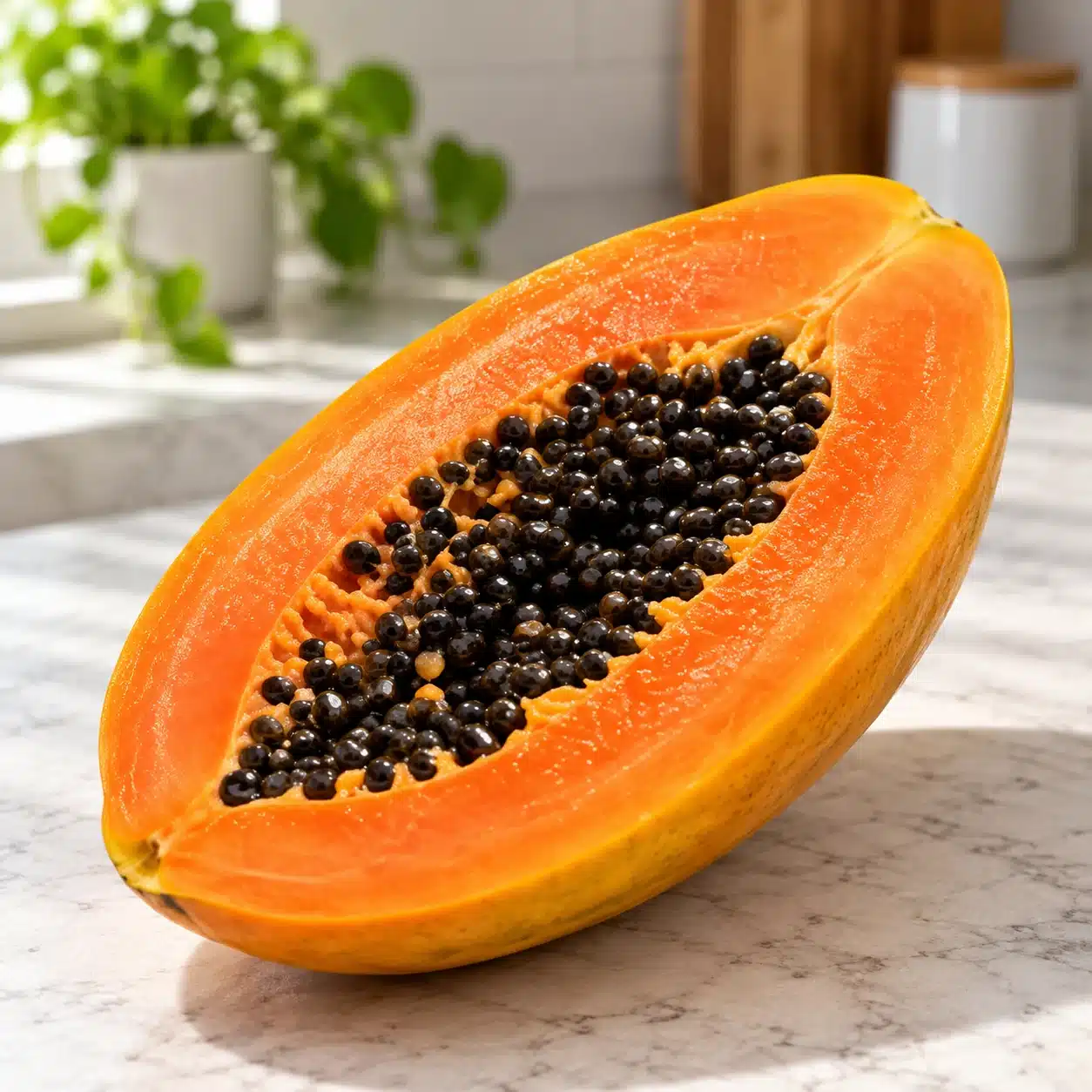
Papaya is a colorful tropical fruit packed with vitamin C, folate, carotenoids, and other naturally occurring plant compounds. Its sweet orange flesh makes it an easy addition to breakfast bowls, smoothies, fruit salads, and healthy snacks.
However, claims like the one shown in the image — that papaya can “eliminate all cancer cells” or prevent blindness — go far beyond what scientific evidence supports. The U.S. National Cancer Institute states that no food, vitamin, herb, supplement, or special diet has been proven to cure cancer or eliminate cancer cells from the body.
Papaya can still be part of a nutritious eating pattern. It provides vitamin C, folate, carotenoids, and other nutrients that support normal body functions, and some of those nutrients are important for maintaining healthy vision. But eating papaya should be viewed as healthy nutrition, not a replacement for cancer treatment or professional eye care.
This detailed guide explains what papaya actually contains, what researchers know about papaya and cancer, how its nutrients relate to eye health, the difference between promising laboratory findings and proven medical treatments, and easy ways to include ripe papaya in a balanced diet.
Quick Overview
| Topic | Evidence-Based Takeaway |
|---|---|
| Can papaya cure cancer? | No evidence shows that it can |
| Can papaya eliminate cancer cells from the body? | No |
| Can papaya cure blindness? | No |
| Is papaya nutritious? | Yes |
| Does papaya contain vitamin C? | Yes |
| Does papaya provide folate? | Yes |
| Does it contain carotenoids? | Yes |
| Can those nutrients support normal eye health? | Yes, as part of overall nutrition |
| Should papaya replace cancer treatment? | No |
| Should vision loss be treated with fruit instead of medical care? | No |
The distinction is important. A food can be nutritious without being a treatment for disease.
Why Papaya Gets So Much Attention
Papaya has bright orange or reddish flesh, which naturally contains several plant pigments and antioxidants. Its nutritional profile has made it a popular subject in wellness articles and laboratory research.
Papaya pulp contains vitamin C, folate, carotenoids and other nutrients. NIH dietary information lists raw papaya as a natural source of folate, while research reviews describe vitamin C and carotenoids among its important nutrients. (Bureau des Suppléments Alimentaires)
The problem begins when legitimate nutritional information is transformed into statements such as “this fruit destroys cancer” or “this recipe prevents blindness.”
Those statements confuse three very different concepts: nutrition, disease-risk research, and actual medical treatment.
Papaya Nutrition and Important Nutrients
Papaya can contribute several useful nutrients to a balanced diet.
Vitamin C
Vitamin C is an essential nutrient involved in collagen formation and normal antioxidant functions in the body. Humans cannot manufacture vitamin C themselves, which means it must come from food or other dietary sources.
Papaya is naturally rich in vitamin C, making it an easy fruit option for people who want more vitamin-C-containing foods.
Folate
Folate, also known as vitamin B9, is involved in DNA and RNA synthesis and normal amino-acid metabolism. NIH lists raw papaya among dietary sources of folate.
Carotenoids
Papaya also contains carotenoids, including provitamin-A carotenoids. These compounds give many fruits and vegetables their yellow, orange, and red colors.
Some carotenoids can be converted to vitamin A in the body.
Fiber
Whole papaya also provides dietary fiber, unlike many highly processed sweet foods.
Choosing whole fruit rather than relying exclusively on juice retains more of that fiber.
Can Papaya Eliminate Cancer Cells?
No clinical evidence shows that eating papaya can eliminate all cancer cells from a person’s body.
The National Cancer Institute specifically states that there is no proof that a particular food, vitamin, mineral, dietary supplement, herb, or special diet can cure cancer, slow it, or prevent it from returning.
That does not mean scientists never study foods or plant compounds.
Researchers frequently expose cancer cells to isolated chemicals in laboratory dishes or test compounds in animals. These experiments can help researchers identify mechanisms worth studying.
But killing cancer cells in a laboratory dish is very different from curing cancer in a human body.
NCI notes that findings from cell and animal studies do not automatically establish that a dietary component prevents or treats cancer in people. Human evidence is required.
Why Laboratory Cancer Studies Can Be Misleading Online
Suppose researchers isolate a plant compound and expose cancer cells to a very high concentration of it in a laboratory.
If some cells die, a social-media post may turn that result into:
“Scientists proved this fruit kills cancer.”
That conclusion skips several critical questions.
Can a person absorb enough of the compound by eating the fruit? Does digestion change it? Can it reach a tumor at an effective concentration? Does it damage healthy tissue? What dose is safe? Does it improve survival in human clinical trials?
Until those questions are answered through appropriate human research, a laboratory result is not evidence of a cancer cure.
This distinction applies not only to papaya but to many viral claims involving lemons, turmeric, ginger, garlic, soursop, baking soda, herbs, seeds, teas, or juices.
Can Healthy Food Still Matter for Cancer Prevention?
Yes, but in a much broader sense.
Diet is one component of long-term health, and scientists continue to study relationships between dietary patterns and cancer risk. But NCI emphasizes that associations between individual foods and cancer risk do not prove that one food directly causes or prevents cancer.
A balanced eating pattern containing fruits, vegetables, legumes, whole grains, and other nutrient-dense foods can be part of an overall healthy lifestyle.
Papaya can fit into that pattern.
The distinction is between saying “papaya is nutritious” and claiming “papaya cures cancer.”
The first is supported. The second is not.
Papaya and Eye Health: What Is Actually Known?
Papaya contains nutrients relevant to normal eye function, particularly carotenoids and vitamin C.
Vitamin A is especially important to the visual system. The National Eye Institute explains that beta-carotene can be converted into vitamin A, which the retina needs to detect light and convert it into electrical signals.
That does not mean that eating papaya will restore lost vision or prevent every form of blindness.
Vision loss can result from many different causes, including cataracts, glaucoma, retinal disease, diabetic eye disease, injury, infections, inherited conditions, and age-related macular degeneration.
Each condition requires appropriate diagnosis and management.
Can Papaya Cure Blindness?
There is no evidence that papaya cures blindness.
Healthy eating can support overall eye health, but the National Eye Institute’s recommendations emphasize an overall healthy diet, including fruits and vegetables—particularly dark leafy greens—and fish containing omega-3 fatty acids.
Food should therefore be considered one part of long-term eye-health habits rather than a treatment for established vision loss.
Anyone experiencing sudden vision loss, flashing lights, a curtain-like shadow, severe eye pain, or a rapid change in vision should seek urgent medical evaluation rather than trying a food remedy.
What About Lutein and Zeaxanthin?
Lutein and zeaxanthin are carotenoids concentrated in the retina and lens. Researchers have studied them particularly in relation to age-related macular degeneration.
The National Eye Institute’s AREDS2 research found that a specific supplement formulation containing lutein and zeaxanthin can reduce progression risk in certain people with age-related macular degeneration. That result applies to particular patients and a studied supplement formula — not to papaya as a cure for blindness.
People should not assume that eating large quantities of one fruit produces the same effect as a clinical formulation used in a specific medical population.
An ophthalmologist can determine whether an AREDS2-type supplement is appropriate for a particular person’s eye condition.
Healthy Habits That Help Protect Vision
Food is only one part of maintaining eye health.
The National Eye Institute recommends healthy eating, physical activity, managing conditions such as diabetes and high blood pressure, avoiding smoking, and protecting the eyes from ultraviolet exposure with appropriate sunglasses.
Regular eye examinations are also important because some serious eye diseases can progress before a person notices major symptoms.
A bowl of fruit can complement those habits, but it cannot replace them.
Ripe Papaya vs. Papaya Leaves, Seeds and Extracts
Another important distinction is the difference between eating ripe papaya fruit and taking concentrated papaya products.
The ripe flesh is a commonly eaten food.
Papaya leaves, seeds, latex, enzymes, extracts, powders, and concentrated supplements are different products and may contain compounds at much higher concentrations.
Natural products should not automatically be assumed to be harmless simply because they come from plants. NCI cautions that dietary and herbal supplements can cause side effects or interfere with cancer treatments.
Anyone receiving chemotherapy, radiation therapy, immunotherapy, targeted treatment, or other cancer care should discuss supplements and concentrated herbal products with their oncology team.
A Simple Healthy Papaya Bowl
Papaya does not need to be turned into a medicinal “cure” recipe to be useful.
One of the easiest ways to enjoy it is simply as part of a balanced breakfast or snack.
Ingredients
- 1 cup ripe papaya, cubed
- 1/2 cup plain Greek yogurt
- 1 tablespoon chia seeds
- 1 tablespoon chopped walnuts or almonds
- A squeeze of fresh lime
- Fresh berries, optional
- A small sprinkle of cinnamon, optional
Instructions
Place the ripe papaya in a serving bowl and add the Greek yogurt.
Top with chia seeds, walnuts or almonds, and optional berries.
Finish with a squeeze of fresh lime.
Serve immediately.
This gives you fruit plus protein and other nutrient-dense foods without making unsupported medical claims.
Easy Papaya Breakfast Smoothie
Another option is a simple smoothie.
Ingredients
- 1 cup ripe papaya
- 1/2 banana
- 3/4 cup plain Greek yogurt or milk
- 1/2 cup ice
- 1 teaspoon chia or ground flaxseed
- Fresh lime juice to taste
Instructions
Add all ingredients to a blender.
Blend until completely smooth.
Taste and adjust the lime if needed.
Serve immediately.
For most people, there is no need to load the smoothie with added sugar because ripe papaya and banana already contribute sweetness.
Best Ways to Eat Papaya
| Serving Idea | How to Use It |
|---|---|
| Fresh papaya | Eat chilled with lime |
| Yogurt bowl | Add yogurt, nuts and berries |
| Smoothie | Blend with yogurt or milk |
| Fruit salad | Combine with berries and citrus |
| Overnight oats | Add diced papaya before serving |
| Salsa | Mix with lime, herbs and peppers |
| Breakfast plate | Serve with eggs and yogurt |
| Dessert | Pair with coconut and lime |
Whole fruit is an easy way to enjoy papaya without treating it like medicine.
How to Choose a Ripe Papaya
A ripe papaya usually develops yellow or orange coloring as it matures.
It should give slightly when gently pressed, similar to a ripe avocado.
A completely hard green papaya usually needs more ripening time if you plan to eat it as sweet fruit.
Avoid fruit with large moldy areas, leaking liquid, or a strong fermented odor.
If your papaya is still firm, leave it at room temperature until it softens.
Once ripe, refrigeration can help slow further ripening.
How to Cut Papaya
Wash the outside before cutting.
Slice the papaya lengthwise.
Use a spoon to scoop out the dark seeds.
Peel the fruit or scoop the flesh away from the skin.
Cut into cubes, wedges, or slices.
Store cut papaya in a covered container in the refrigerator and use it while fresh.
Papaya Seeds: Should You Eat Them?
Papaya seeds are edible in small culinary amounts, but they have a strong, peppery and somewhat bitter flavor.
They should not be treated as a proven cancer therapy.
Online recipes sometimes recommend consuming large quantities of papaya seeds or concentrated extracts for serious diseases. Evidence does not support substituting such approaches for medical treatment.
More is not automatically better when dealing with biologically active plant compounds.
For ordinary nutrition, the ripe fruit itself is the much simpler choice.
Common Myths About Papaya
Myth: Papaya eliminates all cancer cells
There is no human clinical evidence supporting that claim. NCI says no food or special diet has been proven to cure cancer.
Myth: Papaya can replace chemotherapy
No. Replacing evidence-based cancer therapy with an unproven food treatment can allow cancer to progress.
Myth: Papaya prevents blindness
Papaya provides nutrients relevant to normal health, but it cannot prevent every cause of vision loss.
Myth: If something kills cancer cells in a laboratory, eating it will cure cancer
Laboratory experiments are early-stage research and do not prove treatment effectiveness in humans.
Myth: Natural supplements are always safe
Natural products can cause side effects and interact with medications. NCI specifically recommends discussing supplements with the cancer-care team.
How to Evaluate Viral Health Claims
Health claims on Facebook, Pinterest, TikTok, YouTube, and other platforms often use emotionally powerful phrases such as “doctors won’t tell you,” “kills cancer instantly,” or “one fruit prevents blindness.”
Those phrases should trigger skepticism rather than trust.
Check whether the claim comes from a national health agency, major medical center, peer-reviewed clinical trial, or established professional medical organization.
Look specifically for human clinical evidence.
A study performed only in cells, mice, or isolated compounds should not be presented as proof that eating the whole food treats disease.
Also be cautious of posts that ask readers to comment “OK,” share the post, or interact before revealing a supposed cure. Engagement is not evidence.
When Food Advice Becomes Dangerous
Nutrition information becomes dangerous when it encourages someone to delay or stop effective medical treatment.
Cancer treatment may involve surgery, chemotherapy, radiation therapy, immunotherapy, hormone therapy, targeted therapy, or other approaches depending on the cancer.
NCI advises people with cancer to discuss complementary approaches and dietary supplements with their healthcare team because some products can interfere with treatment.
Similarly, unexplained vision loss should be evaluated medically rather than managed with fruit, juice, or supplements alone.
Healthy food can complement medical care. It should not be marketed as a replacement for it.
Nutrition Estimate for Fresh Papaya
Exact values vary by variety and serving size, but ripe papaya is generally a relatively low-calorie fruit containing vitamin C, folate, carotenoids, potassium, and dietary fiber. NIH dietary information specifically lists papaya as a source of folate, while nutrition research describes its vitamin C and carotenoid content.
| Nutritional Feature | Papaya Provides |
|---|---|
| Vitamin C | Yes |
| Folate | Yes |
| Carotenoids | Yes |
| Dietary fiber | Yes |
| Potassium | Yes |
| Naturally occurring sugars | Yes |
| Protein | Small amount |
| Fat | Very little |
The nutritional value of papaya is a good reason to eat it. Claims that it cures serious disease are not.
Frequently Asked Questions
Is papaya healthy?
Yes. Papaya is a nutrient-dense fruit containing vitamin C, folate, carotenoids, and fiber.
Does papaya kill cancer cells?
There is no clinical evidence that eating papaya eliminates cancer cells in people.
Can papaya cure cancer?
No food has been proven to cure cancer. The National Cancer Institute explicitly warns against claims that particular foods, vitamins, herbs, or supplements can cure cancer.
Does papaya prevent cancer?
Researchers study diet and cancer risk, but evidence does not establish papaya as a cancer-prevention treatment. Overall eating patterns and many other health factors matter.
Can cancer patients eat papaya?
For many people, ripe fruit can be part of a balanced diet, but individual dietary needs during cancer treatment vary. Patients should follow guidance from their oncology team or oncology dietitian, particularly if they have treatment-related food restrictions.
Can papaya replace chemotherapy?
No. Papaya should not replace prescribed cancer treatment.
Is papaya good for the eyes?
Papaya provides carotenoids and other nutrients relevant to normal health, but no evidence shows that it cures eye disease.
Can papaya prevent blindness?
No fruit can prevent every cause of blindness.
Why is vitamin A important for vision?
The National Eye Institute explains that vitamin A is required by the retina for normal detection and signaling of light.
Are carotenoids good for the eyes?
Certain carotenoids, particularly lutein and zeaxanthin, have been studied for eye health. The AREDS2 formulation has a proven role in specific people with age-related macular degeneration, but that is different from claiming a particular fruit cures vision loss.
Can I eat papaya every day?
Papaya can be included regularly as part of a varied diet for most people who tolerate it.
Is papaya juice as healthy as whole papaya?
Whole fruit generally provides more intact dietary fiber than strained juice.
Can I put papaya in smoothies?
Yes. It combines well with banana, yogurt, berries, citrus, and other fruits.
Should I eat papaya seeds for cancer?
Papaya seeds should not be used as a cancer treatment. Evidence does not establish them as a cure.
Are papaya supplements better than fruit?
Not necessarily. Concentrated supplements can expose people to larger amounts of compounds and may carry interaction risks. Cancer patients should discuss supplements with their healthcare team.
What foods are recommended for eye health?
The National Eye Institute emphasizes a healthy eating pattern, particularly dark leafy greens and fish rich in omega-3 fatty acids, along with other healthy lifestyle practices.
Can vitamins restore lost eyesight?
That depends on the cause. For example, treating a true nutrient deficiency is different from treating glaucoma, cataracts, retinal disease, or macular degeneration. Eye disease should be diagnosed by a qualified clinician.
Are AREDS2 supplements for everyone?
No. They are designed for particular people with age-related macular degeneration. An eye-care professional can determine whether they are appropriate.
Does vitamin C cure cancer?
No. Vitamin C is an essential nutrient, but eating vitamin-C-rich foods is not a substitute for cancer treatment.
Is antioxidant-rich food still worth eating?
Yes. Fruits and vegetables can contribute valuable nutrients to an overall healthy diet. The problem is not eating nutritious food—the problem is presenting it as a guaranteed treatment for serious disease.
What should I do if I see a viral “cancer cure” recipe?
Check the claim against reliable medical sources and do not stop prescribed treatment based on social-media advice.
Final Thoughts
Papaya is a nutritious tropical fruit and can absolutely have a place in a healthy diet. It provides vitamin C, folate, carotenoids, fiber, and other nutrients while being naturally sweet and easy to use in breakfast bowls, smoothies, salads, and snacks.
What papaya cannot legitimately be called is a cure for cancer or blindness.
The National Cancer Institute states that no individual food, vitamin, supplement, herb, or special diet has been proven to cure cancer or eliminate it from the body.
Likewise, the National Eye Institute supports healthy eating as one component of protecting vision, but eye disease and vision loss have many causes and often require specific medical care.
A strong health article does not need exaggerated claims to attract readers. In fact, a more trustworthy approach is to explain what the food genuinely provides, separate laboratory research from proven human treatments, and give readers practical ways to use the food safely.
Enjoy papaya because it is flavorful and nutritious—not because a viral image promises an impossible cure.