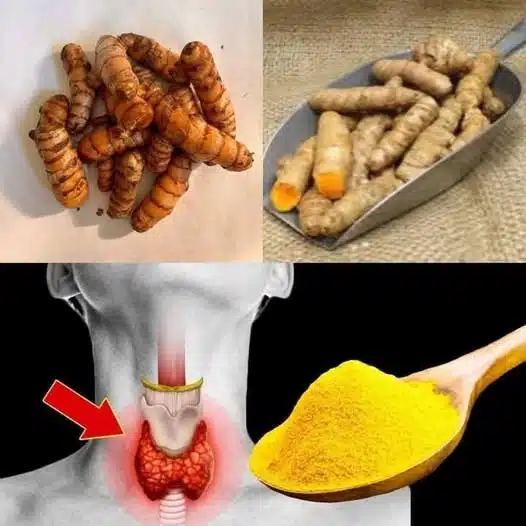
Turmeric and thyroid health are often linked in social-media posts that claim turmeric root or turmeric powder can “heal,” “clean,” or restore the thyroid gland naturally. Turmeric is a useful culinary spice containing curcumin and other plant compounds, but current evidence does not show that turmeric can cure hypothyroidism, Hashimoto’s disease, Graves’ disease, thyroid nodules, or other thyroid disorders.
That distinction is important because thyroid hormones affect energy use, body temperature, heart function, digestion, muscles, and many other processes throughout the body. When the thyroid is not functioning properly, diagnosis usually requires blood testing rather than symptoms alone. American Thyroid Association
Turmeric can still be enjoyed as part of a balanced diet. Fresh turmeric root and turmeric powder work beautifully in soups, rice, vegetables, smoothies, curries, and warm drinks, and researchers continue to study curcumin for several possible health effects.
The best approach is to enjoy turmeric as a food while keeping expectations realistic. Anyone with diagnosed thyroid disease should continue their prescribed treatment and discuss concentrated turmeric or curcumin supplements with a healthcare professional rather than replacing medication with a homemade remedy.
Quick Overview
| Topic | Practical Answer |
|---|---|
| Main Ingredient | Turmeric |
| Active Plant Compound | Curcumin |
| Can turmeric cure thyroid disease? | No proven cure |
| Can it replace thyroid medication? | No |
| Can turmeric be used in food? | Yes |
| Can turmeric supplements cause side effects? | Yes |
| Best Everyday Use | Cooking and beverages |
| Hypothyroidism Treatment | Usually levothyroxine |
| Thyroid Testing | Commonly TSH and free T4 |
| Important Rule | Do not stop prescribed thyroid medicine |
What Is Turmeric?
Turmeric is a yellow-orange spice obtained from the underground stem of the Curcuma longa plant. It is closely related to ginger and has been used for centuries in cooking, particularly throughout South Asian cuisine.
Fresh turmeric resembles a smaller orange-colored ginger root. Once dried and ground, it becomes the bright yellow powder familiar in curry blends and many traditional dishes.
Curcumin is one of turmeric’s best-known natural compounds. Much of the modern research around turmeric focuses on curcumin, although turmeric itself contains many other components.
It is important to understand that eating turmeric as a spice and taking a highly concentrated curcumin supplement are not necessarily equivalent.
What Does the Thyroid Gland Do?
The thyroid is a butterfly-shaped gland in the lower front portion of the neck.
Its hormones help regulate how the body uses energy and influence the function of the heart, brain, muscles, digestive system, and other tissues.
Thyroid function is commonly evaluated with blood tests. TSH is an important test, while free T4 helps doctors determine how much usable thyroid hormone is circulating.
Problems can occur when the thyroid makes too little hormone, too much hormone, becomes enlarged, develops nodules, or is affected by autoimmune disease.
What Is Hypothyroidism?
Hypothyroidism means the thyroid is not producing enough thyroid hormone for the body’s needs.
One common cause is Hashimoto’s disease, an autoimmune condition in which the immune system damages the thyroid over time. Other causes include thyroid surgery, radiation treatment, certain medications, and problems affecting the pituitary gland.
Possible symptoms can include tiredness, feeling cold, constipation, dry skin, changes in body weight, muscle weakness, and difficulty concentrating.
However, those symptoms can have many other causes, which is why hypothyroidism should not be diagnosed from symptoms or social-media checklists alone.
How Hypothyroidism Is Actually Treated
The standard treatment for hypothyroidism is replacement of the thyroid hormone the body cannot make adequately.
Levothyroxine is a synthetic form of T4 that is biologically equivalent to the hormone normally produced by the thyroid. Both the American Thyroid Association and NIDDK describe levothyroxine as the usual treatment for hypothyroidism.
Doctors adjust the dosage according to thyroid blood tests and individual circumstances.
Turmeric should therefore be considered a food or complementary ingredient—not a replacement for thyroid hormone.
Can Turmeric Cure Hypothyroidism?
There is currently no good clinical evidence showing that turmeric cures an underactive thyroid or restores normal thyroid hormone production.
NCCIH notes that although turmeric and curcumin have been studied for several conditions, there is still not enough evidence to definitively conclude that they provide benefits for most health conditions.
That means claims such as:
“Turmeric repairs your thyroid.”
“Drink this for seven days to normalize TSH.”
“Turmeric replaces thyroid medication.”
“Turmeric permanently cures Hashimoto’s.”
should not be treated as established medical facts.
A person who has hypothyroidism can certainly use turmeric in normal cooking unless they have an individual reason to avoid it, but it should not replace appropriate testing or treatment.
Turmeric and Hashimoto’s Disease
Hashimoto’s disease is an autoimmune thyroid disorder and one of the most common causes of hypothyroidism.
Because curcumin has been researched for inflammatory pathways, it is understandable why people are interested in turmeric for autoimmune conditions.
However, laboratory findings about inflammation are not the same as proof that turmeric treats Hashimoto’s disease in people.
If Hashimoto’s has damaged the thyroid enough to cause hypothyroidism, NIDDK states that levothyroxine is the recommended replacement treatment.
Someone with Hashimoto’s can still enjoy turmeric as part of a normal diet, but concentrated supplements should not be used as a substitute for thyroid care.
Can Turmeric Shrink Thyroid Nodules?
There is no established evidence that drinking turmeric tea or taking curcumin supplements will reliably shrink thyroid nodules.
Thyroid nodules can have different causes and characteristics. Some need only monitoring, while others may require ultrasound, laboratory testing, biopsy, or treatment depending on their features.
A visible neck swelling or newly discovered lump should therefore be assessed medically rather than treated with spices at home.
The same principle applies to a goiter, which simply means an enlarged thyroid. Finding the reason for enlargement is more important than trying to treat it blindly with a natural remedy.
Potential Benefits of Turmeric
Turmeric is interesting scientifically because curcumin has biological activity, and researchers have investigated it for inflammation, joint symptoms, metabolic conditions, and other possible uses.
NCCIH reports that some initial research is encouraging in selected areas, such as certain osteoarthritis measures, but emphasizes that stronger evidence is still needed and that benefits for many conditions remain uncertain.
This is a much more accurate way to describe turmeric than calling it a miracle cure.
Enjoying turmeric as part of meals can also help add flavor without requiring large amounts of sugar or salt.
Fresh Turmeric vs. Turmeric Powder
Both forms can be useful in cooking.
| Type | Best Uses |
|---|---|
| Fresh turmeric root | Tea, smoothies, soups, curries |
| Ground turmeric | Rice, eggs, vegetables, soups |
| Turmeric paste | Golden milk and cooking |
| Curcumin supplements | Concentrated products requiring more caution |
Fresh turmeric has an earthy, slightly peppery flavor. Peel or scrub it well, then grate or slice it much like ginger.
Turmeric powder is easier to store and measure. A small amount creates strong color and flavor.
Supplements are different because they may provide concentrated curcumin doses far beyond normal culinary exposure.
How to Use Turmeric in Everyday Food
You do not need supplements to enjoy turmeric.
Try adding it to:
- Scrambled eggs
- Lentil soup
- Chicken soup
- Rice
- Roasted cauliflower
- Chickpeas
- Vegetable stew
- Curry
- Smoothies
- Homemade salad dressing
- Warm milk
- Ginger tea
Start with relatively small quantities because turmeric has a distinctive earthy flavor.
Around 1/4 to 1 teaspoon in a family-sized dish is often enough, depending on the recipe.
Simple Turmeric Ginger Golden Drink
This warm drink is an easy way to enjoy turmeric as a food ingredient.
It is not a thyroid treatment, but it can be a comforting alternative to heavily sweetened beverages.
Ingredients
| Ingredient | Amount |
|---|---|
| Milk or unsweetened plant milk | 2 cups |
| Ground turmeric | 1/2 teaspoon |
| Fresh ginger, grated | 1/2 teaspoon |
| Cinnamon | 1/4 teaspoon |
| Honey | 1 teaspoon, optional |
| Vanilla | 1/4 teaspoon, optional |
Instructions
- Pour the milk into a small saucepan.
- Add turmeric, ginger, and cinnamon.
- Heat gently over medium-low heat.
- Whisk occasionally until hot but not aggressively boiling.
- Remove from the heat.
- Add vanilla if desired.
- Allow it to cool slightly before adding optional honey.
- Serve warm.
The drink can be adjusted according to taste. If you are monitoring added sugar, leave out the honey or use only a very small amount.
Turmeric Ginger Tea
For a lighter drink, combine:
- 2 cups water
- 1/2 teaspoon turmeric powder or several thin fresh turmeric slices
- 3–4 slices fresh ginger
- Fresh lemon, optional
Bring the water to a gentle simmer with the turmeric and ginger.
Simmer for approximately 5–10 minutes, strain, and serve.
Add lemon after removing the tea from the heat.
Again, this is simply a flavorful beverage—not a medicine that restores thyroid function.
Why Black Pepper Is Often Added to Turmeric
You may notice many recipes combining turmeric and black pepper.
Piperine, a compound in black pepper, can increase the absorption of curcumin. NCCIH notes that some curcumin products use piperine or other techniques specifically to increase bioavailability.
Greater absorption is not automatically better, however.
Highly bioavailable curcumin products have also been linked to reported liver injury in some people, which is another reason concentrated supplements deserve more caution than ordinary culinary use.
For everyday cooking, black pepper can simply be used according to taste.
Turmeric Supplements vs. Turmeric in Food
This distinction is particularly important.
Adding turmeric powder to soup is very different from swallowing capsules containing concentrated curcumin every day.
NCCIH states that conventional oral turmeric or curcumin products are likely safe in recommended amounts for short periods for many adults, but possible side effects include nausea, vomiting, acid reflux, stomach upset, diarrhea, and constipation.
Some highly bioavailable formulations have also been associated with liver injury.
Dietary supplements may also interact with medicines, and NCCIH recommends discussing complementary health products with healthcare providers.
Turmeric and Thyroid Medication
If you take levothyroxine or another thyroid medicine, consistency matters.
The American Thyroid Association explains that food can affect thyroid-hormone absorption and that levothyroxine is commonly taken on an empty stomach, with consistent timing from day to day. Other medications may also affect absorption, so timing should be discussed with the prescribing clinician.
There is no reason to stop thyroid medication in order to start turmeric.
If you want to begin taking concentrated curcumin capsules or another herbal supplement while using thyroid medicine, tell your doctor or pharmacist what you plan to take.
That allows them to evaluate the complete product rather than guessing based only on the word “turmeric.”
Important Safety Notes
Using turmeric normally in food is different from taking large medicinal-style doses.
NCCIH reports digestive side effects from oral turmeric and curcumin, including stomach upset, reflux, nausea, diarrhea, and constipation. Highly bioavailable formulations have also been associated with liver damage in some users.
Turmeric supplements during pregnancy may be unsafe, while much less is known about supplement-level exposure during breastfeeding.
Talk with a healthcare professional before using concentrated turmeric or curcumin supplements if you take prescription medicines, are pregnant, have liver problems, or have another medical condition.
Normal culinary turmeric does not need to be feared; the larger concern is treating concentrated supplements as though they were harmless simply because they come from a plant.
Foods That Support Overall Thyroid Nutrition
No food can single-handedly “heal” a dysfunctional thyroid.
The thyroid does require certain nutrients, however, and overall nutritional adequacy matters.
A balanced eating pattern can include:
- Eggs
- Fish
- Dairy foods if tolerated
- Beans and lentils
- Whole grains
- Vegetables
- Fruit
- Nuts and seeds
- Lean meats
- Appropriate iodine-containing foods
Iodine is necessary for thyroid hormone production, but more is not always better. The American Thyroid Association notes that both thyroid function and thyroid treatment should be managed appropriately rather than assuming that large amounts of supplements will improve the gland.
Avoid starting high-dose iodine supplements for a thyroid problem unless a clinician has recommended them.
Common Thyroid Symptoms That Deserve Testing
Symptoms alone cannot reliably diagnose thyroid disease, but evaluation may be appropriate when several unexplained symptoms persist.
Possible hypothyroidism-related symptoms can include fatigue, cold intolerance, constipation, dry skin, changes in weight, muscle weakness, menstrual changes, or difficulty concentrating.
Because these symptoms overlap with many other health conditions, blood testing is important. NIDDK specifically notes that hypothyroidism cannot be diagnosed from symptoms alone.
Do not assume every case of fatigue or weight gain means the thyroid is responsible.
Common Mistakes to Avoid
Replacing Medication with Turmeric
This is the biggest mistake.
If you have diagnosed hypothyroidism and have been prescribed thyroid hormone, do not stop it because of a social-media remedy. The American Thyroid Association specifically advises against stopping thyroid hormone without discussing it with your physician.
Taking Very Large Supplement Doses
More turmeric does not necessarily mean more benefit.
Concentrated or enhanced-absorption products can produce side effects.
Expecting Instant Results
Thyroid diseases are not “cleansed” in three, seven, or ten days.
Medical management is based on diagnosis, laboratory results, symptoms, and the underlying condition.
Assuming Every Thyroid Problem Is the Same
Hypothyroidism, hyperthyroidism, Hashimoto’s disease, Graves’ disease, goiter, and thyroid nodules are different conditions.
One home remedy cannot logically treat them all in the same way.
Ignoring Follow-Up Blood Tests
Medication dosage may need adjustment over time.
Thyroid monitoring is an important part of treatment.
Frequently Asked Questions
Is turmeric good for the thyroid?
Turmeric can be part of a balanced diet, but current evidence does not establish it as a treatment for thyroid disease.
Can turmeric cure hypothyroidism?
No reliable clinical evidence shows that turmeric cures hypothyroidism.
Can turmeric replace levothyroxine?
No. Levothyroxine replaces thyroid hormone that an underactive thyroid cannot produce adequately.
Can turmeric cure Hashimoto’s disease?
There is no established evidence that turmeric cures Hashimoto’s disease.
Can turmeric shrink thyroid nodules?
It has not been proven to reliably shrink thyroid nodules.
Can turmeric reduce a goiter?
A goiter can have several causes. Its treatment depends on the cause, so turmeric should not be relied on as a treatment.
Can I drink turmeric tea every day?
Culinary quantities are different from concentrated supplements. If you have medical conditions, digestive sensitivity, take medication, or want to consume large amounts regularly, discuss it with a healthcare professional.
Can I use fresh turmeric instead of powder?
Yes. Fresh turmeric works well in tea, soups, curries, rice, and other recipes.
What does turmeric taste like?
Turmeric has an earthy, warm, mildly bitter flavor.
Is curcumin the same as turmeric?
Curcumin is one of the compounds naturally present in turmeric. Concentrated curcumin products are not identical to using turmeric as a spice.
Why do people mix turmeric with black pepper?
Piperine in black pepper can increase curcumin absorption.
Does better curcumin absorption always mean better health effects?
No. Higher absorption does not automatically mean greater benefit, and highly bioavailable products have been associated with liver injury in some cases.
Can turmeric supplements upset the stomach?
Yes. NCCIH lists nausea, reflux, stomach upset, diarrhea, vomiting, and constipation among possible oral side effects.
Is turmeric safe during pregnancy?
Turmeric used normally as food is different from concentrated supplements. NCCIH says turmeric supplements during pregnancy may be unsafe.
Can I take turmeric with thyroid medication?
Do not change your thyroid medication because of turmeric. If considering a concentrated turmeric or curcumin supplement, discuss the product with your doctor or pharmacist because supplements can interact with medicines.
When should levothyroxine be taken?
The American Thyroid Association notes that it is commonly taken on an empty stomach and that consistency is important because food and some medications can affect absorption. Follow the instructions given by your prescriber.
How is hypothyroidism diagnosed?
Doctors commonly use TSH and free T4 blood tests along with medical history and examination.
Can thyroid disease be diagnosed from symptoms alone?
No. Many thyroid symptoms overlap with other conditions, so laboratory testing is important.
Is a turmeric drink useful?
It can be an enjoyable warm beverage and a way to use turmeric in food, but it should not be described as a cure for thyroid disease.
Should I stop my medication if I feel better?
No. Do not stop prescribed thyroid hormone without discussing it with your healthcare professional.
Final Thoughts
Turmeric and thyroid health is an interesting subject, but the strongest message is also the simplest: turmeric is a useful food ingredient, not a proven replacement for thyroid treatment.
Fresh turmeric and turmeric powder can be enjoyed in soups, rice, vegetables, curries, teas, and golden drinks. Curcumin has attracted scientific interest, but NCCIH says the available evidence is still insufficient to establish benefits for many health conditions.
If you have hypothyroidism, Hashimoto’s disease, thyroid nodules, a goiter, or another thyroid condition, proper diagnosis and monitoring matter much more than any viral remedy. Hypothyroidism is generally treated by replacing missing thyroid hormone with levothyroxine.
Enjoy turmeric for its flavor and as part of a varied diet, but be cautious with concentrated supplements and exaggerated promises. Natural does not automatically mean risk-free, and no spice should be expected to repair an underactive thyroid overnight.