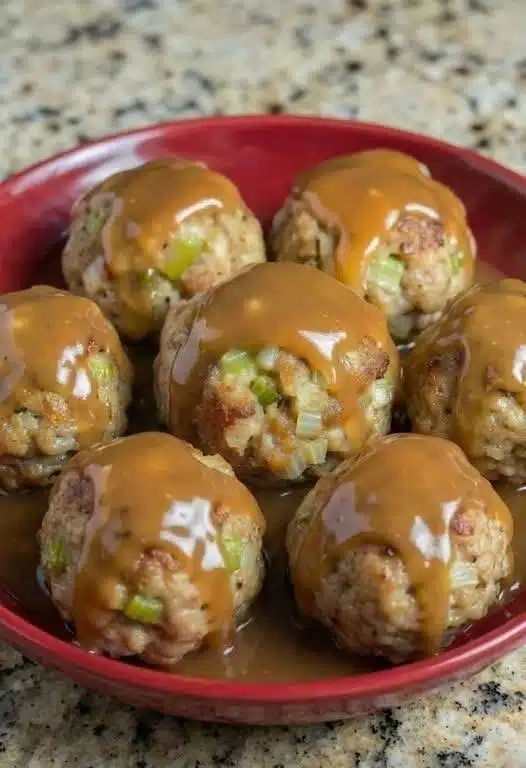
These Sausage Stuffing Balls with Brown Gravy turn classic holiday stuffing into an easy, portioned comfort-food dish that is crispy around the edges, tender in the center, and packed with savory sausage, celery, onion, herbs, and buttery bread.
The recipe is inspired by the dish shown in the image: large golden stuffing balls with visible pieces of celery, served generously with smooth brown gravy. Instead of spooning stuffing from a casserole dish, the mixture is shaped into individual balls so every serving gets plenty of browned exterior while the inside stays moist and flavorful.
They are perfect for Thanksgiving and Christmas, but there is no reason to save them only for the holidays. Serve them with mashed potatoes and gravy for Sunday dinner, make them with leftover stuffing after Thanksgiving, or prepare smaller versions as a party appetizer.
The combination of seasoned sausage, soft bread, sautéed vegetables, sage, thyme, poultry seasoning, and warm gravy gives these stuffing balls that familiar holiday flavor people associate with roast turkey dinners—without requiring an entire turkey.
Recipe Overview
| Recipe Details | Information |
|---|---|
| Recipe Name | Sausage Stuffing Balls with Brown Gravy |
| Focus Keyword | Sausage Stuffing Balls |
| Prep Time | 25 minutes |
| Cook Time | 25–30 minutes |
| Total Time | About 55 minutes |
| Yield | 14–18 stuffing balls |
| Servings | 6–8 |
| Course | Side Dish / Main Dish / Holiday Recipe |
| Cuisine | American Comfort Food |
| Difficulty | Easy |
| Main Protein | Breakfast Sausage |
| Main Texture | Crisp Outside, Moist Inside |
| Oven Temperature | 375°F / 190°C |
| Best For | Thanksgiving, Christmas, Sunday Dinner |
| Make-Ahead Friendly | Yes |
| Freezer Friendly | Yes |
Why You’ll Love These Sausage Stuffing Balls
Traditional stuffing is already delicious, but forming it into individual portions gives you something a casserole cannot provide: more crispy edges.
Each ball gets browned around the outside.
Inside, the bread stays soft and moist.
The sausage adds richness.
The celery provides a little texture.
The onion adds sweetness.
And sage, thyme, and poultry seasoning give the recipe its unmistakable holiday flavor.
They are also convenient to serve.
Instead of scooping stuffing from a large baking dish, place two or three stuffing balls on each plate and spoon gravy over the top.
They are especially good for buffet-style dinners because guests can take exactly the amount they want.
What Are Sausage Stuffing Balls?
Sausage Stuffing Balls are essentially traditional bread stuffing shaped into individual balls and baked until golden.
Depending on the recipe, they may contain:
- Bread cubes
- Prepared stuffing mix
- Breakfast sausage
- Onion
- Celery
- Eggs
- Chicken or turkey broth
- Butter
- Sage
- Thyme
- Poultry seasoning
Some recipes use more sausage and resemble meatballs.
Others use more bread and taste almost exactly like holiday stuffing.
This version falls in the middle: enough sausage to make the balls savory and satisfying, with enough bread to keep that classic stuffing texture.
Ingredients
For the Sausage Stuffing Balls
- 1 pound ground breakfast sausage
- 5 cups dry bread cubes
- 1 medium yellow onion, finely diced
- 1 cup celery, finely diced
- 3 tablespoons butter
- 2 large eggs
- 3/4 to 1 cup chicken or turkey broth
- 1 teaspoon poultry seasoning
- 1 teaspoon dried sage
- 1/2 teaspoon dried thyme
- 1/2 teaspoon garlic powder
- 1/2 teaspoon black pepper
- 1/4 teaspoon salt, or to taste
- 2 tablespoons fresh parsley, chopped
For the Brown Gravy
- 3 tablespoons butter
- 3 tablespoons all-purpose flour
- 2 cups chicken, turkey, or beef broth
- 1 teaspoon Worcestershire sauce
- 1/2 teaspoon onion powder
- 1/4 teaspoon garlic powder
- Black pepper to taste
- Salt to taste
- 2 tablespoons heavy cream, optional
Ingredient Guide
| Ingredient | Why It Matters |
|---|---|
| Breakfast sausage | Adds savory flavor and moisture |
| Bread cubes | Create classic stuffing texture |
| Onion | Adds sweetness and depth |
| Celery | Provides flavor and light crunch |
| Butter | Adds richness |
| Eggs | Help the balls hold together |
| Broth | Keeps the stuffing moist |
| Sage | Gives classic holiday flavor |
| Thyme | Adds savory herbal flavor |
| Poultry seasoning | Reinforces traditional stuffing flavor |
| Parsley | Adds freshness |
| Gravy | Makes the finished dish rich and comforting |
Best Sausage to Use
Regular breakfast sausage works extremely well because it is already seasoned.
You can use:
- Mild breakfast sausage
- Sage sausage
- Turkey sausage
- Chicken sausage
- Hot breakfast sausage
Sage sausage is particularly good for Thanksgiving because it reinforces the traditional stuffing flavor.
If using spicy sausage, reduce other strongly flavored seasonings so the dish does not become overwhelming.
Can You Use Italian Sausage?
Yes.
Mild Italian sausage works well, but the flavor will be slightly different.
Italian sausage usually contains fennel and other seasonings that are not typical of traditional Thanksgiving stuffing.
It is still delicious, especially if you are serving the stuffing balls with pasta-style sides or roasted vegetables rather than a turkey dinner.
For the classic holiday flavor, breakfast sausage is better.
Best Bread for Stuffing Balls
Slightly dry bread works much better than very fresh bread.
Good choices include:
- White sandwich bread
- French bread
- Italian bread
- Sourdough
- Brioche
- Cornbread
- Packaged stuffing cubes
A mixture of white bread and cornbread is especially flavorful.
The bread should be dry enough to absorb broth without becoming mushy.
How to Dry Fresh Bread Quickly
If your bread is fresh, cut it into cubes.
Spread the cubes on a baking sheet.
Bake at 300°F / 150°C for about 15–20 minutes, stirring once.
You want the bread dry but not deeply toasted.
Allow it to cool before using.
This gives the bread enough structure to absorb broth while still holding together.
Can You Use Boxed Stuffing Mix?
Absolutely.
This is one of the easiest shortcuts.
Use approximately one 6-ounce box or bag of dry stuffing mix, depending on the brand and volume.
Because packaged stuffing mix already contains salt and herbs, reduce the added:
- Salt
- Sage
- Poultry seasoning
Taste and adjust carefully.
Boxed stuffing makes this recipe especially convenient after work or when preparing several holiday dishes at once.
Why Celery Is Important
The visible green celery pieces in the image are one of the classic components of stuffing.
Celery contributes more than crunch.
As it cooks with the onion and butter, it develops a mild savory flavor that is immediately recognizable in traditional stuffing.
Dice it relatively small.
Large celery pieces can make the balls harder to shape and may stay too crunchy.
Why Eggs Are Needed
Eggs bind everything together.
Without enough binder, the stuffing balls may crack or fall apart.
Two large eggs are usually enough for this quantity.
The eggs also help give the interior structure while keeping it tender.
Why Broth Amount Can Vary
Different breads absorb different amounts of liquid.
Very dry bread may require almost a full cup of broth.
Softer bread may need less.
That is why the recipe gives a range.
Add the broth gradually.
The stuffing mixture should feel moist enough to hold together when squeezed, but it should not be dripping wet.
Equipment Needed
- Large skillet
- Large mixing bowl
- Baking sheet
- Parchment paper or foil
- Cutting board
- Sharp knife
- Wooden spoon
- Measuring cups
- Measuring spoons
- Medium saucepan for gravy
- Whisk
- Cookie scoop, optional
How to Make Sausage Stuffing Balls
Step 1: Preheat the Oven
Preheat the oven to 375°F / 190°C.
Line a large baking sheet with parchment paper.
You can also lightly grease the pan.
Step 2: Cook the Sausage
Place the sausage in a large skillet over medium heat.
Break it into small crumbles.
Cook until browned.
Because the sausage will bake again, avoid cooking it until extremely dry.
Transfer the cooked sausage to a large bowl.
Leave approximately 1 tablespoon of flavorful fat in the skillet.
Step 3: Cook the Onion and Celery
Add butter to the skillet.
Add the diced onion and celery.
Cook over medium heat for approximately 6–8 minutes.
Stir occasionally.
The onion should become translucent and the celery should soften.
Do not brown them heavily.
Traditional stuffing tastes best when the vegetables are soft and sweet.
Step 4: Add the Seasonings
Add:
- Poultry seasoning
- Sage
- Thyme
- Garlic powder
- Black pepper
Stir for approximately 30 seconds.
Heating the dried herbs briefly in butter helps release their aroma.
Step 5: Combine with the Bread
Add the bread cubes to the large bowl containing the sausage.
Pour the cooked onion, celery, butter, and seasonings over the bread.
Add fresh parsley.
Toss gently.
Try not to crush the bread completely.
Step 6: Add the Eggs
Beat the eggs in a small bowl.
Pour them over the stuffing mixture.
Toss until evenly distributed.
Add the Broth Gradually
Start with approximately 3/4 cup broth.
Mix gently.
Squeeze a handful of stuffing.
If it holds together easily, you have enough moisture.
If it falls apart, add more broth 1–2 tablespoons at a time.
Stop as soon as the mixture holds its shape.
Too much broth can create soft, heavy stuffing balls.
Shape the Stuffing Balls
Scoop approximately 1/3 cup mixture for each ball.
Gently press and roll into a round shape.
They should be about the size of a small meatball or golf ball, depending on your preference.
For the large stuffing balls shown in the image, make them around 2 to 2½ inches across.
Arrange them on the prepared baking sheet with a little space between each one.
How to Keep Stuffing Balls from Falling Apart
The mixture needs the right balance of moisture and binder.
If they crumble:
Add another tablespoon or two of broth.
Press the mixture more firmly.
Allow it to sit for 5 minutes so the bread absorbs the liquid.
If necessary, add one additional beaten egg.
Do not add a lot of broth all at once.
Too much moisture creates the opposite problem.
Bake Until Golden
Bake at 375°F / 190°C for approximately 25–30 minutes.
The outside should become golden brown.
Because the recipe contains sausage and egg, the centers should be fully cooked. Ground pork sausage should reach 160°F / 71°C in the center.
For extra browning, lightly brush the tops with melted butter during the last 5 minutes.
How to Get Extra-Crispy Stuffing Balls
If you love crispy stuffing edges, there are several tricks.
Do not crowd the pan.
Leave space between the balls.
Use a metal baking sheet rather than a deep casserole dish.
Brush the outside with melted butter.
Bake until deeply golden.
For even more color, broil for approximately 1 minute at the end.
Watch carefully because bread can burn quickly.
How to Make Brown Gravy
The stuffing balls are delicious alone, but warm brown gravy makes them look and taste like the dish in the image.
Step 1: Melt the Butter
Add 3 tablespoons butter to a saucepan over medium heat.
Let it melt completely.
Step 2: Add Flour
Whisk in 3 tablespoons flour.
Cook for approximately 1–2 minutes.
The mixture should become smooth and lightly golden.
Step 3: Add Broth
Slowly pour in the broth while whisking constantly.
Adding the broth gradually helps prevent lumps.
Step 4: Add Seasonings
Stir in:
- Worcestershire sauce
- Onion powder
- Garlic powder
- Black pepper
Step 5: Simmer
Bring the mixture to a gentle simmer.
Cook for approximately 4–6 minutes, whisking frequently.
The gravy will gradually thicken.
Step 6: Finish
Taste and add salt if needed.
Stir in heavy cream if you want a richer, smoother gravy.
How Thick Should the Gravy Be?
The gravy should be thick enough to coat the back of a spoon but loose enough to pour.
If it becomes too thick, add broth a few tablespoons at a time.
If it is too thin, simmer longer.
Remember that gravy thickens slightly as it cools.
How to Serve Stuffing Balls with Gravy
Place the hot stuffing balls on a serving platter.
Spoon some gravy over the top.
Serve the remaining gravy separately so everyone can add more.
For presentation, finish with:
- Chopped parsley
- Black pepper
- Fresh thyme
The brown gravy running over the golden stuffing balls creates the classic comfort-food appearance shown in the image.
Pro Tips for Perfect Stuffing Balls
Use slightly stale bread.
Dice the vegetables finely.
Do not skip sautéing the celery and onion.
Season the vegetables while they cook.
Add broth gradually.
Let the mixture rest briefly before shaping.
Press the balls firmly enough to hold together.
Do not pack them so tightly that they become dense.
Leave space between them while baking.
Brush with butter for deeper browning.
Serve with plenty of warm gravy.
Sausage and Cornbread Stuffing Balls
Replace half or all of the regular bread with crumbled cornbread.
Cornbread creates a softer, slightly sweeter stuffing ball.
Use less broth initially because cornbread can absorb liquid differently.
This variation is especially good for Southern-style Thanksgiving dinners.
Turkey Stuffing Balls
Use ground turkey sausage instead of pork sausage.
Turkey sausage is leaner, so add an extra tablespoon of butter if the mixture seems dry.
Serve with turkey gravy and cranberry sauce.
This version feels particularly appropriate for Thanksgiving.
Chicken Stuffing Balls
Ground chicken sausage also works.
Choose a seasoned chicken sausage if possible.
Chicken sausage is lean, so be careful not to overbake.
Use enough broth to keep the stuffing moist.
Bacon Stuffing Balls
Cook 6 slices of bacon until crisp.
Crumble them.
Add the bacon to the stuffing mixture.
You can replace part of the butter with a small amount of bacon drippings for extra flavor.
Bacon works beautifully with sage, onion, and celery.
Cranberry Stuffing Balls
Add 1/2 cup dried cranberries.
The cranberries provide sweet-tart bites that contrast with the savory sausage.
This version is especially beautiful for Thanksgiving or Christmas.
Serve with turkey and cranberry sauce.
Apple Sausage Stuffing Balls
Add one small peeled apple, finely diced.
Cook the apple with the onion and celery.
Choose an apple such as:
- Honeycrisp
- Granny Smith
- Gala
The sweetness of the apple pairs extremely well with sausage and sage.
Pecan Stuffing Balls
Add approximately 1/2 cup toasted chopped pecans.
Pecans add crunch and a slightly buttery flavor.
They pair particularly well with cranberry or apple variations.
Mushroom Stuffing Balls
Cook 8 ounces finely chopped mushrooms with the onions and celery.
Continue cooking until most of the mushroom moisture has evaporated.
Then assemble the stuffing normally.
Mushrooms create deeper savory flavor and make the stuffing taste even richer.
Cheesy Stuffing Balls
Add:
- 3/4 cup shredded cheddar
or
- 1/2 cup Parmesan
Cheddar creates a stronger cheese flavor.
Parmesan adds more subtle savory depth.
Cheese also helps the stuffing balls hold together.
Garlic Herb Stuffing Balls
Increase the garlic.
Add fresh:
- Sage
- Thyme
- Rosemary
- Parsley
This creates a very aromatic stuffing ball that pairs well with roast chicken or turkey.
Fresh rosemary is strong, so use it sparingly.
Stuffing Balls with Turkey Gravy
For Thanksgiving, replace regular broth in the gravy with turkey stock.
If you have turkey pan drippings, use some of the fat instead of butter and some of the drippings instead of broth.
This creates an incredibly flavorful gravy.
Taste before adding salt because turkey drippings can already be salty.
Stuffing Balls with Chicken Gravy
Chicken gravy is the easiest year-round option.
Use chicken stock or broth.
Add:
- Onion powder
- Black pepper
- Thyme
A little heavy cream can make the gravy smoother.
This works well when serving the stuffing balls with roasted chicken.
Can You Use Jarred Gravy?
Yes.
If you are short on time, store-bought gravy works perfectly well.
Warm it gently.
For better flavor, add:
- Black pepper
- Small amount of Worcestershire sauce
- Fresh thyme
- Spoonful of pan drippings
That makes prepared gravy taste more homemade.
How to Turn These into a Main Dish
Stuffing balls are normally a side dish, but they can easily become the main event.
Serve 3–4 large stuffing balls per person with:
- Mashed potatoes
- Brown gravy
- Green beans
- Cranberry sauce
You get nearly all the flavors of a holiday dinner without roasting a turkey.
What to Serve with Sausage Stuffing Balls
| Side Dish | Why It Works |
|---|---|
| Mashed potatoes | Perfect with gravy |
| Green beans | Fresh contrast |
| Cranberry sauce | Sweet-tart balance |
| Roasted carrots | Adds sweetness |
| Brussels sprouts | Great holiday side |
| Mac and cheese | Rich comfort-food pairing |
| Sweet potatoes | Classic Thanksgiving option |
| Roast turkey | Traditional combination |
| Roast chicken | Excellent year-round |
| Pork roast | Sausage and pork pair well |
| Corn | Easy family side |
| Dinner rolls | Perfect for extra gravy |
The Best Thanksgiving Plate
For a classic holiday plate, serve:
- Roast turkey
- 2 sausage stuffing balls
- Mashed potatoes
- Turkey gravy
- Green bean casserole
- Cranberry sauce
- Roasted carrots
- Dinner roll
Spoon gravy over both the potatoes and stuffing balls.
That gives you all the familiar Thanksgiving flavors in one plate.
Perfect for Christmas Dinner
These stuffing balls are equally good for Christmas.
Serve them with:
- Roast chicken
- Turkey
- Ham
- Pork loin
- Roast beef
Because the portions are already separated, they work especially well for holiday buffets.
Guests can simply take one or two.
How to Make Smaller Party Stuffing Balls
For appetizers, use approximately 2 tablespoons mixture per ball.
Bake for around 18–22 minutes, depending on size.
Serve them with warm gravy for dipping.
To make them easier to eat at parties, place toothpicks beside the serving platter.
These small stuffing bites are excellent for:
- Holiday parties
- Football gatherings
- Potlucks
- Family celebrations
How to Use Leftover Stuffing
This is one of the best recipes for Thanksgiving leftovers.
If you already have cooked stuffing:
Use approximately 4 cups leftover stuffing.
Add:
- 1 egg
- 1/2 pound cooked sausage, optional
- Small amount of broth if needed
Shape into balls.
Bake until golden and heated through.
Serve with leftover turkey gravy.
This turns holiday leftovers into a completely different meal.
Air Fryer Stuffing Balls
Stuffing balls can also be cooked in an air fryer.
Preheat to 370°F / 188°C.
Lightly spray the basket.
Arrange the balls in a single layer.
Cook approximately 12–16 minutes, turning once if needed.
Make sure sausage-containing stuffing balls are fully cooked in the center.
Air frying creates especially crispy edges.
Slow Cooker Option
A slow cooker is not ideal for creating crispy stuffing balls because the enclosed environment traps steam.
However, you can bake the balls first and then keep them warm in a slow cooker.
Place a small amount of gravy on the bottom.
Add the cooked stuffing balls.
Keep on warm.
Do not drown them in gravy too early or the exterior will soften.
Make-Ahead Instructions
These stuffing balls are excellent for holiday meal preparation because much of the work can be done in advance.
Prepare the entire mixture.
Shape the balls.
Arrange them on a baking sheet or in an airtight container.
Cover.
Refrigerate for up to 24 hours before baking.
When ready, bake directly from the refrigerator.
You may need approximately 3–5 extra minutes.
Can You Bake Them Ahead?
Yes.
Bake completely.
Cool.
Refrigerate.
Reheat shortly before serving.
For best texture, reheat uncovered in the oven rather than microwaving.
This restores some of the crispy exterior.
Storage
Allow leftover stuffing balls to cool.
Transfer to an airtight container.
Refrigerate for approximately 3–4 days.
Store gravy separately when possible.
Keeping the gravy separate helps the stuffing balls maintain a better texture.
How to Reheat Stuffing Balls
Oven
Preheat the oven to 350°F / 175°C.
Arrange the stuffing balls on a baking sheet.
Cover loosely with foil.
Bake for about 10 minutes.
Remove the foil.
Bake another 5 minutes until hot and lightly crisp.
Air Fryer
Reheat at 350°F / 175°C for about 5–7 minutes.
This gives the best crispy exterior.
Microwave
Microwave for approximately 45–90 seconds depending on size.
The microwave is fastest but produces a softer exterior.
How to Reheat the Gravy
Place gravy in a small saucepan.
Warm over low heat.
Add a splash of broth if it has become too thick.
Whisk until smooth.
Do not aggressively boil cream-enriched gravy.
Can You Freeze Sausage Stuffing Balls?
Yes.
They freeze very well.
You can freeze them either baked or unbaked.
To Freeze Baked Stuffing Balls
Cool completely.
Arrange on a tray.
Freeze until firm.
Transfer to a freezer-safe bag or container.
Freeze for approximately 2–3 months for best quality.
To Freeze Unbaked Stuffing Balls
Shape the mixture.
Freeze on a tray.
Transfer the frozen balls to a freezer container.
Thaw overnight in the refrigerator before baking.
Can You Freeze Gravy?
Yes.
Basic flour-and-broth gravy usually freezes reasonably well.
Cool completely.
Freeze in an airtight container.
Thaw overnight.
Reheat slowly while whisking.
Add a little broth if needed.
Gravy containing a lot of cream may separate slightly after freezing.
Common Mistakes to Avoid
| Mistake | What Happens | Better Method |
|---|---|---|
| Using very fresh wet bread | Mushy stuffing | Dry the bread first |
| Adding too much broth | Balls become soft | Add broth gradually |
| Too little liquid | Balls crumble | Add small amounts of broth |
| Large vegetable pieces | Balls break apart | Dice vegetables finely |
| Skipping eggs | Poor binding | Use the eggs |
| Overpacking | Dense interior | Shape firmly but gently |
| Crowding the pan | Less browning | Leave space between balls |
| Overbaking | Dry stuffing | Remove once cooked and golden |
| Pouring gravy on too early | Soft exterior | Add gravy at serving time |
| Oversalting | Sausage may already be salty | Taste carefully |
Troubleshooting Guide
My Stuffing Balls Fall Apart
The mixture is probably too dry.
Add 1–2 tablespoons broth.
Let it rest for 5 minutes.
Try shaping again.
If necessary, add another beaten egg.
My Stuffing Balls Are Mushy
Too much broth may have been added.
Add more dry bread cubes or breadcrumbs.
Allow the mixture to rest so the bread absorbs excess moisture.
My Stuffing Balls Are Dry
They may have been overbaked or made with too little broth.
Serve with gravy and adjust the moisture level next time.
They Aren’t Browning
Brush with melted butter.
Bake a little longer.
Or broil briefly at the end.
My Gravy Is Lumpy
Add broth gradually while whisking constantly.
If lumps remain, strain the gravy through a fine-mesh sieve.
My Gravy Is Too Thick
Add broth a few tablespoons at a time.
My Gravy Is Too Thin
Simmer for several additional minutes.
Nutrition Estimate
Approximate nutrition per two stuffing balls without a large serving of gravy:
| Nutrition | Approximate Amount |
|---|---|
| Calories | 280–340 |
| Protein | 11–15 g |
| Carbohydrates | 24–30 g |
| Fat | 15–20 g |
| Fiber | 2–3 g |
| Sugar | 3–5 g |
| Serving Size | 2 large stuffing balls |
Exact nutrition depends on sausage, bread, broth, butter, gravy, and portion size.
Frequently Asked Questions
What are Sausage Stuffing Balls?
They are individual portions of bread stuffing made with sausage, onion, celery, herbs, egg, and broth, then shaped into balls and baked.
What is the best sausage to use?
Breakfast sausage or sage sausage gives the most traditional flavor.
Can I use turkey sausage?
Yes.
Can I use chicken sausage?
Absolutely.
Can I use Italian sausage?
Yes, although the flavor will be less traditional.
Can I make them without sausage?
Yes. Increase the bread and vegetables slightly and use additional butter and broth.
Can I use boxed stuffing mix?
Yes. It is an excellent shortcut.
Can I use leftover stuffing?
Absolutely.
Do I need eggs?
Eggs strongly help the balls hold together.
Why are my stuffing balls falling apart?
The mixture may be too dry or may need more binding.
Why are they mushy?
Too much broth is usually the cause.
Should I cook the sausage first?
Cooking it first makes it easier to control the texture and grease level.
Can I add cranberries?
Yes.
Can I add apple?
Yes. Cook diced apple with the onion and celery.
Can I add pecans?
Absolutely.
Can I add mushrooms?
Yes.
Can I add cheese?
Yes.
What gravy works best?
Turkey gravy, chicken gravy, or brown gravy all work.
Can I use store-bought gravy?
Yes.
Can I make them ahead?
Yes. Shape them up to one day ahead.
Can I bake them ahead?
Yes.
How long do they keep?
Approximately 3–4 days refrigerated.
Can they be frozen?
Yes, before or after baking.
Can I air fry them?
Yes.
Can I make mini stuffing balls?
Absolutely.
What temperature should sausage stuffing balls reach?
If made with pork sausage, the center should reach 160°F / 71°C.
What should I serve with them?
Mashed potatoes, turkey, chicken, gravy, cranberry sauce, green beans, and roasted vegetables are excellent choices.
Budget-Friendly Tips
This recipe is naturally good for feeding a crowd.
Bread helps stretch one pound of sausage into many servings.
To reduce the cost further:
Use day-old bread.
Buy celery and onions in larger bags.
Use homemade chicken stock if available.
Choose store-brand breakfast sausage.
Make gravy from broth instead of buying prepared gravy.
Use leftover stuffing from holiday dinner.
The final dish feels substantial without requiring a large amount of expensive meat.
Holiday Meal-Prep Strategy
Stuffing balls are particularly helpful when preparing a large holiday dinner.
One or two days before:
Chop the vegetables.
Dry the bread.
Prepare the gravy base if desired.
The day before:
Cook the sausage.
Assemble and shape the stuffing balls.
Refrigerate.
On serving day:
Bake the stuffing balls.
Finish the gravy.
Keep everything warm until dinner.
This spreads the work across several days and reduces stress when the turkey, potatoes, vegetables, and desserts all need attention at the same time.
Ad-Friendly Article Structure
For a long recipe post like this, these are natural places for in-content ads without interrupting important cooking instructions:
| Content Position | Suggested Placement |
|---|---|
| After Introduction | Ad 1 |
| After Recipe Overview | Ad 2 |
| After Ingredient Guide | Ad 3 |
| Before Step-by-Step Instructions | Ad 4 |
| After Gravy Instructions | Ad 5 |
| Before Variations | Ad 6 |
| Before Make-Ahead & Storage | Ad 7 |
| Before FAQs | Ad 8 |
| Before Final Thoughts | Optional |
Keep ads away from the middle of individual cooking steps so readers can follow the recipe easily.
Final Thoughts
These Sausage Stuffing Balls with Brown Gravy take all the best parts of traditional holiday stuffing and turn them into individual golden portions that are easy to serve and impossible to resist.
The outside becomes lightly crisp.
The center stays moist and tender.
Breakfast sausage provides richness.
Celery and onion give you classic stuffing flavor.
Sage, thyme, and poultry seasoning create that unmistakable Thanksgiving aroma.
And warm brown gravy brings everything together.
The technique is simple, but a few details make a big difference.
Use bread that is slightly dry.
Cook the onion and celery before mixing.
Add broth gradually.
Use eggs for binding.
Shape the mixture firmly without compressing it too tightly.
Leave enough room between the balls so the edges can brown.
And spoon the gravy over them only when you are ready to serve so that crispy exterior does not disappear too quickly.
Once you master the basic recipe, you can customize it endlessly.
Add cranberries for sweetness.
Add apple for a classic sausage-and-fruit combination.
Add toasted pecans for crunch.
Use cornbread for a Southern-inspired version.
Make turkey-sausage stuffing balls for Thanksgiving.
Or prepare mini versions and serve them as a holiday appetizer with warm gravy for dipping.
Whether you make them for Thanksgiving, Christmas, Sunday dinner, a potluck, or simply because you are craving comfort food, these stuffing balls deliver everything people love about a holiday dinner in one easy, gravy-covered bite.