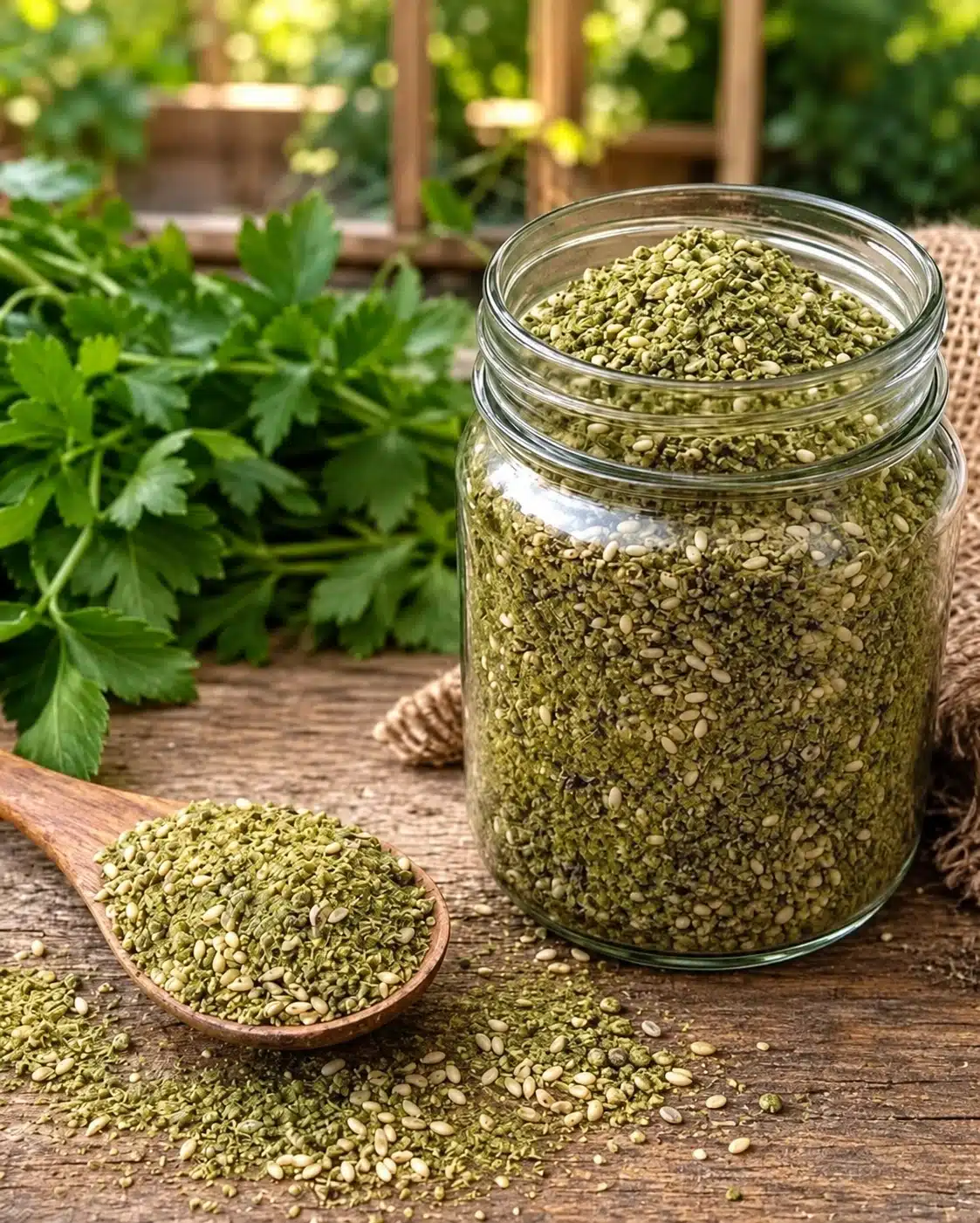
The image claims that a spoonful of a green seed-and-herb mixture is “full of collagen” and that taking it daily for three months can make a person look dramatically younger. That is an appealing promise, but it is important to separate the useful nutrition idea from the exaggerated claim.
The exact ingredients in the jar cannot be confirmed from the photograph alone. More importantly, plant seeds and herbs do not naturally contain collagen. Collagen is an animal protein found in tissues such as skin, bones, cartilage, tendons, fish skin, and connective tissue.
What plant foods can provide are nutrients the body uses while making and maintaining its own collagen: protein-building amino acids, vitamin C from accompanying foods, zinc, copper, healthy fats, and antioxidants.
So rather than presenting a spoonful of seeds as a miracle anti-aging treatment, this article turns the idea into a practical Collagen-Support Seed & Herb Mix that can be added to yogurt, oatmeal, smoothies, salads, or breakfast bowls as part of an overall nutritious diet.
Recipe Overview
| Recipe Details | Information |
|---|---|
| Recipe Name | Collagen-Support Seed & Herb Mix |
| Focus Keyword | Collagen-Support Seed Mix |
| Prep Time | 10 minutes |
| Cooking Time | None |
| Total Time | 10 minutes |
| Yield | About 2 cups |
| Serving Size | 1–2 tablespoons |
| Course | Topping / Pantry Mix |
| Cuisine | General Wellness |
| Difficulty | Very Easy |
| Texture | Nutty, Slightly Crunchy |
| Storage | Airtight container |
| Best Uses | Yogurt, Oatmeal, Smoothies, Salads |
| Contains Collagen? | No |
| Provides Collagen-Supporting Nutrients? | Yes |
First: Does This Mixture Really Contain Collagen?
No—not if it is made entirely from seeds, herbs, or other plant ingredients.
Collagen is a structural protein produced by animals, including humans. Plants do not produce collagen.
That means a jar of ground herbs, seeds, or leaves cannot truthfully be described as naturally “full of collagen.”
However, that does not make plant foods useless for skin or connective tissue.
Your body manufactures its own collagen, and that process depends on adequate overall nutrition.
Protein provides amino acids.
Vitamin C is necessary for normal collagen formation.
Minerals including zinc and copper also participate in normal tissue maintenance.
So the more accurate description is collagen-supporting nutrition, not a collagen replacement.
Can One Tablespoon Make You Look Younger in Three Months?
There is no reliable basis for promising that “no one will be able to guess your age” after eating one tablespoon of a seed mixture every day.
Appearance is influenced by many things, including genetics, sun exposure, smoking, sleep, hydration, diet, hormones, skin care, body composition, and age itself.
No single spoonful of food can reverse aging.
A nutritious diet can support normal skin, muscle, and bone health, but dramatic guaranteed anti-aging claims should be treated cautiously.
The useful goal is not to chase an overnight transformation. It is to build dietary habits that supply the body with the nutrients it regularly needs.
What the Body Needs to Make Collagen
Your body makes collagen from amino acids, particularly glycine, proline, and related building blocks.
Vitamin C is also essential to normal collagen synthesis.
Other nutrients can contribute to normal tissue health, including zinc and copper.
That means a collagen-supportive eating pattern can include:
- Adequate protein
- Vitamin C-rich fruits and vegetables
- Seeds and nuts
- Legumes
- Fish, poultry, eggs, or dairy if included in your diet
- Whole grains
- Colorful vegetables
- Healthy fats
The overall diet matters much more than one “miracle” ingredient.
Ingredients for a Practical Seed Mix
This version is intentionally simple and made with recognizable ingredients.
Seed & Herb Mix
- 1/2 cup pumpkin seeds
- 1/2 cup sesame seeds
- 1/3 cup chia seeds
- 1/3 cup ground flaxseed
- 2 tablespoons hemp hearts
- 1 tablespoon dried parsley or finely ground leafy herbs, optional
- 1/2 teaspoon cinnamon, optional
For a fresher flavor, leave the herbs out and add fresh fruit when serving.
Ingredient Guide
| Ingredient | What It Contributes |
|---|---|
| Pumpkin Seeds | Protein, zinc, magnesium |
| Sesame Seeds | Healthy fats, protein, copper |
| Chia Seeds | Fiber, plant omega-3 fats |
| Flaxseed | Fiber and plant fats |
| Hemp Hearts | Protein and healthy fats |
| Parsley | Flavor and plant compounds |
| Cinnamon | Warm flavor without added sugar |
Why Pumpkin Seeds Are Useful
Pumpkin seeds are nutrient-dense and contain protein along with minerals such as zinc and magnesium.
Zinc is involved in many normal functions in the body, including tissue repair and immune function.
That does not mean pumpkin seeds “produce collagen” by themselves.
They simply contribute useful nutrients as part of a balanced eating pattern.
Why Sesame Seeds Are a Good Addition
Sesame seeds provide healthy fats, protein, and minerals including copper.
Copper participates in normal connective-tissue processes in the body.
Again, that does not turn sesame seeds into collagen.
It simply makes them a nutritious food worth including in a varied diet.
Why Chia Seeds Work Well
Chia seeds add fiber and plant-based omega-3 fats.
They absorb liquid, so they can make yogurt, oatmeal, and smoothies thicker.
They are also easy to mix into a daily tablespoon of seed blend without dramatically changing the flavor.
If you are not used to high-fiber foods, begin with a smaller serving and increase gradually.
Why Flaxseed Should Be Ground
Whole flaxseeds can pass through the digestive tract without being fully broken down.
Ground flaxseed is easier to incorporate into foods and exposes more of the seed.
Use ground flax rather than whole flax for this mixture.
Store it tightly sealed because the natural oils can become stale over time.
How to Make the Seed Mix
Step 1: Toast the Pumpkin and Sesame Seeds
This step is optional but improves flavor.
Place the pumpkin seeds and sesame seeds in a dry skillet over medium-low heat.
Toast for approximately 3–5 minutes.
Stir frequently.
Remove them when they smell nutty.
Do not allow them to burn.
Step 2: Cool Completely
Let the toasted seeds cool before grinding.
Grinding warm seeds can release more oil and turn the mixture into a paste.
Step 3: Grind Lightly
Place the cooled pumpkin and sesame seeds in a food processor or spice grinder.
Pulse several times.
You want a coarse meal rather than nut butter.
Some texture is completely fine.
Step 4: Add the Remaining Ingredients
Combine the ground seeds with:
- Chia seeds
- Ground flaxseed
- Hemp hearts
- Optional herbs
- Optional cinnamon
Stir thoroughly.
Step 5: Store Properly
Transfer the mixture to an airtight container.
Keep it somewhere cool and dark.
For longer storage, refrigeration is a good option because seeds contain natural oils that can eventually become rancid.
How Much Should You Use?
A practical serving is about 1–2 tablespoons.
That amount can be added to:
- Yogurt
- Oatmeal
- Smoothies
- Salads
- Cottage cheese
- Overnight oats
- Soup
- Grain bowls
There is no evidence-based reason to believe exactly one tablespoon for exactly three months has a special anti-aging effect.
Think of it as a nutrient-dense food topping rather than medicine.
The Best Way to Make It More Collagen-Supportive
Pair the seed mix with a source of vitamin C.
Vitamin C is needed for normal collagen formation.
Good pairings include:
- Strawberries
- Kiwi
- Oranges
- Grapefruit
- Bell peppers
- Berries
- Mango
- Pineapple
- Broccoli
For example, yogurt with berries and one tablespoon of the seed mix makes much more nutritional sense than taking a spoonful of dry powder alone.
Easy Breakfast Bowl
Add to a bowl:
- 1 cup plain Greek yogurt
- 1 tablespoon seed mix
- 1/2 cup strawberries
- 1 kiwi
- Small drizzle of honey, optional
This provides protein along with vitamin C-rich fruit and the nutrients from the seeds.
It is a far more balanced approach than relying on one “anti-aging” ingredient.
Oatmeal Version
Prepare your favorite oatmeal.
Add:
- 1 tablespoon seed mix
- Fresh berries
- Chopped apple or kiwi
- Cinnamon
The seed mixture adds texture while increasing the nutritional variety of breakfast.
Smoothie Version
Blend:
- 1 cup milk or unsweetened plant milk
- 1/2 cup berries
- 1 kiwi or orange segments
- 1 tablespoon seed mix
- 1/2 banana
- Ice
Blend until smooth.
This is an easy way to combine protein, fruit, seeds, and vitamin C-rich ingredients.
Can You Add Moringa?
You can use small amounts of moringa leaf powder as a food ingredient if you already use it and tolerate it, but it should not be marketed as a collagen source or a proven anti-aging treatment.
It has its own nutritional profile, but adding it does not suddenly create collagen.
If you take medications or have a medical condition, it is sensible to discuss concentrated herbal products with your clinician or pharmacist because supplements and herbs can sometimes interact with medications.
What Foods Actually Contain Collagen?
Collagen itself is found in animal tissues.
Examples include foods or ingredients made from:
- Skin
- Bones
- Cartilage
- Connective tissue
- Gelatin
- Fish skin
Hydrolyzed collagen supplements are also produced from animal collagen.
That is fundamentally different from seeds and herbs, which do not contain collagen.
What About Bone Broth?
Bone broth may contain some collagen-derived proteins or gelatin depending on how it is prepared.
The exact amount varies widely.
It should still be viewed as food rather than a guaranteed anti-aging treatment.
A bowl of broth does not erase wrinkles or reverse aging.
What About Collagen Supplements?
Collagen supplements usually contain hydrolyzed animal collagen peptides.
Some research suggests they may have modest effects on certain skin measures in some people, but results are not equivalent to “looking years younger,” and supplements are not a substitute for good nutrition, sun protection, or appropriate medical care.
They are also very different from herbal seed powders.
Skin Health Depends on More Than Collagen
Collagen gets a lot of attention online, but healthy-looking skin depends on many factors.
Adequate sleep matters.
Sun protection matters.
Smoking status matters.
Hydration matters.
Protein intake matters.
Fruits and vegetables matter.
Genetics matter.
And normal aging continues regardless of which superfood is trending online.
No food should be presented as if it overrides those factors.
What About Bone Health?
Bone health is also much more complicated than taking a tablespoon of seeds.
Important factors include adequate:
- Protein
- Calcium
- Vitamin D
- Physical activity
- Resistance exercise
- Overall energy intake
Certain health conditions and medications can also affect bones.
A seed mixture can be part of a nutritious diet, but it cannot diagnose or treat osteoporosis.
Leg and Bone Pain Is Not Automatically a Vitamin Deficiency
This is particularly important because the image connects leg and bone pain with a missing vitamin.
Pain in the legs or bones can have many possible causes.
These may include muscle strain, joint problems, nerve irritation, circulation issues, injuries, vitamin or mineral deficiencies, or other medical conditions.
It is therefore not possible to look at leg pain and conclude that one particular vitamin is missing.
Persistent, severe, unexplained, or worsening pain deserves proper evaluation.
When Leg Pain Needs Medical Attention
Seek prompt medical care if leg pain is accompanied by concerning symptoms such as significant swelling, redness, warmth, weakness, loss of sensation, inability to bear weight, fever, or sudden severe pain.
Chest pain or shortness of breath occurring with a swollen painful leg can require emergency evaluation.
Food or supplements should not be used to delay medical assessment of potentially serious symptoms.
Can This Seed Mix Replace a Multivitamin?
No.
It is simply food.
It provides useful nutrients, but it does not necessarily contain every vitamin or mineral a person needs.
If someone has a medically diagnosed deficiency, treatment should match the deficiency and the clinician’s recommendation.
Taking an unrelated powder is not a reliable substitute.
Can This Mix Replace Protein?
No.
Although seeds contain protein, one tablespoon is a small serving.
Use the blend as a topping rather than your main protein source.
Good protein options can include beans, lentils, dairy, eggs, fish, poultry, tofu, tempeh, nuts, and seeds depending on your dietary preferences.
Can You Add It to Coffee?
You technically can, but the texture may be gritty.
It works better in thicker foods such as oatmeal, yogurt, smoothies, or porridge.
If adding it to a drink, blending is better than simply stirring.
Can You Eat It Dry?
A small amount can be eaten dry, but it is more pleasant mixed into food.
Chia and flax also absorb liquid.
Pairing the mixture with food and fluids makes it easier to consume.
Storage
Store the seed blend in an airtight container.
A cool pantry works for shorter storage.
Refrigeration is better if making a large batch.
For best flavor, make smaller batches rather than keeping ground seeds for many months.
If the mixture develops a bitter, paint-like, or stale smell, discard it.
Can You Freeze the Seed Mix?
Yes.
Seed mixtures freeze well.
Divide into small airtight containers or freezer-safe bags.
Freeze for several months.
Remove only the quantity you need.
This can help protect the natural oils from becoming stale.
Common Mistakes to Avoid
| Common Mistake | Better Approach |
|---|---|
| Calling plant seeds “collagen” | Call them nutrient-rich or collagen-supportive |
| Promising dramatic anti-aging effects | Use realistic nutrition language |
| Treating leg pain with one food | Identify the actual cause |
| Taking very large servings immediately | Start with moderate portions |
| Ignoring allergies | Avoid seeds that trigger reactions |
| Using stale ground seeds | Store airtight and cool |
| Replacing meals with powders | Use the mix as a topping |
| Assuming natural means risk-free | Consider medications and health conditions |
Who Should Be Careful?
Anyone with a known seed or nut allergy should obviously avoid ingredients that trigger them.
People who have digestive sensitivity may want to begin with a smaller amount because chia and flax are high in fiber.
Anyone taking medications, pregnant, breastfeeding, or managing a chronic medical condition should be cautious about adding concentrated herbal powders or supplement-style mixtures without checking whether they are appropriate.
A basic food mixture made from familiar seeds is generally much easier to evaluate than an unidentified viral powder.
Nutrition Estimate
Approximate values for 1 tablespoon of the basic seed mixture:
| Nutrition | Approximate Amount |
|---|---|
| Calories | 55–75 |
| Protein | 2–3 g |
| Fat | 4–6 g |
| Carbohydrates | 2–4 g |
| Fiber | 1–2 g |
| Sugar | Less than 1 g |
Exact values depend on the final seed proportions and serving size.
Frequently Asked Questions
Does this seed mixture contain collagen?
No. Plant seeds and herbs do not naturally contain collagen.
Why do people call foods like this “collagen”?
Online posts often use “collagen” loosely when they actually mean nutrients that may support the body’s normal collagen production.
Can seeds help the body make collagen?
Seeds can provide protein and minerals that contribute to overall nutrition, but collagen synthesis depends on the total diet and other factors.
Is vitamin C important for collagen?
Yes. Vitamin C is needed for normal collagen formation.
Should I combine the mix with fruit?
That is an excellent idea. Berries, kiwi, oranges, and other vitamin C-rich foods pair well with it.
Will one tablespoon remove wrinkles?
No food can reliably promise that result.
Will it make people unable to guess my age?
There is no scientific basis for that claim.
Will it cure leg pain?
No. Leg pain has many possible causes and should not automatically be attributed to one nutrient deficiency.
Does bone pain mean vitamin D deficiency?
Vitamin D deficiency can sometimes contribute to bone or muscle symptoms, but pain alone does not diagnose it.
Should I take vitamin D without testing?
Not necessarily. Supplement needs vary, and high doses can be harmful. A clinician can help determine whether testing or supplementation is appropriate.
Can I use chia seeds?
Yes.
Can I use flaxseed?
Yes. Ground flax is usually easier to incorporate.
Can I use sesame seeds?
Yes, unless you have a sesame allergy.
Can I use pumpkin seeds?
Yes.
Can I add sunflower seeds?
Absolutely.
Can I add nuts?
Yes. Almonds or walnuts can be added if tolerated.
Can I add moringa powder?
You can use it as a food ingredient, but it does not provide collagen and should not be treated as a proven anti-aging therapy.
How much should I take?
Think of it as food rather than medicine. Around 1–2 tablespoons added to meals is a practical serving.
Must I use it for three months?
No special three-month duration has been established for this mixture.
Can I take it every day?
Many people can include seeds regularly as part of their diet, but serving size and individual tolerance matter.
Is more always better?
No. Larger quantities add calories and fiber and may cause digestive discomfort.
Can children eat it?
Age, allergy risk, choking risk, and individual dietary needs matter. Whole seeds and nuts can also be a choking hazard for young children.
Can I use it during pregnancy?
Ordinary food amounts of familiar seeds may fit many diets, but concentrated herbal blends should be discussed with a healthcare professional.
Better Foods to Pair with This Mix
Instead of focusing on one powder, build a complete plate.
A useful combination might include Greek yogurt or another protein-rich food, berries or kiwi for vitamin C, the seed blend for healthy fats and minerals, and oatmeal or whole grains for additional fiber.
That combination provides far more nutritional variety than simply swallowing a spoonful of mystery powder.
A Simple Daily Routine
At breakfast, add one tablespoon to oatmeal or yogurt.
Include a vitamin C-rich fruit.
At lunch and dinner, include adequate protein and colorful vegetables.
Drink normally according to thirst.
Get regular physical activity.
Protect your skin from excessive sun exposure.
Those habits may not sound as dramatic as “look years younger in three months,” but they are far more grounded in how health actually works.
Final Thoughts
The viral message in the image takes a reasonable idea—eating nutrient-rich seeds and herbs—and turns it into an unrealistic promise.
A plant-based seed blend is not full of collagen because plants do not produce collagen.
And there is no trustworthy reason to promise that one tablespoon a day for three months will make someone’s age impossible to guess.
What a good seed mixture can do is contribute protein, healthy fats, fiber, zinc, copper, magnesium, and other nutrients to an already balanced diet.
Pair it with vitamin C-rich foods such as berries, kiwi, oranges, or bell peppers.
Use it in yogurt.
Add it to oatmeal.
Blend it into smoothies.
Sprinkle it over salads.
But treat it as food—not as a cure, anti-aging drug, or treatment for unexplained leg and bone pain.
Healthy aging is built from many factors working together: adequate nutrition, physical activity, sleep, medical care when needed, avoiding smoking, and protecting skin from excessive sun exposure.
That message may be less sensational than the viral image, but it is much more useful.