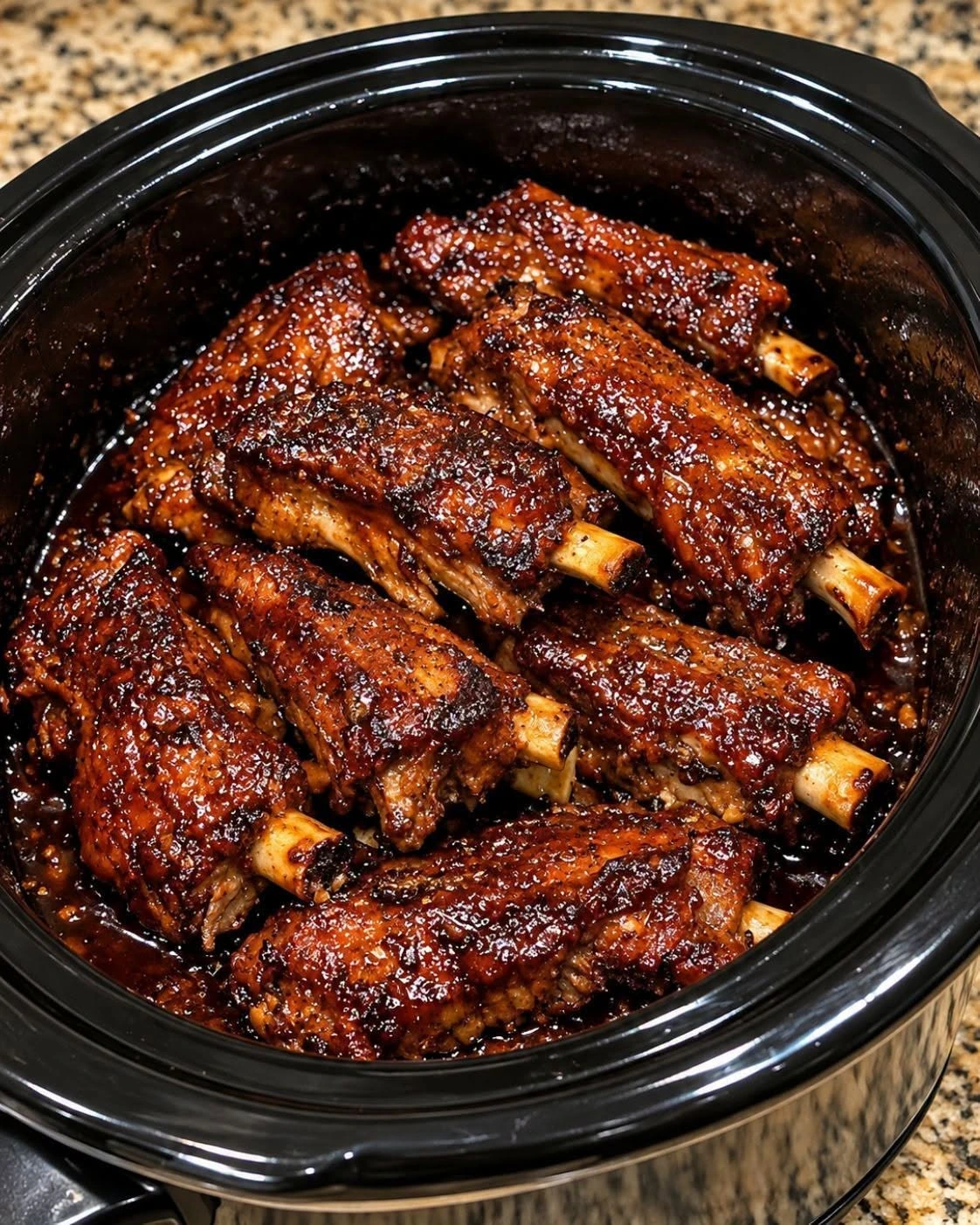
These Slow Cooker BBQ Pork Ribs are the kind of dinner that looks like you spent all afternoon tending a smoker, even though the slow cooker does most of the work. Thick, meaty pork ribs cook gently in a smoky brown sugar and garlic seasoning, then finish in a rich barbecue glaze that becomes sticky, glossy, and deeply caramelized.
Inspired by the ribs in the image, this recipe is designed to create incredibly tender meat with a dark, lacquered exterior rather than pale, watery slow-cooker ribs. The key is using very little added liquid, seasoning the ribs generously, and finishing them under the broiler with an extra layer of sauce after slow cooking.
The slow cooker softens the connective tissue in the ribs while preserving moisture. Once the meat is tender, a quick blast of high heat caramelizes the barbecue sauce and creates the beautiful browned edges that make the ribs look oven-roasted or grilled.
Serve these ribs with mashed potatoes, mac and cheese, coleslaw, baked beans, corn, potato salad, roasted vegetables, or warm dinner rolls. They are perfect for family dinners, Sunday supper, game day, summer gatherings, holidays, or any time you want serious comfort food without standing over the grill.
Recipe Overview
| Recipe Details | Information |
|---|---|
| Recipe Name | Slow Cooker BBQ Pork Ribs |
| Focus Keyword | Slow Cooker BBQ Pork Ribs |
| Prep Time | 20 minutes |
| Cook Time on LOW | 6–8 hours |
| Cook Time on HIGH | 3½–5 hours |
| Broiling Time | 4–8 minutes |
| Total Time | About 7 hours |
| Servings | 4–6 |
| Course | Main Dish |
| Cuisine | American BBQ |
| Difficulty | Easy |
| Main Ingredient | Pork Ribs |
| Cooking Method | Slow Cooker + Broiler |
| Flavor | Smoky, Sweet, Savory & Garlicky |
| Texture | Very Tender with Sticky Edges |
| Best For | Family Dinner, BBQ, Game Day |
| Make Ahead | Yes |
| Freezer Friendly | Yes |
Why You’ll Love These Slow Cooker Ribs
This recipe gives you the tenderness of long-cooked ribs without requiring a smoker or outdoor grill.
The ribs cook slowly enough for the tough connective tissue to soften, while the bone helps protect the meat and add flavor.
The dry rub creates layers of seasoning before the sauce is added.
Brown sugar encourages caramelization.
Paprika brings color.
Garlic and onion powder provide savory depth.
Black pepper adds warmth.
And the barbecue sauce gives the ribs the sticky, glossy coating that makes them irresistible.
Another advantage is that this recipe works year-round.
Rainy day?
No problem.
Cold winter evening?
No problem.
No grill?
Still no problem.
The slow cooker handles the tenderness, and your oven broiler handles the caramelization.
What Do These Slow Cooker BBQ Ribs Taste Like?
The flavor is rich, smoky, sweet, savory, and slightly tangy.
You first taste the caramelized barbecue sauce.
Then the brown sugar and smoked paprika come through.
Garlic, onion, Worcestershire sauce, mustard, and black pepper keep the sweetness balanced.
The pork itself becomes deeply savory after several hours of slow cooking.
The final result tastes much closer to sticky barbecue ribs than to plain braised pork.
Best Ribs for the Slow Cooker
Several pork rib cuts can work.
Baby Back Ribs
Baby back ribs are leaner, curved, and relatively tender.
They cook a little faster than larger rib cuts.
They are an excellent choice if you want neat portions and tender meat.
St. Louis-Style Ribs
St. Louis ribs are larger and usually contain more fat and connective tissue.
That makes them particularly good for long, slow cooking.
They tend to be richer and meatier.
Spare Ribs
Spare ribs are also excellent.
They are usually larger and fattier than baby backs, with plenty of flavor.
For the thick, substantial ribs visible in the image, St. Louis-style or meaty spare ribs would be an excellent choice.
Ingredients
For the Ribs
- 3½ to 4 pounds pork ribs
- 1 tablespoon yellow mustard or Dijon mustard
- 1 tablespoon Worcestershire sauce
For the Dry Rub
- 1/4 cup packed brown sugar
- 2 teaspoons smoked paprika
- 1½ teaspoons garlic powder
- 1½ teaspoons onion powder
- 1 teaspoon kosher salt
- 1 teaspoon coarse black pepper
- 1 teaspoon chili powder
- 1/2 teaspoon ground cumin
- 1/2 teaspoon dried oregano
- 1/4 teaspoon cayenne pepper, optional
For the BBQ Glaze
- 1½ cups barbecue sauce
- 2 tablespoons brown sugar
- 2 tablespoons apple cider vinegar
- 1 tablespoon Worcestershire sauce
- 1 tablespoon honey
- 2 garlic cloves, finely minced
- 1 teaspoon Dijon mustard
- 1/2 teaspoon smoked paprika
- 1/4 teaspoon black pepper
Optional Garnish
- Chopped parsley
- Green onions
- Extra cracked black pepper
Ingredient Guide
| Ingredient | Purpose |
|---|---|
| Pork Ribs | Main protein |
| Brown Sugar | Sweetness and caramelization |
| Smoked Paprika | Smoke flavor and color |
| Garlic Powder | Savory seasoning |
| Onion Powder | Adds depth |
| Chili Powder | Warm spice |
| Mustard | Helps rub stick and adds tang |
| Worcestershire | Adds savory complexity |
| BBQ Sauce | Main sticky glaze |
| Apple Cider Vinegar | Balances sweetness |
| Honey | Adds gloss and sweetness |
| Fresh Garlic | Gives sauce stronger flavor |
Why Use a Dry Rub Before the Sauce?
If you simply pour barbecue sauce over raw ribs, the outside can taste sweet while the meat underneath remains underseasoned.
A dry rub solves that problem.
The seasoning sits directly against the meat throughout the slow cooking process.
Salt penetrates the surface.
Brown sugar dissolves into the pork juices.
Paprika and spices create flavor underneath the sauce.
Then the barbecue glaze is added at the end for a second layer of flavor.
That combination creates ribs that taste seasoned all the way through rather than only on the surface.
Why Mustard Is Useful
Mustard acts as a binder.
A thin layer helps the dry rub stick evenly to the ribs.
It also adds a tiny amount of acidity and flavor.
Once the ribs are cooked, the mustard flavor is not strongly noticeable.
You can use yellow mustard or Dijon.
If you dislike mustard, simply omit it and rub the ribs with Worcestershire sauce or a very small amount of oil instead.
Do You Need to Remove the Membrane?
If the tough membrane is still attached to the bone side of the ribs, removing it usually gives you a better texture.
The membrane can remain chewy even after long cooking.
To remove it:
Slide a butter knife under one corner.
Lift the membrane.
Grab it with a paper towel for traction.
Pull it away from the rack.
Sometimes it comes off in one piece.
Sometimes you need to remove it in sections.
Many store-bought rib racks already have the membrane removed.
Equipment Needed
- 6-quart slow cooker
- Cutting board
- Sharp knife
- Small mixing bowls
- Measuring spoons
- Tongs
- Baking sheet
- Aluminum foil
- Pastry brush or spoon
- Meat thermometer, optional but useful
A 6-quart oval slow cooker is ideal because rib sections fit more naturally inside it.
How to Prepare the Ribs
Pat the ribs dry with paper towels.
Remove the membrane if necessary.
Trim any very large loose pieces of fat.
Do not remove all the fat.
Some fat helps keep the ribs flavorful during cooking.
Cut the rack into sections containing approximately 2–4 ribs each.
This makes the ribs easier to arrange inside the slow cooker and easier to serve later.
How to Make the Dry Rub
In a small bowl, combine:
- Brown sugar
- Smoked paprika
- Garlic powder
- Onion powder
- Salt
- Black pepper
- Chili powder
- Cumin
- Oregano
- Optional cayenne
Stir until evenly blended.
Break apart any brown sugar lumps with your fingers.
How to Make Slow Cooker BBQ Pork Ribs
Step 1: Coat the Ribs
Rub the ribs lightly with mustard and Worcestershire sauce.
You only need enough to make the surface slightly sticky.
Do not drench them.
Step 2: Apply the Dry Rub
Sprinkle the seasoning mixture generously over both sides of every rib section.
Press the seasoning into the meat.
Try to coat the edges as well.
For deeper flavor, season the ribs several hours ahead and refrigerate them covered.
Step 3: Arrange the Ribs in the Slow Cooker
Stand some rib sections upright around the sides of the slow cooker and place additional pieces in the center.
Another option is stacking them in layers.
Avoid adding water.
The ribs will release plenty of natural moisture as they cook.
This is one of the most important secrets to keeping the sauce concentrated.
Do Slow Cooker Ribs Need Liquid?
Usually, no extra liquid is necessary.
Pork ribs release fat and juices during cooking.
Adding several cups of broth or water can dilute the seasoning and leave you with ribs that taste more boiled than barbecued.
If your slow cooker tends to cook very dry, you can add a few tablespoons of apple juice or broth.
But keep it minimal.
Step 4: Add a Light Layer of Sauce
Mix the BBQ glaze ingredients together.
Brush or spoon a light layer over the ribs.
Reserve most of the glaze for the finishing step.
Using too much sauce at the beginning can create a lot of watery liquid because the ribs release moisture while cooking.
Step 5: Slow Cook
Cover the slow cooker.
Cook on:
LOW for approximately 6–8 hours
or
HIGH for approximately 3½–5 hours.
The exact time depends on the rib cut, thickness, and your slow cooker.
Baby backs generally finish sooner.
Large spare ribs may take longer.
How to Know When the Ribs Are Tender
Pork is considered safe at a much lower internal temperature, but ribs usually need to reach a substantially higher temperature for the connective tissue to soften enough for classic rib texture.
For tender ribs, the internal meat temperature is often around 190–205°F / 88–96°C.
Temperature is helpful, but texture matters even more.
Look for these signs:
The meat has pulled back slightly from the ends of the bones.
A fork slides easily into the meat.
The rack bends easily when lifted.
The meat feels tender but is not completely disintegrating.
Fall-Off-the-Bone vs. Bite-Tender Ribs
Some people love ribs so tender that the meat slides completely off the bone.
Others prefer ribs that remain attached but pull away easily when bitten.
For firmer, bite-tender ribs, check earlier.
For fall-off-the-bone ribs, cook longer.
Be careful near the end because the difference between tender and collapsing can happen quickly in a slow cooker.
Step 6: Carefully Remove the Ribs
Line a baking sheet with foil.
Use tongs or a wide spatula to transfer the rib sections from the slow cooker.
Handle them carefully.
If they are very tender, the meat may begin separating from the bones.
Arrange them meat-side up.
Step 7: Brush with BBQ Glaze
Brush the ribs generously with the reserved barbecue glaze.
Cover every exposed surface.
This fresh layer of sauce is what creates the glossy appearance after broiling.
Step 8: Broil
Set the oven broiler to high.
Place the ribs several inches below the heat.
Broil for approximately 2–4 minutes.
Watch closely.
Brush with another layer of sauce.
Broil again for another 1–3 minutes.
The sauce should become:
- Darker
- Sticky
- Glossy
- Lightly charred around the edges
This finishing step is what transforms slow-cooked ribs into something that looks like the ribs in the image.
Why Broiling Is Essential for the Best Finish
The crockpot creates tenderness but very little browning.
The broiler provides intense dry heat.
That heat caramelizes the sugar in the barbecue sauce.
It creates slightly charred edges.
It reduces surface moisture.
And it concentrates the sauce.
Without broiling, the ribs can still taste good, but they will look softer and paler.
With broiling, they develop the dark sticky exterior associated with barbecue.
How to Make an Extra-Sticky BBQ Glaze
If you want a thicker glaze, transfer the reserved sauce to a small saucepan.
Simmer for approximately 5–7 minutes.
Allow it to reduce slightly.
Then brush it onto the cooked ribs.
A reduced sauce sticks much more strongly and creates a lacquered appearance.
You can also add one extra tablespoon of honey for additional shine.
How to Use the Slow Cooker Juices
Do not automatically throw away the liquid left in the crockpot.
It contains pork juices, seasoning, and barbecue flavor.
Skim off excess fat.
Transfer the remaining liquid to a saucepan.
Simmer until reduced.
Taste.
If needed, add a little fresh barbecue sauce.
You can serve this reduced sauce on the side.
It is especially good over mashed potatoes or rice.
Brown Sugar Garlic Ribs
For an even deeper sweet-and-savory version, increase the fresh garlic to 5 cloves.
Add another 2 tablespoons brown sugar to the glaze.
Include:
- Soy sauce
- Worcestershire
- Apple cider vinegar
This creates a darker, stickier sauce with strong caramelized garlic flavor.
Honey Garlic Ribs
Replace part of the brown sugar with honey.
Use:
- 1/4 cup honey
- 2 tablespoons brown sugar
- 1/4 cup soy sauce
- 4 garlic cloves
- 1 tablespoon vinegar
- 1 tablespoon Worcestershire
This variation tastes less like traditional BBQ and more like sticky honey-garlic ribs.
Serve with rice and roasted vegetables.
Sweet and Spicy Ribs
Add:
- 1/2 teaspoon cayenne
- 1 teaspoon crushed red pepper
- 1 tablespoon hot sauce
The brown sugar and honey help balance the heat.
For a milder family version, keep the base sauce mild and offer hot sauce separately.
Smoky Chipotle Ribs
Add one finely chopped chipotle pepper in adobo to the sauce.
Chipotle provides both smoke and heat.
Reduce other spicy ingredients because chipotle can be strong.
This version is excellent with corn, beans, and coleslaw.
Maple BBQ Ribs
Replace the honey with pure maple syrup.
Add:
- 1 tablespoon Dijon mustard
- Pinch of cinnamon
- Extra black pepper
Maple gives the sauce a rich sweetness that works particularly well for fall dinners.
Bourbon-Style BBQ Ribs
For an adult-oriented variation, you can use a commercially prepared bourbon-style barbecue sauce or add a small amount of bourbon to a saucepan sauce and cook it thoroughly before glazing.
Combine with:
- Brown sugar
- Mustard
- Worcestershire
- Garlic
Do not pour raw alcohol directly over finished ribs.
Cook the sauce first so the flavor becomes balanced.
Asian-Inspired Sticky Ribs
Use a glaze made from:
- 1/3 cup soy sauce
- 1/4 cup honey
- 1/4 cup brown sugar
- 4 garlic cloves
- 1 tablespoon grated ginger
- 1 tablespoon rice vinegar
- 1 teaspoon sesame oil
After broiling, garnish with green onions and sesame seeds.
Serve with rice.
Garlic Parmesan Ribs
Skip the barbecue glaze.
Cook the ribs with garlic, paprika, onion powder, salt, and pepper.
After cooking, broil until browned.
Brush with garlic butter.
Sprinkle generously with Parmesan and parsley.
This creates a savory rib variation without a sweet BBQ sauce.
Dry-Rub Slow Cooker Ribs
If you prefer dry ribs, omit the sauce during slow cooking.
Season generously.
Slow cook until tender.
Transfer to a baking sheet.
Broil briefly.
Sprinkle with a little additional dry rub after cooking.
Serve BBQ sauce on the side.
Can You Add Onions?
Yes.
Slice one large onion.
Place it at the bottom of the slow cooker.
Arrange the ribs on top.
The onion absorbs pork juices and becomes extremely soft.
You can serve it alongside the ribs or blend it into the cooking sauce.
Can You Add Garlic?
Absolutely.
Fresh garlic works very well in the sauce.
However, do not rely only on fresh garlic in the dry rub because minced garlic can burn under the broiler.
Use garlic powder for the dry rub and fresh garlic in the wet sauce.
What to Serve with Slow Cooker BBQ Ribs
| Side Dish | Why It Works |
|---|---|
| Mac and Cheese | Classic BBQ comfort food |
| Coleslaw | Cool, crunchy contrast |
| Baked Beans | Traditional BBQ side |
| Mashed Potatoes | Perfect with extra sauce |
| Potato Salad | Great for cookouts |
| Corn on the Cob | Sweet and fresh |
| Green Beans | Easy vegetable side |
| Roasted Potatoes | Hearty pairing |
| Cornbread | Excellent with BBQ sauce |
| Dinner Rolls | Great for extra glaze |
| Cucumber Salad | Light, fresh contrast |
| Grilled Vegetables | Balances rich ribs |
The Best Classic BBQ Plate
Serve a generous portion of ribs with:
- Mac and cheese
- Coleslaw
- Baked beans
- Cornbread
Add pickles and sliced onions on the side.
Keep extra barbecue sauce at the table.
This gives you a complete BBQ-style meal without needing an outdoor smoker.
Slow Cooker Ribs with Mashed Potatoes
Mashed potatoes are an excellent choice when serving ribs as a Sunday dinner.
Prepare creamy mashed potatoes.
Place a scoop on each plate.
Add several ribs.
Spoon a little reduced cooking sauce over the potatoes.
Add green beans or carrots.
The result feels more like comfort food than traditional barbecue.
Ribs for Game Day
Cut each rib section into individual bones after broiling.
Arrange on a large serving tray.
Offer several sauces:
- Classic BBQ
- Spicy BBQ
- Honey mustard
- Ranch
Serve alongside wings, sliders, fries, nachos, or chips.
Individual ribs make excellent handheld party food.
How Many Ribs Per Person?
As a main course, plan approximately:
Baby Back Ribs: 1/2 rack per adult.
Spare or St. Louis Ribs: Around 3–4 ribs per adult.
If you have many side dishes, slightly smaller portions are usually enough.
For parties, cut ribs individually and plan based on the number of other appetizers available.
How to Double the Recipe
For a larger crowd, two slow cookers usually work better than overfilling one.
Do not pack a slow cooker to the very top with tightly stacked ribs.
Overcrowding can increase cooking time and lead to uneven results.
Prepare the same rub and sauce quantities proportionally.
Broil the cooked ribs in batches.
Make-Ahead Instructions
You can season the ribs up to 24 hours ahead.
Apply the mustard and dry rub.
Cover.
Refrigerate.
The next day, arrange the ribs in the slow cooker and cook.
The sauce can also be prepared one or two days ahead.
Store it separately in the refrigerator.
This makes the recipe especially easy for parties.
Can You Cook the Ribs Ahead and Finish Later?
Yes.
Slow cook the ribs until tender.
Allow them to cool.
Refrigerate them carefully in a covered container.
When ready to serve, brush generously with fresh BBQ sauce.
Heat in a 350°F / 175°C oven until warm.
Then broil to caramelize.
This is one of the best ways to prepare ribs for a party because all the long cooking can be completed beforehand.
Storage
Allow leftovers to cool promptly.
Place the ribs in an airtight container.
Store with a small amount of sauce.
Refrigerate for approximately 3–4 days.
Keeping some sauce around the ribs helps protect the meat from drying during reheating.
Best Way to Reheat Ribs
Oven Method
Place ribs in a baking dish.
Brush with barbecue sauce.
Add a tablespoon or two of water or broth to the bottom.
Cover tightly with foil.
Heat at 300°F / 150°C until warm.
Uncover.
Brush with additional sauce.
Broil for 1–2 minutes.
This is the best method for restoring the sticky exterior.
Air Fryer
Reheat individual ribs at moderate heat.
Brush with sauce.
Air fry until hot and caramelized.
Microwave
The microwave works for convenience, but the exterior stays softer.
Cover the ribs and heat in short intervals.
Can You Freeze Cooked Ribs?
Yes.
Slow-cooked ribs freeze very well.
Allow them to cool completely.
Wrap portions tightly.
Transfer to a freezer-safe bag or container.
Add a small amount of barbecue sauce.
Freeze for approximately 2–3 months for best quality.
Thaw overnight in the refrigerator.
Reheat gently and finish under the broiler.
Can You Freeze Raw Seasoned Ribs?
Yes.
Apply the dry rub.
Wrap tightly.
Freeze.
Thaw completely in the refrigerator before slow cooking.
Do not place a solid frozen rack directly into the slow cooker.
Common Mistakes to Avoid
| Common Mistake | Result | Better Method |
|---|---|---|
| Adding lots of water | Diluted flavor | Use little or no added liquid |
| Skipping dry rub | Bland meat under sauce | Season generously first |
| Too much sauce at beginning | Watery crockpot liquid | Reserve most sauce for finishing |
| Cooking too briefly | Tough ribs | Cook until connective tissue softens |
| Cooking too long | Meat completely collapses | Check near lower time range |
| Skipping broiler | Pale, soft exterior | Broil with fresh sauce |
| Burning glaze | Bitter sauce | Watch broiler constantly |
| Not removing membrane | Chewy underside | Remove when possible |
| Using sauce contaminated by raw pork | Food-safety risk | Reserve clean sauce separately |
| Cutting immediately while very hot | Meat may shred excessively | Rest briefly |
Troubleshooting Guide
My Ribs Are Tough
They likely need more time.
Tough ribs usually mean the connective tissue has not softened enough.
Continue cooking and check again.
My Ribs Are Falling Apart
They cooked longer than necessary.
They are still delicious.
Handle carefully and serve with plenty of sauce.
My Ribs Taste Boiled
Too much liquid was probably added.
Use little or no broth or water next time.
My Sauce Is Too Thin
Reduce it in a saucepan.
You can also add additional BBQ sauce.
My Sauce Is Too Sweet
Add:
- Apple cider vinegar
- Mustard
- Worcestershire
- Hot sauce
- Black pepper
My Sauce Is Too Salty
Add unsalted tomato sauce, water, or a little honey depending on the recipe.
My Ribs Are Pale
Slow cookers do not brown meat well.
Use the broiler after cooking.
My Sauce Burned Under the Broiler
The ribs were too close to the heat or left too long.
Broil in short intervals and watch constantly.
Pro Tips for the Best Slow Cooker BBQ Ribs
Use thick, meaty ribs.
Remove the membrane.
Pat the meat dry.
Use mustard as a binder.
Season both sides generously.
Let seasoned ribs rest overnight when possible.
Do not add unnecessary water.
Reserve most BBQ sauce for the end.
Cook on LOW for the most controlled texture.
Start checking before the maximum cooking time.
Handle cooked ribs gently.
Brush with fresh sauce.
Broil in short intervals.
Add a second glaze layer for extra stickiness.
Let ribs rest for several minutes before serving.
How to Make the Ribs Look Restaurant-Quality
Presentation matters.
After broiling, brush the ribs with one final thin layer of warmed barbecue sauce.
Do not return them to the broiler after this final layer.
The warmed sauce gives the surface a glossy appearance.
Add:
- Chopped parsley
- Cracked black pepper
- Tiny pinch smoked paprika
Serve on a large platter.
That final glaze gives the ribs the shiny lacquered appearance visible in the image.
Nutrition Estimate
Approximate values per serving:
| Nutrition | Approximate Amount |
|---|---|
| Calories | 520–680 |
| Protein | 35–45 g |
| Carbohydrates | 25–38 g |
| Fat | 30–42 g |
| Sugar | 20–30 g |
| Fiber | 1–2 g |
| Serving Size | About 3–4 ribs |
Actual values vary significantly depending on rib cut, fat content, and amount of sauce.
Frequently Asked Questions
What are Slow Cooker BBQ Pork Ribs?
They are pork ribs seasoned with a dry rub, cooked slowly until tender, then coated with barbecue sauce and usually broiled for a sticky finish.
Is this the exact recipe shown in the image?
The image shows dark, glossy, very tender ribs inside a slow cooker. This recipe is designed to recreate that style rather than claim the exact original recipe.
What ribs are best for a slow cooker?
Baby back, St. Louis-style, and spare ribs can all work.
Which ribs are the most tender?
Baby backs are naturally tender, while spare and St. Louis ribs become exceptionally rich after longer slow cooking.
Do I need to remove the membrane?
It is recommended for better texture.
Do I need to brown ribs first?
No.
Do I need water in the slow cooker?
Usually no. Ribs release plenty of moisture.
Can I add apple juice?
Yes. A few tablespoons can add mild sweetness, but avoid adding too much liquid.
Should I add BBQ sauce before cooking?
Use a small amount initially and reserve most for the finishing step.
Can I cook ribs on LOW?
Yes. LOW is usually the preferred method.
How long should ribs cook on LOW?
Approximately 6–8 hours, depending on size and cut.
How long on HIGH?
Approximately 3½–5 hours.
What temperature should ribs reach?
Pork is safe at a lower temperature, but rib texture generally becomes tender after the meat reaches approximately 190–205°F / 88–96°C.
Why do ribs need a higher temperature than ordinary pork chops?
Ribs contain more connective tissue that needs additional heat and time to soften.
Can ribs become overcooked?
Yes. Eventually they can become so soft that the meat completely falls apart.
Can I make fall-off-the-bone ribs?
Yes. Cook toward the longer end of the range.
How do I get sticky sauce?
Broil the cooked ribs with fresh barbecue sauce.
Can I use homemade BBQ sauce?
Absolutely.
Can I use store-bought BBQ sauce?
Yes. It is an excellent shortcut.
Can I add honey?
Yes.
Can I add brown sugar?
Yes. It helps create caramelization.
Can I make them spicy?
Absolutely. Add cayenne, hot sauce, chipotle, or chili flakes.
Can I use beef ribs?
Beef ribs require somewhat different cooking times and benefit from a recipe designed specifically for them.
Can I prepare the ribs the night before?
Yes. Season and refrigerate them overnight.
Can I cook them a day ahead?
Yes. Reheat and glaze before serving.
How long do leftovers keep?
About 3–4 days refrigerated.
Can I freeze cooked ribs?
Yes, for approximately 2–3 months for best quality.
What is the best side dish?
Mac and cheese, coleslaw, baked beans, mashed potatoes, corn, or potato salad all work beautifully.
Budget-Friendly Tips
Ribs can vary significantly in price.
Look for family packs and seasonal sales.
Spare ribs are often less expensive than premium baby backs.
Store-brand barbecue sauce works perfectly once enhanced with brown sugar, vinegar, Worcestershire, garlic, and mustard.
Serve ribs with inexpensive filling sides such as:
- Potatoes
- Beans
- Corn
- Coleslaw
- Rice
- Cornbread
That makes the meal feel generous without requiring an enormous amount of meat per person.
Leftover Rib Ideas
If you have leftover ribs, remove the meat from the bones and use it in another meal.
BBQ Rib Sandwiches
Pile shredded rib meat onto toasted buns.
Add coleslaw.
Loaded Baked Potatoes
Top baked potatoes with rib meat, cheddar, sour cream, and green onions.
BBQ Quesadillas
Combine rib meat with cheese inside tortillas.
Toast until crisp.
BBQ Pizza
Use rib meat as a pizza topping with mozzarella and red onion.
Mac and Cheese
Stir chopped rib meat into creamy mac and cheese.
Rice Bowls
Serve shredded ribs over rice with corn, beans, and sauce.
One batch of ribs can therefore become several different meals.
Ad-Friendly Article Structure
| Article Position | Suggested Placement |
|---|---|
| After Introduction | Natural first ad |
| After Recipe Overview | Second placement |
| After Ingredient Guide | Third placement |
| Before Main Instructions | Strong engagement break |
| After Cooking Instructions | Mid-article placement |
| Before Variations | Natural content break |
| Before Storage & Reheating | Additional placement |
| Before FAQs | Strong late-article placement |
| Before Final Thoughts | Optional final placement |
Keep the actual step-by-step rib instructions together so readers can follow the recipe without unnecessary interruptions.
Final Thoughts
These Slow Cooker BBQ Pork Ribs prove that you do not need a smoker, grill, or complicated cooking technique to make deeply flavorful ribs at home.
The slow cooker takes care of the hardest part.
It gently cooks the pork until the connective tissue softens and the meat becomes tender.
The dry rub seasons the ribs underneath the sauce.
Brown sugar and smoked paprika create warm barbecue flavor.
Garlic, onion, Worcestershire, mustard, and black pepper add savory depth.
Then the final barbecue glaze and broiler finish create that dark, sticky, glossy exterior that makes the ribs look and taste so impressive.
The most important part is using the slow cooker for what it does best—tenderizing—and using the broiler for what it does best—browning.
Do not drown the ribs in liquid.
Do not use all the barbecue sauce at the beginning.
Do not skip the dry rub.
And do not walk away while the ribs are under the broiler.
From there, the recipe is easy to customize.
Make them spicy.
Add honey.
Use maple syrup.
Try chipotle.
Make an Asian-style glaze.
Use a dry rub only.
Or add extra garlic and brown sugar for an intensely sticky sauce.
Serve these ribs with mac and cheese and coleslaw for a classic BBQ dinner, or pair them with mashed potatoes and vegetables for a comforting Sunday meal.
Either way, the combination of tender pork and caramelized sauce makes this one of those slow-cooker recipes worth saving and making again.