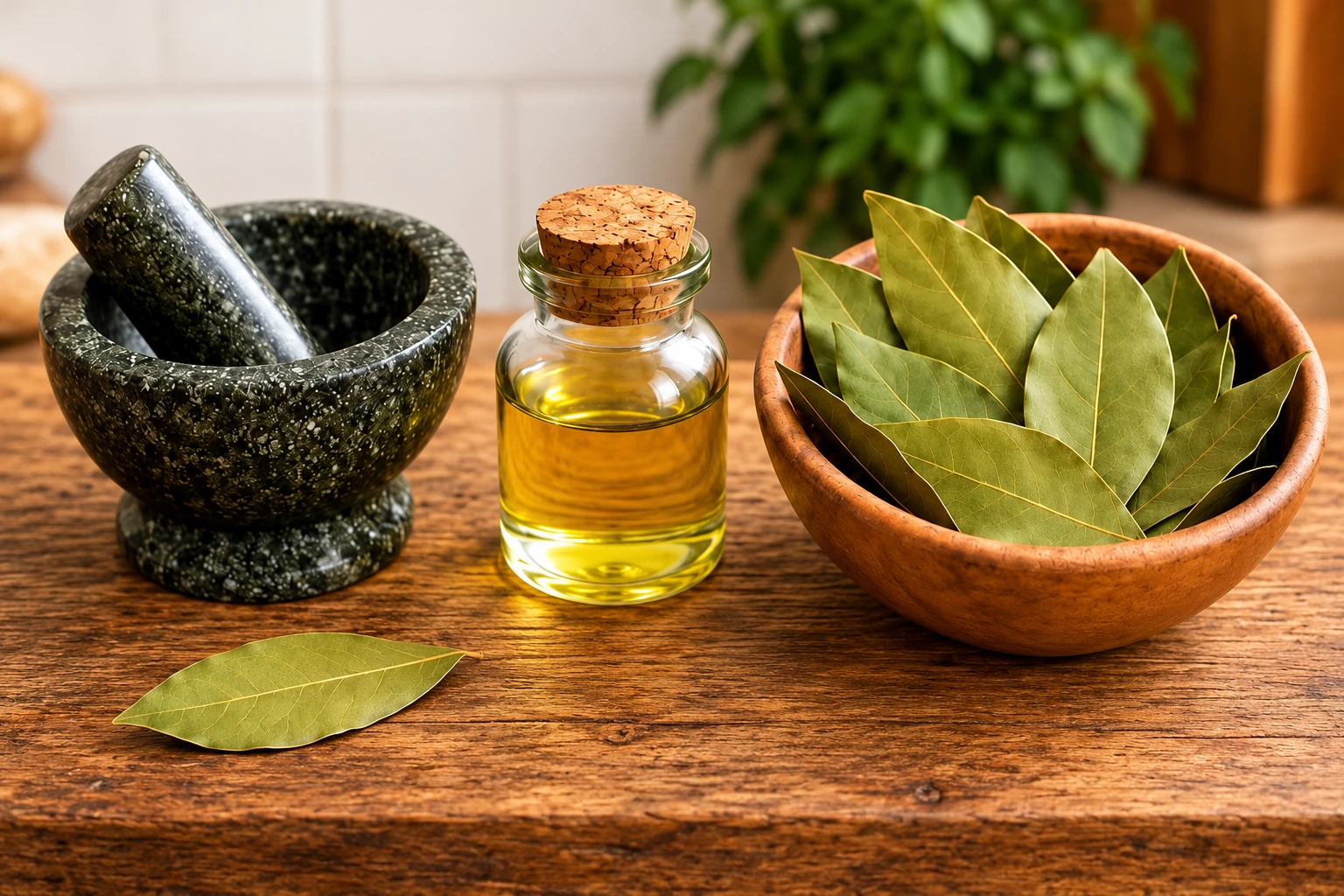
The image claims that bay leaves are “100,000 times more powerful than Botox” and can reduce wrinkles even at age 70. That claim is not supported by clinical evidence. Botox is an FDA-approved botulinum toxin treatment that temporarily reduces certain facial wrinkles by relaxing targeted muscles, while bay leaves have not been shown in human clinical trials to produce a comparable effect.
Bay leaves, also known as Laurus nobilis, do contain naturally occurring plant compounds, and recent laboratory research has explored bay-laurel hydrosols for antioxidant, antimicrobial, and skin-related properties. However, those early findings do not establish bay leaves as a proven wrinkle treatment, collagen-restoring therapy, or substitute for Botox. A 2025 laboratory study specifically noted that more extensive research is needed before dermatological benefits can be established in humans.
That does not mean bay leaves have no place in a gentle self-care routine. A mild bay-leaf infusion can be used as an aromatic rinse or incorporated into a simple moisturizing skincare routine, provided your skin tolerates it. The realistic goal should be hydration, comfort, and temporary improvement in how dry skin looks and feels—not erasing wrinkles or reversing age.
Below is a safer, evidence-aware way to approach the viral bay-leaf skincare trend.
Quick Overview
| Details | Information |
|---|---|
| Main Ingredient | Dried bay leaves |
| Botanical Name | Laurus nobilis |
| Viral Claim | “100,000 times more powerful than Botox” |
| Is That Claim Proven? | No |
| Realistic Use | Aromatic infusion / gentle skincare addition |
| Main Goal | Hydration and skin comfort |
| Best For | Normal skin that tolerates botanical products |
| Avoid On | Irritated, broken, highly sensitive skin |
| Patch Test | Recommended |
| Replaces Botox? | No |
| Proven to Remove Wrinkles? | No |
| Best Long-Term Anti-Aging Habit | Daily sun protection |
What the Viral Image Gets Wrong
The biggest problem with the image is the comparison to Botox.
Botox and other approved botulinum toxin products are injectable medicines. They work by temporarily reducing the contraction of specific facial muscles, making certain expression lines less visible. The FDA has approved botulinum toxin products for temporary improvement of particular facial wrinkles.
Bay leaves do not work through that mechanism.
There is no good clinical evidence demonstrating that applying bay-leaf preparations to the face produces Botox-like muscle relaxation, and there is no scientific basis for saying bay leaves are “100,000 times” stronger than Botox.
Claims that a homemade cosmetic can “remove wrinkles” or substantially change skin structure also deserve caution. The FDA distinguishes ordinary cosmetic moisturizing claims from claims that a product changes skin structure or increases collagen, which move into drug-like territory and require stronger evidence.
What Bay Leaves Actually Contain
Bay leaves are culinary herbs from the bay laurel tree.
They contain aromatic compounds and plant chemicals that are responsible for their characteristic fragrance.
Researchers have investigated preparations made from bay laurel for properties including:
- Antioxidant activity
- Antimicrobial activity
- Aromatic compounds
- Potential skin-related applications
A recent laboratory study of bay-laurel hydrosols found antioxidant activity and examined effects on skin-cell models. However, the researchers described the skin-related effects as still insufficiently explored and emphasized the need for further research on effectiveness and safety.
That distinction matters.
A plant showing interesting activity in a laboratory is not the same as proving that putting crushed leaves or homemade bay oil on your face will remove wrinkles.
Can Bay Leaves Reduce Wrinkles?
There is currently no strong human clinical evidence showing that a homemade bay-leaf preparation can meaningfully remove facial wrinkles.
Wrinkles develop through multiple processes.
These include:
- Collagen changes
- Loss of elasticity
- Repeated facial movements
- Sun exposure
- Age-related changes
- Smoking
- Environmental stress
- Skin dryness
Research on skin aging shows that ultraviolet exposure plays a major role in visible photoaging and changes to collagen and elastic fibers. PubMed
A moisturizer can make fine lines temporarily look softer because hydrated skin looks plumper.
But that is different from permanently rebuilding collagen or removing established wrinkles.
Why Moisturized Skin Can Look Younger
One reason homemade skincare recipes sometimes seem to “work” immediately is hydration.
Dry skin can exaggerate the appearance of:
- Fine lines
- Roughness
- Flaking
- Uneven texture
Once the skin is moisturized, the surface becomes smoother and reflects light more evenly.
The FDA notes that products that make wrinkles look less noticeable simply by moisturizing are considered cosmetic products.
So if someone uses a gentle moisturizing routine and thinks their wrinkles look softer afterward, that visual improvement may be real.
But it should not be confused with permanent wrinkle removal.
Gentle Bay Leaf Facial Infusion
If you still want to experiment with bay leaves as part of a simple skincare routine, keep the preparation mild.
Ingredients
- 3 dried culinary bay leaves
- 1½ cups water
- Clean glass container
- Cotton pad or clean reusable facial cloth
Optional
- 1 teaspoon plain glycerin-based moisturizer applied afterward
- Fragrance-free moisturizer
How to Make a Mild Bay Leaf Infusion
Step 1: Rinse the Bay Leaves
Quickly rinse the dried bay leaves to remove any surface dust.
Do not use leaves that appear moldy, damp, or unusually discolored.
Step 2: Heat the Water
Bring the water to a boil.
Step 3: Add the Leaves
Remove from the heat.
Add the bay leaves.
Cover.
Let steep for approximately 10–15 minutes.
Step 4: Cool Completely
Remove the leaves.
Allow the liquid to cool completely before applying it anywhere near your skin.
Never put hot herbal infusions on the face.
Step 5: Patch Test
Apply a small amount to the inner forearm.
Wait and observe for irritation before applying it to the face.
Step 6: Use Lightly
If your skin tolerates it, lightly pat a small amount onto clean skin.
Avoid:
- Eyes
- Eyelids
- Broken skin
- Freshly shaved skin
- Areas with active irritation
Follow with a gentle fragrance-free moisturizer.
Why Moisturizer Matters More Than the Bay Leaf
If your goal is softer-looking mature skin, moisturizing is likely to make a bigger visible difference than the bay leaf infusion itself.
After using any water-based rinse, apply moisturizer while the skin is still slightly damp.
This helps reduce water loss from the skin surface.
For mature or dry skin, look for moisturizers containing ingredients such as:
- Glycerin
- Ceramides
- Hyaluronic acid
- Petrolatum
- Squalane
These are better established for hydration than DIY herbal anti-aging claims.
Do Not Rub Crushed Bay Leaves on Your Face
Using a whole leaf infusion is very different from scrubbing the face with ground bay leaves.
Crushed dried herbs can be abrasive.
Physical scrubbing may cause:
- Redness
- Irritation
- Micro-abrasion
- Worsening sensitivity
- Increased dryness
If you are trying bay leaf at all, use a mild strained infusion rather than a rough homemade scrub.
Be Careful with Bay Leaf Essential Oil
Essential oils are highly concentrated.
Do not assume that because bay leaves are safe in cooking, concentrated bay essential oil is automatically safe to apply directly to skin.
Undiluted essential oils can irritate skin.
They should never be placed directly near the eyes.
If you have sensitive skin, eczema, rosacea, or a history of fragrance reactions, skipping essential oils entirely may be the better choice.
Bay Leaf and Aloe Gel Option
If your skin already tolerates aloe products, you can make a simple soothing-style mask using a very small amount of cooled bay infusion.
Ingredients
- 1 tablespoon plain aloe vera gel
- 1 teaspoon cooled bay leaf infusion
Mix until smooth.
Apply a thin layer for about 5–10 minutes.
Rinse.
Follow with moisturizer.
The main benefit here is likely hydration and soothing from the gel rather than any proven anti-wrinkle effect from bay leaf.
Bay Leaf and Oatmeal Option
For dry skin, oatmeal is a gentler addition than harsh scrubs.
Combine:
- 1 tablespoon finely ground plain oats
- Enough cooled bay infusion to create a soft paste
Apply gently.
Do not scrub.
Leave on for approximately 5–10 minutes.
Rinse with lukewarm water.
Follow with moisturizer.
Avoid this completely if your skin is actively irritated or if you know you react to any ingredient.
What Actually Helps Prevent Premature Skin Aging?
One of the most important evidence-supported strategies is limiting ultraviolet damage.
Sun exposure is a major contributor to visible skin aging, including coarse wrinkles and loss of elasticity.
A practical daily routine should prioritize:
- Broad-spectrum sunscreen
- Moisturizer
- Gentle cleansing
- Avoiding tanning
- Avoiding smoking
- Consistent skincare rather than harsh DIY treatments
No kitchen ingredient can compensate for years of unprotected UV exposure.
What About Retinoids?
Retinoids are among the more established topical approaches used in anti-aging skincare.
They are different from herbal remedies because they have been studied more extensively for effects on photoaged skin.
Some retinoids are prescription products, while weaker retinol forms are sold over the counter.
They can cause dryness and irritation, so they should be introduced carefully.
Anyone with significant skin concerns may benefit from discussing appropriate options with a dermatologist.
What About Alpha Hydroxy Acids?
Alpha hydroxy acids, often called AHAs, are used in some skincare products to exfoliate the surface of the skin.
The FDA notes that cosmetic AHA products are marketed for smoothing fine surface lines, improving texture, and improving skin appearance.
However, acids can increase irritation and sun sensitivity in some users.
More is not always better.
DIY acid combinations should be avoided.
Bay Leaves vs. Botox
| Bay Leaf Preparation | Botox / Botulinum Toxin |
|---|---|
| Culinary herb | Prescription injectable medicine |
| Not proven to relax facial muscles | Temporarily reduces muscle contraction |
| No established Botox-equivalent dose | Standardized medical dosing |
| No evidence it is “100,000× stronger” | FDA-approved for certain facial lines |
| DIY preparations vary widely | Administered by trained professionals |
| Possible cosmetic hydration ritual | Demonstrated temporary wrinkle reduction |
Botulinum toxin typically begins showing results within several days, and effects commonly last a few months. Académie Américaine de Dermatologie
Bay leaves should not be marketed as an equivalent.
Can Bay Leaves Increase Collagen?
There is not enough evidence to say that applying homemade bay-leaf tea to the skin increases human collagen production in a clinically meaningful way.
Plant antioxidants are an active area of skincare research, and phytochemicals are being studied for potential roles in skin aging. But researchers also emphasize major challenges such as delivery into skin, stability, effectiveness, and formulation.
That means eating or applying an antioxidant-rich plant does not automatically translate into visible anti-aging results.
Why “Natural” Does Not Automatically Mean Better
Natural ingredients can still irritate skin.
Plants contain biologically active compounds.
Some people tolerate them well.
Others develop redness, itching, or contact dermatitis.
A safe skincare routine is not determined by whether something came from a plant or a laboratory.
What matters is:
- Concentration
- Formulation
- Evidence
- Skin compatibility
- Correct use
Common Mistakes to Avoid
| Mistake | Better Approach |
|---|---|
| Believing bay leaf replaces Botox | Treat it as an optional skincare ritual |
| Applying essential oil directly | Avoid undiluted essential oils |
| Scrubbing with crushed leaves | Use a mild strained infusion |
| Applying near the eyes | Keep away from eyes and eyelids |
| Using on irritated skin | Wait until skin has recovered |
| Skipping a patch test | Test a small area first |
| Expecting permanent wrinkle removal | Expect, at most, temporary cosmetic softness |
| Skipping sunscreen | Protect skin daily from UV exposure |
| Combining many DIY ingredients | Keep routines simple |
| Continuing despite irritation | Stop immediately if reaction occurs |
A Simple Mature-Skin Routine
For someone focused on dryness, texture, and visible aging, a basic routine can be more useful than complicated viral remedies.
Morning
Cleanse gently if needed.
Apply moisturizer.
Apply broad-spectrum sunscreen.
Evening
Cleanse gently.
Use a moisturizer.
If using an evidence-based treatment such as a retinoid, introduce it according to professional or product guidance.
The bay-leaf rinse, if tolerated, should be considered optional rather than the foundation of the routine.
Can You Use Bay Leaf Every Day?
There is no proven wrinkle benefit that requires daily use.
For DIY botanical preparations, frequent use can also increase the opportunity for irritation.
If you choose to experiment, start infrequently.
For example, try it once or twice per week.
Stop immediately if you notice:
- Burning
- Persistent redness
- Itching
- Swelling
- Rash
- Increased sensitivity
How Long Can Homemade Bay Leaf Water Be Stored?
Homemade water-based plant preparations do not contain professional cosmetic preservatives.
That means microorganisms can eventually grow in them.
Prepare small amounts rather than large jars.
Refrigerate promptly.
Discard if the smell, color, or appearance changes.
For skincare, freshly prepared small batches are preferable to storing homemade herbal liquid for long periods.
Frequently Asked Questions
Are bay leaves really stronger than Botox?
No credible evidence supports that claim.
Botulinum toxin is an FDA-approved injectable drug used for certain facial wrinkles, while bay leaves have not been shown to produce the same effect.
Can bay leaves erase wrinkles?
There is no strong clinical evidence that they erase wrinkles.
Can bay leaves make skin look smoother?
Possibly indirectly if a gentle routine helps keep the skin hydrated, but that would be a cosmetic surface effect rather than wrinkle removal.
Do bay leaves contain antioxidants?
Bay-laurel preparations have demonstrated antioxidant activity in laboratory research, but that does not establish proven anti-aging effectiveness on human facial skin.
Can bay leaves rebuild collagen?
That has not been demonstrated convincingly in humans with a homemade topical preparation.
Can I put bay leaves directly on my face?
A mild strained infusion is less abrasive than rubbing leaves directly onto skin.
Can I use bay leaf essential oil?
Undiluted essential oils should not be casually applied to facial skin.
Can I use bay leaf around my eyes?
Avoid the eye area.
Can I leave bay leaf water on overnight?
There is no evidence that overnight exposure gives greater anti-aging benefit, and longer exposure can increase irritation risk.
Can I mix it with baking soda?
That is not recommended. Baking soda is alkaline and may irritate the skin barrier.
Can I mix it with lemon juice?
Putting concentrated lemon juice directly on facial skin can be irritating, so it is better not to combine DIY acids with herbal preparations.
Can I use it if I have eczema?
Sensitive or inflamed skin can react unpredictably to botanical products. Ask a healthcare professional before experimenting.
Can I use it for dark spots?
Bay leaves are not a proven treatment for hyperpigmentation.
Can it tighten loose skin?
There is no strong evidence that homemade bay-leaf preparations tighten loose skin.
Can older adults use it?
Age alone does not make it effective or ineffective. Skin becomes more prone to dryness and sensitivity with age, so gentle skincare becomes particularly important.
Does drinking bay leaf tea remove wrinkles?
There is no evidence that drinking bay-leaf tea removes facial wrinkles.
Is Botox permanent?
No. Cosmetic botulinum toxin effects are temporary and commonly last several months.
Is Botox the only option for wrinkles?
No. Skincare, sun protection, prescription topicals, chemical treatments, lasers, fillers, and other procedures may be considered depending on the type of wrinkle and individual goals.
When should I see a dermatologist?
Consider professional advice if you have persistent irritation, rapidly changing skin lesions, troublesome pigmentation, or want treatment for established wrinkles rather than simple moisturization.
What to Expect Realistically
If you try a gentle bay-leaf skincare preparation, realistic expectations are important.
You might enjoy:
- The herbal aroma
- The ritual of skincare
- Temporary freshness
- Softer-feeling skin after moisturizing
You should not expect:
- Botox-like results
- Permanent wrinkle disappearance
- Facelift-level tightening
- Guaranteed collagen regeneration
- Dramatic age reversal
Being accurate about those limits makes the article more trustworthy and safer.
Final Thoughts
The viral claim that bay leaves are “100,000 times more powerful than Botox” is not supported by reliable evidence.
Bay laurel is an interesting culinary plant that contains aromatic and antioxidant compounds, and researchers continue exploring possible dermatological applications. But existing research does not justify presenting a homemade bay-leaf recipe as a replacement for Botox or a clinically proven wrinkle treatment.
If you enjoy natural skincare rituals, a mild bay-leaf infusion can be approached as an optional cosmetic routine rather than a cure.
Keep it gentle.
Patch test first.
Avoid the eyes.
Do not apply concentrated essential oil directly.
Stop if irritation develops.
And follow with moisturizer.
For long-term skin appearance, consistent sun protection, moisturizing, and evidence-based skincare matter much more than viral promises.
The most useful way to think about bay leaves is not as a miracle anti-aging treatment, but as an aromatic plant that can be explored cautiously while maintaining realistic expectations.