Introduction
Have you ever cracked several eggs into a pan and noticed that one yolk is pale yellow, another is golden, and another is deep orange? It is easy to assume that the darkest yolk must come from the healthiest chicken, but egg yolk color alone cannot tell you whether a hen is healthy.
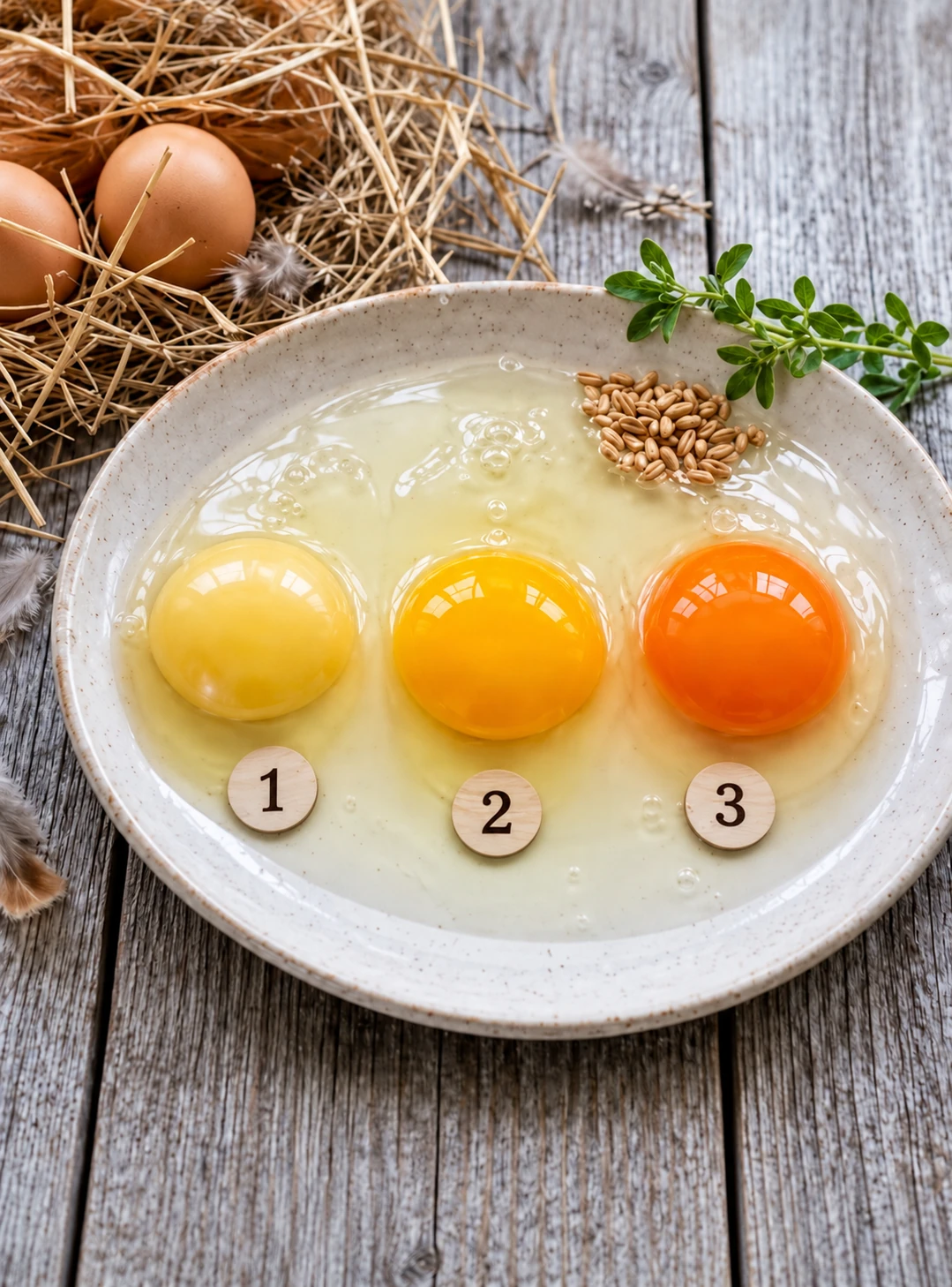
The three yolks shown in the image could all come from healthy chickens. The biggest factor controlling yolk color is the hen’s diet, especially the amount and type of naturally occurring yellow and orange pigments in her feed.
According to the USDA, yolk color can range through different shades of yellow depending on what the hen eats. Feed containing yellow-orange plant pigments, including ingredients such as yellow corn or marigold petals, can produce deeper-colored yolks, while diets lower in those pigments can produce paler yolks.
This means a bright orange yolk is not automatically proof that an egg is healthier, organic, free-range, farm-fresh, or produced by a happier chicken.
Yolk color can still tell us something interesting about diet, but it needs to be interpreted correctly.
Quick Answer
If you are looking at yolks numbered 1, 2, and 3 in the image, there is no scientifically reliable way to say that one definitely came from a healthier chicken based only on color.
| Yolk | Appearance | What It Most Likely Suggests |
|---|---|---|
| 1 | Pale yellow | Diet relatively lower in yellow-orange pigments |
| 2 | Deep yellow/golden | Diet containing moderate pigment-rich ingredients |
| 3 | Orange | Diet containing more carotenoid-rich pigments |
| Healthiest chicken? | Cannot be determined | Yolk color alone is not enough |
The correct answer is therefore not simply #1, #2, or #3.
It depends mostly on the hen’s feed.
Why Are Egg Yolks Different Colors?
Egg yolk gets much of its yellow or orange color from pigments in the hen’s diet.
These pigments include compounds known as xanthophylls, which belong to the larger carotenoid family.
When a hen eats food containing these pigments, some of them are deposited into the yolk.
Utah State University Extension explains that feed ingredients such as corn and alfalfa contain xanthophyll pigments that can contribute to yellow pigmentation, including in egg yolks.
Diets based heavily on ingredients that contain fewer of these pigments can create lighter yolks.
So two equally healthy hens eating different balanced diets may lay eggs with noticeably different yolk colors.
What Makes a Yolk Dark Orange?
A dark orange yolk usually suggests that the hen consumed a diet containing relatively high amounts of yellow-orange pigments.
These can come from feed ingredients such as:
- Yellow corn
- Alfalfa
- Marigold
- Certain leafy plants
- Grass and pasture plants
- Some pigment-rich feed ingredients
USDA food-safety guidance specifically notes that hens consuming yellow-orange plant pigments can produce darker yellow yolks.
However, this still does not mean the hen was necessarily healthier.
Feed can be deliberately formulated to increase yolk pigmentation.
Color is therefore best understood as a dietary clue rather than a health test.
Does a Pale Yolk Mean the Chicken Was Unhealthy?
No.
A pale yellow yolk does not automatically indicate a sick, poorly treated, or unhealthy hen.
The chicken may simply have eaten a diet containing fewer carotenoid pigments.
For example, older poultry-extension guidance notes that hens eating diets containing wheat or barley can produce lighter-colored yolks compared with hens eating pigment-rich feeds such as yellow corn or alfalfa.
A nutritionally adequate diet can therefore still produce a pale yolk.
That is why judging the hen’s health from yolk color alone can be misleading.
Does an Orange Yolk Mean the Egg Is Healthier?
Not necessarily.
A darker yolk may contain more of certain pigments such as carotenoids depending on the feed, but the overall nutritional quality of an egg cannot be determined from yolk color alone.
Researchers have shown that changing a hen’s diet can alter both yolk pigmentation and some aspects of nutrient composition. For example, USDA Agricultural Research Service research has reported dietary changes that altered yolk color and beta-carotene content.
But that does not mean every orange yolk is automatically much more nutritious than every pale yolk.
Many other nutritional factors depend on:
- Hen diet
- Feed formulation
- Breed
- Farming system
- Egg size
- Specific fatty-acid composition
- Added nutrients in feed
Color is only one visible characteristic.
What Do Carotenoids Do?
Carotenoids are naturally occurring pigments found in many plants.
Some are yellow.
Some are orange.
Some can appear red.
Two carotenoids commonly associated with egg yolks are lutein and zeaxanthin.
USDA Agricultural Research Service information notes that egg yolks are a dietary source of these xanthophyll carotenoids.
These compounds are also present in foods such as leafy green vegetables.
When hens consume carotenoid-rich ingredients, some of those pigments can be transferred into the yolk.
Does Free-Range Automatically Mean Orange Yolks?
No.
Free-range or pasture access can influence yolk color if hens actually eat plants, insects, seeds, or other pigment-rich foods.
But the label itself does not guarantee a specific yolk color.
A free-range hen could produce a lighter yolk if its total diet contains fewer pigments.
A conventionally housed hen could produce a very dark yolk if its feed is formulated with pigment-rich ingredients.
This is another reason why yolk color alone cannot reliably tell you how the chicken was raised.
Does Organic Mean a Darker Yolk?
No.
Organic production standards and yolk color are different issues.
An organic egg can have:
- A pale yolk
- A medium-yellow yolk
- A deep orange yolk
The final color depends largely on what pigment-containing ingredients are included in the hen’s permitted diet.
You therefore cannot identify an organic egg just by looking at the yolk.
What About Farm-Fresh Eggs?
Farm-fresh eggs are also not guaranteed to have orange yolks.
Backyard chickens often eat a more varied diet that may include:
- Grass
- Weeds
- Seeds
- Vegetables
- Insects
- Commercial feed
If these foods contain lots of carotenoid pigments, the yolks may become deep yellow or orange.
But another backyard flock eating a different diet may produce lighter yolks.
Both flocks could still be perfectly healthy.
Can Feed Be Used to Change Yolk Color?
Yes.
Farmers and feed manufacturers know that consumers often prefer certain yolk colors.
Feed composition can therefore be adjusted to influence pigmentation.
Ingredients naturally rich in xanthophylls can deepen yolk color.
USDA guidance notes that yellow-orange plant pigments in feed can make yolks darker.
This is important because it shows why color should not be treated as proof of farming quality by itself.
A dark yolk can simply reflect a particular feed formulation.
What Does Yolk Color Actually Tell You?
Yolk color is best treated as information about dietary pigments.
It can tell you that the hen probably consumed more or less of certain pigment-containing foods.
It cannot reliably tell you:
- Whether the hen was free-range
- Whether the hen was organic
- Whether the hen was happier
- Whether the hen was disease-free
- Whether the egg is fresher
- Whether the egg is automatically safer
- Whether the egg has more protein
- Whether the farm had better welfare standards
Those questions require other information.
Does Yolk Color Tell You How Fresh an Egg Is?
No.
Freshness is better evaluated through other characteristics.
USDA notes that fresh eggs tend to have cloudier whites, while the whites become clearer as eggs age.
Egg-quality specialists also evaluate characteristics such as albumen height and yolk structure.
Utah State University Extension notes that egg whites become thinner and yolk structure changes as eggs age.
Therefore, yolk shade itself is not a good freshness test.
Better Signs of Egg Freshness
When you crack a fresh egg onto a flat surface, you will often notice:
- A yolk that stands relatively high
- A thicker egg white close to the yolk
- Less spreading across the plate
- A firm yolk membrane
As an egg ages, the white gradually becomes thinner and spreads more easily.
The yolk may also become flatter.
These characteristics are more useful for judging freshness than whether the yolk is yellow or orange.
Can Yolk Color Tell You Whether an Egg Is Safe?
No.
A deep orange yolk does not guarantee that an egg is free from harmful bacteria.
A pale yolk does not automatically make an egg unsafe.
Food safety depends much more on:
- Proper handling
- Clean production
- Refrigeration
- Storage conditions
- Cooking
- Avoiding cross-contamination
USDA specifically explains that normal variation in yolk color is largely related to diet rather than food safety.
What Egg Colors Can Be Normal?
Healthy eggs can show a surprisingly wide range of natural variation.
Normal yolks may be:
- Pale yellow
- Lemon yellow
- Golden yellow
- Deep yellow
- Yellow-orange
- Deep orange
The precise color reflects the types and quantities of pigments consumed by the hen.
As long as the egg has been properly handled and shows no signs of spoilage, normal yolk-color variation is usually not a concern.
What About the Color of the Eggshell?
Eggshell color is also commonly misunderstood.
White eggs are not inherently less nutritious than brown eggs.
USDA states that breed determines shell color and that there are no significant nutritional differences simply because an egg has a white or brown shell.
Depending on breed, chicken eggs may be:
- White
- Brown
- Cream
- Blue
- Greenish
Shell color is mainly genetic.
Brown Eggs vs. White Eggs
Many shoppers assume brown eggs are more natural or nutritious because they are sometimes sold at higher prices.
But the color itself does not make them healthier.
Different breeds simply produce different shell pigments.
A white egg and a brown egg can have essentially similar nutritional profiles when hens are fed comparable diets.
The higher price sometimes associated with brown eggs can reflect production factors rather than superior nutrition.
Does a Healthy Hen Always Lay Perfect Eggs?
Not necessarily.
Healthy hens can occasionally lay unusual eggs.
Examples include:
- Double yolks
- Small eggs
- Large eggs
- Wrinkled shells
- Thin shells
- Misshapen eggs
Age, stress, genetics, nutrition, and stage of production can all influence egg characteristics.
A single unusual egg does not automatically indicate serious disease.
What Really Matters for Hen Health?
If you genuinely want to know whether a hen is healthy, experts look at much more than yolk color.
Important factors can include:
- Body condition
- Feather condition
- Activity level
- Appetite
- Water consumption
- Egg-production consistency
- Shell quality
- Signs of parasites
- Respiratory health
- Droppings
- Mobility
- Overall flock behavior
Utah State University Extension notes that poultry health and production can be evaluated through characteristics such as body condition, feather condition, and pigmentation patterns rather than simply looking at yolk color.
Why Diet Matters So Much
Eggs are biological products created from nutrients the hen consumes.
Changing the diet can therefore change aspects of the egg.
Feed can influence:
- Yolk color
- Fatty-acid composition
- Some vitamins
- Carotenoid content
- Flavor
- Egg production
- Shell quality
This is why two eggs that look different may simply reflect two different feeding programs.
Can Pasture Affect Yolk Color?
Yes.
Pasture plants can contain carotenoids.
When hens consume more green vegetation and other pigment-rich material, their yolks may become deeper yellow or orange.
However, pasture conditions change throughout the year.
The amount and type of plants available can vary with:
- Season
- Climate
- Rainfall
- Soil
- Location
So even eggs from the same flock may change color over time.
Why Can Yolk Color Change From Week to Week?
If a chicken’s diet changes, yolk color can also change.
For example, a farmer might change:
- Feed brands
- Grain mixture
- Pasture access
- Vegetable scraps
- Seasonal forage
After dietary changes, yolk pigmentation can gradually shift.
This does not necessarily mean the bird suddenly became healthier or less healthy.
It may simply mean the source of dietary pigments changed.
Is Darker Always Better?
No.
Darker is not automatically better.
A dark yolk may indicate more pigment-rich feed, but the complete nutritional profile matters more than a single visible feature.
When choosing eggs, it makes more sense to consider several things together:
- Freshness
- Storage
- Food-safety practices
- Production method if important to you
- Nutrition label
- Farm reputation
- Personal taste
- Price
Yolk color can be interesting, but it should not dominate the decision.
Which Yolk Usually Has the Most Carotenoid Pigments?
In general, a deeper yellow or orange color may reflect greater deposition of carotenoid pigments.
Research has demonstrated that changing hen diets can alter both yolk pigmentation and carotenoid content.
So, looking only at the image, yolk #3 likely reflects a diet richer in orange-yellow pigments than yolk #1.
But that is very different from saying chicken #3 was the healthiest chicken.
Comparing the Three Yolks in the Image
Egg Number 1 – Pale Yellow
This yolk likely came from a hen whose diet contained fewer deeply pigmented carotenoid sources.
That does not mean the chicken was unhealthy.
The egg may still provide normal protein, fat, vitamins, and minerals.
Egg Number 2 – Golden Yellow
This shade suggests a moderate amount of pigment-rich ingredients in the hen’s diet.
Golden yellow is an extremely common yolk color.
Again, health cannot be determined from this color alone.
Egg Number 3 – Deep Orange
This yolk probably reflects a diet richer in carotenoid or xanthophyll pigments.
The bird may have consumed foods such as pigment-rich feed ingredients or pasture plants.
The deeper color may correlate with greater amounts of some carotenoids in certain feeding situations, but it is not automatic proof of superior overall nutrition or hen health.
The Most Accurate Answer to the Image
If someone asks:
“Which one comes from a healthy chicken: 1, 2, or 3?”
The best answer is:
Any of them could.
Yolk color primarily reflects the pigments in the hen’s diet, not a simple healthy-versus-unhealthy distinction.
Egg #3 may indicate a diet richer in carotenoid pigments, but you cannot conclude from the photo alone that the hen was healthier than the hens that produced eggs #1 and #2.
Common Myths About Egg Yolks
Myth 1: Orange Yolks Always Mean Free-Range
Not necessarily.
Feed can also produce orange yolks.
Myth 2: Pale Yolks Mean Sick Chickens
False.
A low-pigment diet can produce pale yolks in healthy hens.
Myth 3: Dark Yolks Always Have More Protein
False.
Protein content cannot be judged by yolk color.
Myth 4: Brown Eggs Have Orange Yolks
Not necessarily.
Shell color and yolk color are controlled by different factors.
Myth 5: Orange Yolks Mean the Egg Is Fresher
False.
Freshness is better evaluated by white thickness and other quality characteristics.
Myth vs. Reality Table
| Myth | Reality |
|---|---|
| Dark orange yolk means healthier chicken | Not necessarily |
| Pale yolk means unhealthy chicken | No |
| Yolk color shows freshness | No |
| Orange yolks always come from pasture-raised hens | No |
| Brown eggs are more nutritious | Not because of shell color |
| Hen diet affects yolk color | Yes |
| Carotenoids affect yolk pigmentation | Yes |
| All normal yolk shades can occur in healthy birds | Yes |
How to Choose Good Eggs
Instead of choosing eggs solely by yolk color, pay attention to more practical quality factors.
Buy eggs from a reliable source.
Check the carton for cracks.
Keep eggs properly refrigerated.
Pay attention to freshness dates where applicable.
Avoid eggs with damaged shells.
Once cracked, look for obvious signs of spoilage.
Cook and handle eggs safely.
These factors matter much more for your health than choosing the darkest yolk available.
How to Store Eggs Properly
Egg storage practices vary internationally, but if you buy eggs that are sold refrigerated, keep them refrigerated consistently.
USDA emphasizes prompt refrigeration for maintaining microbial and physical egg quality in the U.S. system.
Keep eggs in their original carton rather than loose in the refrigerator door when possible.
The carton protects the eggs and reduces moisture loss and odor absorption.
Frequently Asked Questions
Which egg in the image comes from the healthiest chicken?
You cannot determine that from yolk color alone.
Eggs #1, #2, and #3 could all come from healthy chickens.
Is egg number 3 healthier?
It may reflect a diet containing more carotenoid pigments, but the color alone does not establish that the egg or hen is healthier overall.
Why are some yolks orange?
The hen consumed more yellow-orange pigments, often carotenoids or xanthophylls, in its diet.
Why are some yolks pale?
The hen may have consumed feed lower in those pigments.
That can happen even with a balanced diet.
Does orange yolk mean free-range?
No.
Free-range hens can produce orange yolks, but feed formulation can also produce the same color.
Does pale yolk mean factory-farmed?
No.
You cannot reliably determine the farming system from yolk color alone.
Are orange yolks more nutritious?
They may contain higher amounts of some carotenoids depending on the hen’s diet, but overall nutritional quality cannot be judged from color alone.
Are brown eggs healthier than white eggs?
Not simply because they are brown.
USDA says shell color is determined by breed and does not create significant nutritional differences by itself.
What determines egg yolk color?
Primarily the pigments in the hen’s diet.
Can farmers make yolks darker?
Feed composition can be adjusted using pigment-rich ingredients that deepen yolk color.
Are artificial colors put directly into eggs?
USDA notes that artificial color additives are not permitted in eggs; yolk pigmentation reflects pigments delivered through the hen’s diet.
Does yolk color show freshness?
No.
The condition and thickness of the egg white and other structural characteristics are better indicators.
Can egg yolk color change during the year?
Yes.
Seasonal changes in feed and pasture can change the amount of pigments the hen consumes.
Which color yolk tastes best?
Taste is subjective.
Feed, freshness, cooking method, and personal preference can all influence how people perceive flavor.
Final Thoughts
The image makes it tempting to choose the deepest orange yolk and assume that it came from the healthiest chicken, but biology is more complicated than that.
A pale yellow yolk, a golden yolk, and an orange yolk can all come from healthy laying hens.
The main reason they look different is diet.
Hens consuming more carotenoid-rich yellow and orange pigments generally produce more deeply colored yolks, while diets containing fewer of those pigments can produce lighter yolks. USDA and poultry-extension sources both describe this relationship between feed pigments and yolk color.
So if you are comparing the three eggs in the photo, #3 likely reflects a diet richer in coloring pigments—but it is not scientifically correct to declare #3 the “healthy chicken” based on color alone.
When choosing eggs, freshness, safe handling, proper storage, overall nutrition, and the farming practices that matter to you are more useful than simply looking for the darkest orange yolk.