
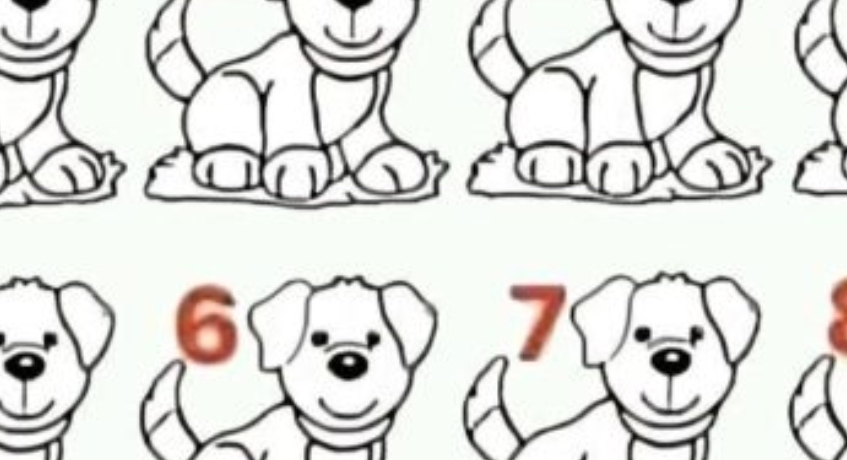
Brain teasers, visual puzzles, and spot-the-difference challenges have become incredibly popular across social media. They entertain us, test our observation skills, and challenge our brains in ways that can be surprisingly difficult. One puzzle that has been catching people’s attention lately is the “Which Dog Is Different?” challenge.
At first glance, all eight adorable cartoon dogs appear exactly the same. They have the same posture, facial expression, tail, paws, ears, and collar. However, one dog contains a subtle difference that many people miss on their first attempt.
The question is simple:
Can you find the dog that is different from the others?
Why This Puzzle Is So Tricky
The human brain is designed to recognize patterns quickly. When several images look nearly identical, the brain often assumes they are the same and stops examining every detail carefully.
This phenomenon is known as pattern recognition bias. Instead of analyzing each dog individually, most people scan the images rapidly and overlook tiny differences.
That’s why visual puzzles like this are excellent exercises for improving concentration, attention to detail, and cognitive flexibility.
Take a Closer Look
Before scrolling further, spend a few moments studying each dog carefully.
Compare:
- The ears
- The eyes
- The nose
- The paws
- The tail
- The collar
- The body outline
Many people focus on the face first, but the difference may not be where you expect it.
The Answer
If you examine the dogs carefully, you’ll notice that Dog Number 6 is different.
The key difference is found in the dog’s facial features. While the other dogs have a distinct mouth and nose arrangement, Dog Number 6 has a noticeably different nose and mouth configuration, making it unique among the eight images.
Did you spot it right away, or did it take a few minutes?
Why Some People Find It Faster
Research suggests that people who regularly engage in puzzles, memory games, and visual challenges often perform better at spotting subtle differences.
Several factors can influence success:
Attention to Detail
People who naturally focus on small visual details tend to identify the odd image more quickly.
Patience
Rushing usually leads to mistakes. Taking time to compare each image carefully increases accuracy.
Pattern Recognition
Strong pattern-recognition skills help people identify when something breaks the expected visual sequence.
Experience with Brain Teasers
Those who frequently solve spot-the-difference puzzles develop strategies that make these challenges easier.
Benefits of Solving Visual Puzzles
These seemingly simple games offer several mental benefits.
Improves Concentration
Carefully examining visual details strengthens focus and attention.
Exercises Memory
Your brain constantly compares each image to the others, engaging short-term memory.
Enhances Observation Skills
Spotting subtle differences trains you to notice details that might otherwise go unnoticed.
Reduces Stress
Many people find puzzles relaxing because they provide a break from everyday worries and encourage mindful thinking.
Keeps the Brain Active
Mental exercises can help maintain cognitive sharpness and support lifelong learning.
Tips for Solving Spot-the-Difference Challenges
If you struggled with this puzzle, try these techniques next time:
- Compare images one pair at a time.
- Focus on one body part across all images.
- Check the outline of each figure.
- Look for missing or extra lines.
- Examine the face last rather than first.
- Move slowly and systematically.
These methods can dramatically improve your success rate.
Why Visual Illusions Fascinate Us
Visual puzzles reveal how the brain processes information. Even when differences are right in front of us, our minds can overlook them because we expect patterns to remain consistent.
This makes challenges like the Which Dog Is Different Puzzle both entertaining and educational. They remind us that seeing isn’t always the same as observing.
Final Thoughts
The Most People Fail: Can You Spot Which Dog Is Different? puzzle proves that tiny details can make a big difference. While all eight dogs appear identical at first glance, a careful observer will notice that Dog Number 6 contains the subtle variation.
Whether you found the answer immediately or needed a second look, puzzles like this are a fun way to challenge your brain, sharpen your observation skills, and enjoy a quick mental workout.
So, how long did it take you to find the different dog? Share this puzzle with friends and family and see who can spot the answer the fastest!