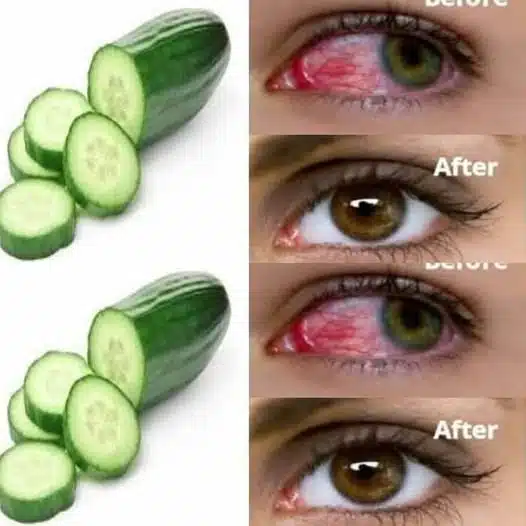
Using cucumber for red eyes is one of the most popular home remedies shared on social media. The idea is simple: place cool cucumber slices over irritated eyes and wait for the redness to disappear.
The cooling sensation may feel refreshing, especially when the eyelids are tired, puffy, or mildly irritated. However, the dramatic “before and after” result shown in viral images can be misleading. A cucumber slice does not cure conjunctivitis, bacterial eye infections, corneal problems, allergies, or every other cause of a red eye.
Current CDC guidance for conjunctivitis recommends measures such as cold compresses and artificial tears for symptom relief. Mayo Clinic similarly recommends a clean cool or warm compress and artificial tears depending on the situation. Neither recommends cucumber as a treatment for the underlying cause of pink eye.
That distinction matters. A chilled cucumber slice used on closed eyelids can essentially function as a temporary cooling compress, but it should never replace appropriate eye care when redness is painful, severe, persistent, associated with discharge, or accompanied by changes in vision.
This detailed guide explains what cucumber may realistically do, what it cannot do, how to use a cool cucumber compress more safely, other evidence-based comfort measures, and the symptoms that should prompt professional eye care.
Quick Answer: Can Cucumber Cure Red Eyes?
| Question | Evidence-Based Answer |
|---|---|
| Can cucumber cure pink eye? | No proven evidence |
| Can cucumber treat a bacterial eye infection? | No |
| Can cucumber cure allergic conjunctivitis? | No |
| Can cool cucumber feel soothing? | Possibly, mainly because it is cool |
| Can it temporarily soothe tired closed eyelids? | It may |
| Should cucumber juice be put in the eye? | No |
| Are cool compresses commonly recommended? | Yes |
| Can artificial tears help some irritation? | Yes |
| Should contact lenses be worn with red eyes? | Usually no until the problem resolves |
| Can some red-eye symptoms require medical care? | Yes |
The safest way to think about cucumber is as an optional cooling compress for closed eyelids, not as medicine.
What Does “Red Eye” Actually Mean?
“Red eye” describes an appearance rather than one specific disease.
The white part of the eye may look pink or red because blood vessels have become more visible. Redness can happen for many reasons, so two people whose eyes look similar in photographs may actually have completely different conditions.
Conjunctivitis, commonly called pink eye, is one possible cause. The CDC says common causes include viruses, bacteria, and allergens, while other causes can include irritants, foreign bodies, and contact-lens-related problems.
This is why it is risky to diagnose an eye problem from a social-media image alone.
A cucumber slice cannot tell whether redness is caused by dryness, allergy, infection, irritation, an injury, or something more serious.
Common Symptoms That Can Occur with Pink Eye
According to the CDC, conjunctivitis can involve more than simple redness. Symptoms may include watery eyes, swelling, itching, irritation, burning, crusting, mucus or pus-like discharge, and the sensation that something is in the eye.
Different causes may produce different patterns.
Viral conjunctivitis often causes watery discharge and may begin in one eye before spreading to the other.
Bacterial conjunctivitis is more likely to produce thicker discharge that can make the eyelids stick together.
Allergic conjunctivitis commonly affects both eyes and may cause significant itching along with other allergy symptoms.
Because these causes differ, treatment also differs.
Does Cucumber Actually Treat Eye Redness?
There is no established clinical evidence that ordinary cucumber slices treat the underlying causes of conjunctivitis or other significant red-eye conditions.
What cucumber can provide is coolness.
Medical guidance for uncomplicated pink-eye symptoms commonly includes cool compresses. Mayo Clinic recommends placing a clean, lint-free cloth soaked in water over closed eyelids and notes that a cool compress often feels soothing.
A refrigerated cucumber slice may create a similar cooling sensation against the eyelid.
That does not mean special chemicals inside cucumber are curing the eye.
It means the cool temperature may temporarily feel comforting.
This distinction is important for a trustworthy health article.
What a Cool Cucumber Compress May Help With
A clean chilled cucumber slice placed over a closed eyelid may provide temporary comfort when the eyelids feel warm, tired, or mildly puffy.
It may also simply encourage you to close your eyes and rest for several minutes.
The moisture and cool surface can feel refreshing.
However, any improvement in appearance immediately afterward should not be interpreted as proof that an infection, allergy, or inflammatory eye condition has been cured.
Temporary soothing and medical treatment are not the same thing.
Safe Cool Cucumber Eye Compress
If you simply want to use cucumber as a cooling comfort measure, keep the method simple and hygienic.
What You Need
- 1 fresh cucumber
- Clean running water
- A clean knife
- A clean cutting board
- A clean towel
- Refrigerator
- Two freshly cut cucumber slices
Do not add lemon, vinegar, essential oils, herbs, honey, salt, or other ingredients.
Those substances do not belong in the eye.
How to Prepare the Cucumber
Wash the outside of the cucumber thoroughly.
Dry it with a clean towel.
Chill it in the refrigerator until cool.
Use a clean knife and cutting board to cut two fresh slices.
Do not use cucumber that is moldy, damaged, or has been sitting uncovered for a long period.
How to Use It
- Wash your hands thoroughly with soap and water.
- Remove contact lenses before using any eye compress.
- Lie back or sit comfortably.
- Close both eyes.
- Place one cool cucumber slice over each closed eyelid.
- Leave the slices in place for approximately 5–10 minutes.
- Remove them and discard them.
- Wash your hands again afterward.
Do not press the slices forcefully onto the eyes.
Do not push cucumber juice under the eyelid.
Do not reuse the slices later.
Why Closed Eyelids Matter
The surface of the eye is sensitive.
Putting foods, homemade liquids, juices, or unsterile preparations directly into the eye creates unnecessary irritation and contamination risks.
The purpose of the cucumber is simply to provide a cool surface over the closed eyelid.
If you want a simpler option, a clean cool washcloth is actually closer to standard medical guidance.
Mayo Clinic recommends soaking a clean lint-free cloth in water, wringing it out, and gently applying it to closed eyelids.
A Clean Cool Compress May Be the Better Option
A cucumber looks attractive in photographs, but a clean washcloth is easier to control.
Use cool clean water and a freshly washed cloth.
Wring out excess water and rest the cloth gently over closed eyes.
If only one eye appears affected, Mayo Clinic advises against using the same cloth on both eyes because doing so could potentially spread infection from one eye to the other.
Use a separate clean cloth for each eye when infection is a possibility.
Wash the cloth afterward
Artificial Tears for Mild Irritation
Artificial tears are another commonly recommended comfort measure for some causes of red or irritated eyes.
The CDC recommends cold compresses and artificial tears to help relieve some inflammation and dryness associated with pink eye.
Mayo Clinic also lists nonprescription artificial tears among measures that can relieve symptoms.
However, not every eye drop is appropriate for every person or condition.
If symptoms are persistent, severe, recurrent, or unusual, professional advice is safer than repeatedly experimenting with different over-the-counter drops.
Cucumber vs. Cool Compress vs. Artificial Tears
| Option | What It May Do | What It Does Not Do |
|---|---|---|
| Chilled cucumber | Provides temporary cooling over closed eyelids | Does not cure infection |
| Clean cool compress | May soothe irritation and inflammation | Does not identify the cause |
| Artificial tears | May relieve dryness or irritation | Do not treat every red-eye condition |
| Antibiotic drops | Useful only when medically appropriate | Do not treat viral conjunctivitis |
| Allergy treatment | May help allergic symptoms | Does not treat bacterial infection |
| Professional exam | Helps identify the cause | Not a home remedy |
The correct choice depends on why the eye is red.
Never Put Cucumber Juice Directly Into Your Eyes
Slices placed on closed eyelids are very different from dripping cucumber juice into the eye.
Homemade cucumber juice is not a sterile ophthalmic preparation.
Do not blend cucumber and use the liquid as eye drops.
Do not mix it with rosewater.
Do not combine it with lemon juice.
Do not add honey.
Do not add herbal extracts or essential oils.
Products placed directly into the eye should be specifically designed and manufactured for ophthalmic use.
A viral post should never be treated as a substitute for sterile eye-care products.
What About Cucumber for Puffy Eyes?
People also use cucumber slices for cosmetic puffiness around the eyes.
A chilled object can temporarily make the area feel cooler and more comfortable.
However, cosmetic puffiness around the eyelids is different from redness of the eyeball itself.
If the eyelid is swollen because of an infection, allergic reaction, injury, or another medical problem, cucumber does not address the underlying cause.
Persistent or significant swelling deserves appropriate evaluation.
Contact Lenses and Red Eyes
Contact-lens wearers should be particularly careful about unexplained eye redness.
The CDC advises stopping contact lenses until an eye-care professional says they can be worn again. If you have not seen a doctor, CDC guidance says not to wear contacts until pink-eye symptoms are gone.
Contact lenses can also be associated with corneal complications and infections.
A red, painful eye in someone who wears contact lenses should therefore not simply be covered with cucumber slices and ignored.
Remove the lenses and seek professional advice when appropriate.
What to Do With Contacts During Pink Eye
Do not keep wearing the same lenses while the eye remains irritated.
Mayo Clinic notes that people with pink eye may be advised to discard soft contacts they were already wearing and disinfect hard lenses before reusing them, depending on professional guidance.
Lens cases and related products may also need attention.
Follow your eye-care professional’s instructions rather than simply putting the same contacts back in once the eye looks less red.
Hygiene Matters If Pink Eye Is Possible
Viral and bacterial conjunctivitis can spread from person to person.
The CDC recommends frequent handwashing and avoiding touching or rubbing the eyes. It also advises against sharing items such as towels, makeup, eye drops, bedding, contact lenses, or contact-lens containers.
That means a home remedy should never involve repeatedly touching the eyes with unwashed hands.
Do not share cucumber slices between people.
Do not use the same cucumber slice on both eyes if one eye appears infected.
Discard used slices immediately.
Clean anything that may have touched eye discharge.
Simple Eye-Hygiene Checklist
| Habit | Recommendation |
|---|---|
| Wash hands before touching face | Yes |
| Rub irritated eyes | Avoid |
| Share towels | Avoid |
| Share eye makeup | Avoid |
| Reuse cucumber slices | Avoid |
| Wear contact lenses during symptoms | Avoid until appropriate |
| Use separate clean compresses | Recommended |
| Clean eyelids gently | May help depending on cause |
| Use homemade juice as eye drops | Avoid |
When a Red Eye Needs Medical Attention
Red eyes should not always be managed at home.
The CDC recommends seeing a healthcare provider when pink eye occurs with eye pain, light sensitivity, blurred vision that does not improve after wiping away discharge, intense redness, worsening symptoms, or symptoms that fail to improve.
These symptoms can indicate that something more significant than simple irritation is happening.
A healthcare professional can examine the eye and determine whether the problem involves the conjunctiva, cornea, eyelid, or another structure.
A cucumber cannot make that distinction.
Red-Flag Symptoms
Seek prompt professional care for symptoms such as:
- Significant eye pain
- New or persistent blurred vision
- Sensitivity to light
- Very intense redness
- Worsening symptoms
- Significant injury
- Chemical exposure
- Trouble keeping the eye open
- Contact-lens-associated pain or marked redness
- Symptoms that are not improving
CDC guidance also says newborns with signs of pink eye should be seen by a doctor right away.
Viral vs. Bacterial vs. Allergic Pink Eye
Understanding the broad differences can explain why a single home remedy cannot treat every red eye.
Viral Conjunctivitis
Viral pink eye commonly produces watery discharge and may occur around the time of a respiratory infection.
The CDC notes that many viral cases are mild and may clear without specific treatment, though some can take two to three weeks or longer. CDC
Antibiotics do not treat viruses.
Bacterial Conjunctivitis
Bacterial pink eye can produce thicker pus-like discharge and eyelids that stick together.
Some mild cases improve without antibiotics, while others may require treatment depending on severity and circumstances.
Contact-lens wearers deserve particular caution because certain infections involving the cornea can be more serious.
Allergic Conjunctivitis
Allergic conjunctivitis often affects both eyes.
Itching can be especially noticeable.
Other allergy symptoms such as sneezing or an itchy nose may occur as well. CDC
Reducing exposure to the allergy trigger and appropriate allergy treatments may be more useful than cucumber.
Red Eyes Caused by Dryness
Dry eyes can also feel irritated, gritty, burning, tired, or red.
Artificial tears are commonly used for dryness, although persistent symptoms may require evaluation.
Environmental factors can contribute as well.
Long hours in front of screens, dry indoor air, wind, air conditioning, and reduced blinking may make some people’s eyes feel more uncomfortable.
A cooling compress can feel pleasant, but ongoing dryness should not automatically be assumed to be conjunctivitis.
Common Mistakes With Home Eye Remedies
Putting Food Juice Directly Into the Eye
Foods are not sterile eye drops.
Keep cucumber on closed eyelids only.
Assuming Every Red Eye Is Pink Eye
Redness has many possible causes.
Do not diagnose solely from appearance.
Continuing to Wear Contact Lenses
Contacts can make some eye problems more concerning.
Remove them during unexplained redness and follow professional guidance.
Rubbing the Eyes
Rubbing can worsen irritation and may help spread infectious conjunctivitis.
The CDC specifically recommends avoiding touching or rubbing the eyes when pink eye is possible.
Sharing Towels
Shared towels can contribute to transmission of infectious conjunctivitis.
Use your own clean towels and washcloths.
Waiting Despite Pain or Vision Changes
Pain, photophobia, blurred vision, or intense redness deserve medical attention rather than repeated home remedies.
Can You Prevent Pink Eye?
Not every case is preventable, but hygiene can reduce transmission of infectious forms.
Wash your hands frequently.
Avoid touching your eyes unnecessarily.
Do not share makeup, towels, pillowcases, eye drops, contact lenses, or lens cases.
Clean reusable items appropriately.
CDC guidance emphasizes these measures because viral and bacterial conjunctivitis can be contagious. CDC
If you suspect infectious pink eye, hygiene is considerably more important than whether you use cucumber or a washcloth for cooling.
Frequently Asked Questions
Does cucumber remove eye redness?
It may temporarily cool closed eyelids and make them feel more comfortable, but it does not reliably treat the underlying cause of red eyes.
Does cucumber cure conjunctivitis?
Cucumber is not an established treatment for conjunctivitis. CDC guidance instead discusses approaches such as cold compresses and artificial tears for symptom relief, with treatment depending on the cause.
Can cucumber cure bacterial pink eye?
No. A cucumber slice is not an antibiotic or medical treatment.
Does cucumber kill eye bacteria?
You should not rely on cucumber to disinfect or treat an eye infection.
Can cucumber help allergic eyes?
Cooling may feel soothing, but cucumber does not remove the allergy trigger or replace appropriate allergy management.
Can cucumber help dry eyes?
A cool slice may feel comfortable on closed lids, but artificial tears are a more established option for dryness-related symptoms.
Should cucumber touch the eyeball?
No. Use it only over closed eyelids.
Can I put cucumber juice in my eyes?
No. Homemade cucumber juice is not a sterile ophthalmic preparation.
Can I mix cucumber juice with rosewater?
Do not put homemade mixtures into your eyes.
Can I add lemon juice?
No. Lemon juice is acidic and should not be used as homemade eye drops.
Can I add honey?
Do not put food-based homemade preparations into the eye.
Should cucumber be cold?
If you are using it purely as a cooling compress, chilled—not frozen—slices are the most logical approach.
How long should I leave cucumber slices on my eyes?
Approximately 5–10 minutes is reasonable for simple cooling.
Can I reuse the slices?
No. Discard them after use.
Should I wash the cucumber first?
Yes. Wash the outside thoroughly before cutting.
Can I use one slice on both eyes?
It is better to use separate clean slices, particularly when infection is possible.
Is a cool washcloth better?
A clean cool compress is specifically included in medical guidance for symptomatic relief of pink eye and is simpler to keep hygienic.
Can I use a warm compress instead?
Depending on the condition and personal comfort, warm or cool compresses may be used. Mayo Clinic notes that either can be soothing for pink-eye symptoms.
Can I wear contacts after using cucumber?
If you have unexplained redness or pink-eye symptoms, do not simply put your contacts back in. CDC guidance recommends stopping contact-lens use until symptoms have resolved or an eye-care professional says it is appropriate.
When should I see a doctor?
Seek care for pain, light sensitivity, significant blurred vision, intense redness, worsening symptoms, or symptoms that are not improving.
What if a newborn has a red eye?
The CDC advises that newborns with pink-eye symptoms should be evaluated by a doctor right away.
Are antibiotics always needed for pink eye?
No. Viral conjunctivitis does not respond to antibiotics, and treatment depends on the cause.
Why is my eye red but not itchy?
Redness has many causes besides allergy. Persistent or concerning symptoms should be professionally evaluated.
What if my red eye hurts?
Pain is a warning sign. CDC guidance recommends medical evaluation when red eye or pink eye is accompanied by eye pain.
What if bright light hurts my eyes?
Light sensitivity with a red eye is another reason to seek professional care.
What if my vision becomes blurry?
Blurred vision that does not improve after clearing discharge should be evaluated.
Final Thoughts
Using cucumber for red eyes is not the miracle treatment that some social-media before-and-after images suggest.
A cool cucumber slice placed on closed eyelids may feel refreshing in the same general way that a cold compress feels refreshing. That temporary comfort is very different from curing conjunctivitis or treating an infection.
For mild pink-eye symptoms, major medical guidance discusses simple supportive measures such as clean compresses and artificial tears. The appropriate treatment ultimately depends on what is causing the redness.
Good hygiene is especially important when infection is possible. Wash your hands, avoid rubbing the eyes, do not share towels or eye products, and stop wearing contact lenses while symptoms are active.
Most importantly, do not allow a home remedy to delay care when symptoms include pain, light sensitivity, blurred vision, intense redness, or worsening symptoms.
Enjoy cucumber as food—and, if you like, as a clean cool compress over closed eyelids—but do not treat it as a substitute for proper eye care.