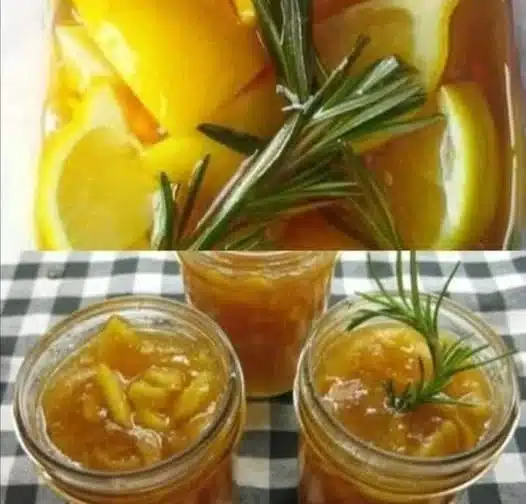
This Lemon Rosemary Marmalade Recipe transforms fresh lemons, sugar, and aromatic rosemary into a glossy homemade preserve with a beautiful balance of sweet, tart, slightly bitter, and herbal flavors. Inspired by the jars in the image, the finished marmalade has tender pieces of lemon suspended in a thick golden citrus syrup, with fresh rosemary adding an elegant fragrance.
Unlike ordinary lemon jam, marmalade traditionally includes pieces of citrus peel. Those thin strips soften during cooking and provide the characteristic flavor and texture that make homemade citrus preserves so distinctive.
Rosemary may sound unusual in a sweet recipe, but lemon and rosemary are a classic combination. The herb adds a subtle piney aroma that makes the marmalade taste more sophisticated without overpowering the fruit.
This recipe is excellent spread over warm toast, biscuits, croissants, English muffins, pancakes, scones, or pound cake. It also works beautifully with yogurt, oatmeal, baked Brie, cream cheese, roasted chicken glazes, and cheese boards.
For simplicity and safety, this version is written primarily as a refrigerator lemon rosemary marmalade. If you want shelf-stable jars, use a properly tested home-canning recipe and processing method rather than improvising canning times.
Recipe Overview
| Recipe Details | Information |
|---|---|
| Recipe Name | Lemon Rosemary Marmalade |
| Focus Keyword | Lemon Rosemary Marmalade Recipe |
| Prep Time | 20 minutes |
| Cooking Time | 40–55 minutes |
| Cooling Time | 1–2 hours |
| Total Time | About 2½ hours |
| Yield | About 3 small jars |
| Course | Breakfast, Condiment, Preserve |
| Cuisine | Homemade Preserves |
| Difficulty | Easy to Intermediate |
| Main Ingredient | Fresh lemons |
| Flavor | Sweet, tart, citrusy, herbal |
| Texture | Thick, glossy, slightly chunky |
| Best For | Toast, brunch, gifting, cheese boards |
| Refrigerator Friendly | Yes |
| Freezer Friendly | Yes |
Why You’ll Love This Lemon Rosemary Marmalade
This marmalade has much more character than a simple sweet fruit spread. Fresh lemon juice provides brightness, while softened lemon peel contributes a pleasant citrus bitterness that balances the sugar.
Rosemary adds another layer of flavor. You only need a small amount because the goal is to create a gentle herbal aroma rather than make the marmalade taste strongly savory.
The recipe also uses a short ingredient list. You do not need artificial flavoring, complicated equipment, or an extensive collection of specialty ingredients.
Another advantage is versatility. A jar can begin as breakfast spread and later become a glaze for roasted chicken, a topping for cheesecake, or an accompaniment for soft cheese.
Homemade marmalade also makes an attractive edible gift. The warm golden color and visible pieces of citrus look especially beautiful in small glass jars.
Complete Grocery List
| Ingredient | Amount | Purpose |
|---|---|---|
| Fresh lemons | 5–6 medium | Main citrus flavor |
| Granulated sugar | 3 cups | Sweetness and preservation |
| Water | 2½ cups | Softens peel and creates syrup |
| Fresh rosemary | 2 small sprigs | Herbal aroma |
| Lemon juice | Included from lemons | Acidity and flavor |
| Salt | Tiny pinch | Balances sweetness |
| Vanilla | Optional, ½ tsp | Softer flavor |
| Honey | Optional, 1–2 tbsp | Adds floral sweetness |
Ingredients
| Ingredient | Amount |
|---|---|
| Fresh unwaxed lemons | 5–6 medium |
| Granulated sugar | 3 cups |
| Water | 2½ cups |
| Fresh rosemary | 2 small sprigs |
| Fine salt | Small pinch |
| Vanilla extract | ½ teaspoon, optional |
| Honey | 1–2 tablespoons, optional |
For the strongest citrus flavor, choose lemons that feel heavy for their size and have bright, fragrant skin.
Best Lemons for Homemade Marmalade
Regular supermarket lemons work perfectly, but thinner-skinned lemons are especially convenient because the peel softens more quickly.
Meyer lemons can also be used. They are sweeter and less sharply acidic than standard lemons, producing a softer, more floral marmalade.
If using conventional waxed lemons, scrub the outside thoroughly under warm running water before slicing.
Because the peel becomes part of the recipe, the quality and flavor of the lemon skin matter much more here than they would in a recipe using only lemon juice.
Why Rosemary Works with Lemon
Rosemary has a strong aroma, so moderation matters.
One or two small sprigs are usually enough for a batch of marmalade. The rosemary should sit in the background while lemon remains the dominant flavor.
The herb works particularly well because its resinous fragrance contrasts with the bright acidity and sweetness of citrus.
If you prefer a milder marmalade, remove the rosemary halfway through cooking. For a stronger herbal aroma, leave the sprigs in until the final few minutes.
Do not chop large quantities of rosemary directly into the marmalade unless you specifically enjoy a strong herbal texture.
Kitchen Equipment
| Equipment | Purpose |
|---|---|
| Large saucepan | Cooking marmalade |
| Sharp knife | Slicing lemons |
| Cutting board | Preparing fruit |
| Wooden spoon | Stirring |
| Measuring cups | Sugar and water |
| Fine-mesh strainer | Optional seed removal |
| Small plate | Testing consistency |
| Clean glass jars | Refrigerator storage |
| Ladle | Filling jars |
Step-by-Step Instructions
- Wash the lemons thoroughly. Scrub the outside well because the peel will remain in the marmalade. Dry the fruit before slicing.
- Slice the lemons. Cut each lemon in half lengthwise, then slice into very thin half-moons. Remove all visible seeds. For a chunkier marmalade similar to the image, leave some pieces slightly larger.
- Reserve the seeds if desired. Lemon seeds and membranes naturally contain pectin. You can place them in a small piece of cheesecloth and simmer them with the lemons, then remove the bundle before adding sugar.
- Add the lemons and water to a saucepan. Place the sliced fruit in a large heavy-bottomed saucepan and add 2½ cups water.
- Add the rosemary. Place two small rosemary sprigs in the saucepan. Keeping them whole makes them easy to remove later.
- Simmer the lemons. Bring the mixture to a gentle boil, then reduce to medium-low. Simmer for approximately 20–25 minutes, or until the lemon peel becomes noticeably tender.
- Remove the rosemary if you want a mild flavor. Taste the liquid. If the rosemary aroma is already noticeable, remove the sprigs now. Leave them longer only if you prefer a stronger herbal note.
- Add the sugar. Stir in the granulated sugar and tiny pinch of salt. Continue stirring until the sugar dissolves completely.
- Boil the marmalade. Increase the heat to medium or medium-high and cook, stirring regularly, for approximately 20–30 minutes. The mixture should gradually become glossy and slightly thicker.
- Watch the bottom of the saucepan. Once sugar is added, marmalade can scorch if left unattended. Stir more frequently as the mixture thickens.
- Test the set. Place a small spoonful onto a chilled plate. Let it sit for about 30 seconds, then push it gently with your finger. If the surface wrinkles slightly and does not immediately run like water, the marmalade is close to ready.
- Add optional flavoring. Remove from the heat and stir in vanilla or a small amount of honey if desired.
- Rest briefly. Let the marmalade stand for about 5–10 minutes. This allows the fruit pieces to distribute more evenly instead of floating entirely to the top.
- Fill clean jars. Carefully spoon or ladle the hot marmalade into clean heat-safe jars.
- Cool and refrigerate. Allow the jars to cool, cover them, and refrigerate. The marmalade will continue thickening as it chills.
How to Tell When Marmalade Is Ready
Marmalade often looks thinner while hot than it will after cooling.
This leads many people to overcook it.
The chilled-plate test is one of the easiest ways to judge consistency. Put a small plate in the refrigerator or freezer before you begin cooking.
When you think the marmalade is ready, place a teaspoon on the cold plate. Wait briefly and push it.
If it wrinkles slightly and moves slowly, the marmalade is usually ready.
If it immediately spreads like syrup, cook for another few minutes and test again.
How to Prevent Bitter Marmalade
A little bitterness is normal because citrus peel naturally contains bitter compounds.
However, extremely bitter marmalade can usually be avoided.
Slice the peel thinly and cook it in water until tender before adding sugar. This softens both the texture and intensity.
Avoid including large amounts of the thick white pith if your lemons have unusually heavy skins.
Meyer lemons are another good option if you prefer a sweeter, gentler marmalade.
Sugar should balance the acidity and bitterness rather than completely eliminate them.
How to Make the Marmalade Thicker
First, remember that marmalade thickens substantially after cooling.
Do not immediately assume a hot mixture is too thin.
If the chilled-plate test still shows a very watery consistency, continue simmering in short intervals.
Lemon contains natural pectin, particularly in its peel, membranes, and seeds. That natural pectin helps the mixture set as it cooks with sugar and acid.
If the mixture is excessively reduced, however, the marmalade can become sticky or candy-like.
Stop cooking when it reaches a soft spreadable consistency rather than waiting for it to become thick inside the saucepan.
How to Fix Marmalade That Is Too Thick
If your marmalade becomes much firmer than expected after cooling, place it back into a saucepan.
Add a small amount of hot water.
Warm gently while stirring until the texture loosens.
Start with only one or two tablespoons because a little liquid can make a noticeable difference.
Allow it to cool again before deciding whether it needs more adjustment.
Pro Tips for the Best Lemon Rosemary Marmalade
Use fresh, fragrant lemons and slice them as evenly as possible. Thin peel becomes tender more quickly and produces a more pleasant finished texture.
Cook the lemon peel before adding the sugar. Once sugar is added, the fruit does not soften as efficiently.
Use rosemary sparingly because its flavor becomes stronger during cooking. Whole sprigs give you more control than large amounts of chopped rosemary.
Stir more frequently toward the end of cooking when the mixture becomes thick and concentrated.
Do not judge final consistency while the marmalade is boiling. Always use a chilled test plate and remember that cooling creates additional thickness.
Delicious Variations
Lemon Ginger Marmalade
Replace the rosemary with approximately 1 tablespoon finely grated fresh ginger.
Ginger adds warmth and slight spice while keeping the citrus flavor bright.
Lemon Vanilla Marmalade
Omit the rosemary and stir in vanilla after cooking.
This produces a softer flavor that works particularly well with croissants, pancakes, waffles, and desserts.
Lemon Thyme Marmalade
Use several sprigs of fresh thyme instead of rosemary.
Thyme is more delicate and gives the preserve an elegant herbal note.
Lemon Orange Marmalade
Replace two of the lemons with oranges.
The orange softens the acidity and gives the preserve a sweeter, more traditional citrus flavor.
Meyer Lemon Rosemary Marmalade
Use Meyer lemons for a slightly sweeter, less bitter variation.
You may find that you prefer slightly less sugar depending on the sweetness of the fruit.
Spiced Lemon Marmalade
Add a small cinnamon stick during simmering.
Remove it before filling the jars.
Ginger, cardamom, or a tiny amount of clove can also be used, but keep the spices restrained so they do not overpower the lemon.
Best Ways to Serve Lemon Rosemary Marmalade
| Serving Idea | Why It Works |
|---|---|
| Buttered toast | Classic breakfast option |
| Croissants | Rich buttery contrast |
| English muffins | Holds marmalade well |
| Scones | Excellent with tea |
| Greek yogurt | Adds citrus sweetness |
| Oatmeal | Brightens breakfast |
| Pancakes | Alternative to syrup |
| Cheesecake | Tart citrus topping |
| Pound cake | Adds moisture and flavor |
| Brie or goat cheese | Sweet-savory pairing |
| Crackers | Excellent for cheese boards |
| Roast chicken glaze | Rosemary complements poultry |
How to Use Marmalade Beyond Breakfast
Lemon rosemary marmalade is surprisingly useful in savory cooking.
Mix a spoonful with Dijon mustard and olive oil to create a glaze for roasted chicken.
Stir it into a pan sauce for pork or chicken.
Serve a small amount beside Brie, Camembert, goat cheese, or aged cheddar.
You can also mix it with softened cream cheese for a quick spread.
For desserts, warm a spoonful slightly and drizzle it over cheesecake, vanilla ice cream, pound cake, or yogurt.
This versatility makes the recipe more useful than a jar that can only be spread on toast.
How to Build a Breakfast Board
Place the marmalade in a small serving jar or bowl.
Arrange warm croissants, toast, English muffins, or scones around it.
Add butter, cream cheese, Greek yogurt, fresh berries, nuts, and sliced fruit.
Coffee and tea both work beautifully with the strong citrus flavor.
For brunch entertaining, add cheeses and crackers so guests can experiment with both sweet and savory combinations.
Make-Ahead Instructions
Lemon rosemary marmalade is naturally make-ahead friendly because it needs time to cool and thicken.
Prepare it one or two days before you plan to serve it.
The rosemary flavor may become slightly more noticeable after resting.
For gifts or brunch, prepare the jars ahead and keep them refrigerated until needed.
Because this recipe is written as a refrigerator marmalade, do not treat filled jars as shelf-stable unless you have used a tested canning process specifically designed for the recipe.
Storage
Store refrigerator marmalade in clean, tightly covered jars.
Keep it refrigerated rather than storing it at room temperature.
Use a clean spoon each time you serve it to reduce contamination.
For best quality, enjoy it within approximately 3 to 4 weeks.
Discard the marmalade if you notice mold, fermentation, unusual bubbling, an unpleasant odor, or other signs of spoilage.
Can You Freeze Lemon Marmalade?
Yes.
Freezing is an easy alternative if you want to store extra marmalade without home canning.
Transfer cooled marmalade into freezer-safe containers, leaving some empty space at the top because liquids expand during freezing.
Freeze for approximately 3 months for best quality.
Thaw overnight in the refrigerator.
Stir before serving because the texture may change slightly after freezing.
Important Note About Home Canning
If you want jars that can safely sit unopened in a pantry, use a tested marmalade canning recipe from a recognized home-preservation source and follow its specified jar size, ingredients, headspace, and processing time.
Do not simply pour this refrigerator version into jars and assume the lids make it shelf-stable.
Acidity, sugar concentration, jar size, processing method, altitude, and recipe proportions can all matter in home canning.
For most home cooks who only want a few jars, refrigeration or freezing is the simplest option.
Budget-Friendly Tips
Lemons are often cheaper when purchased in bags instead of individually.
Rosemary is needed only in a small amount. If you have a rosemary plant, one small sprig can flavor an entire batch.
Granulated sugar is inexpensive and keeps well in the pantry.
Save small glass jars from other foods when appropriate, wash them thoroughly, and use them for refrigerated marmalade rather than purchasing decorative containers.
The recipe is especially economical when lemons are in season or discounted.
Common Mistakes and How to Avoid Them
Marmalade Is Too Bitter
The peel may be too thick or insufficiently softened.
Slice lemons thinly and simmer them well before adding sugar.
Marmalade Is Too Runny
It may simply still be hot.
Cool a small sample before deciding whether additional cooking is required.
Marmalade Becomes Hard
It was likely cooked too long.
Warm it gently with a small amount of water.
Rosemary Flavor Is Too Strong
Too much rosemary was used or the sprigs remained in the pot too long.
Next time, remove the rosemary earlier.
Marmalade Scorches
The heat was too high or it was not stirred enough near the end.
Use a heavy saucepan and stir more frequently after the sugar is added.
Peel Remains Tough
The peel was not fully softened before the sugar went into the saucepan.
Allow more simmering time during the first cooking stage.
Troubleshooting Guide
| Problem | Likely Cause | Solution |
|---|---|---|
| Too runny | Under-reduced | Simmer a little longer |
| Too thick | Overcooked | Add warm water gradually |
| Very bitter | Thick peel or too much pith | Slice thinner |
| Rosemary too strong | Herb steeped too long | Remove earlier |
| Peel tough | Sugar added too early | Soften peel first |
| Scorched flavor | Excessive heat | Use lower heat |
| Fruit floats | Jarred immediately | Rest 5–10 minutes first |
| Sugar crystals | Sugar not fully dissolved | Stir thoroughly early |
Nutrition Estimate
| Nutrition | Approximate Amount |
|---|---|
| Calories | 45–60 per tablespoon |
| Protein | Less than 1 g |
| Carbohydrates | 12–15 g |
| Fat | Negligible |
| Fiber | Small amount |
| Sugar | 10–14 g |
| Sodium | Minimal |
| Serving Size | 1 tablespoon |
Nutrition varies according to the amount of sugar used and final yield.
Frequently Asked Questions
What is lemon rosemary marmalade?
It is a citrus preserve made from lemons, sugar, water, and rosemary, usually containing softened pieces of lemon peel.
Is marmalade the same as jam?
Not exactly. Jam is usually made primarily with fruit pulp, while marmalade traditionally includes citrus peel.
Can I use regular lemons?
Yes. Standard lemons work perfectly.
Can I use Meyer lemons?
Yes. They create a sweeter and more floral marmalade.
Should I peel the lemons?
No. The peel is an important part of traditional marmalade.
How thin should I slice the lemons?
Thin slices produce the most tender texture.
Do I need commercial pectin?
Not necessarily. Lemons naturally contain pectin, particularly in their peel, membranes, and seeds.
Why use rosemary?
Rosemary adds a subtle herbal fragrance that complements lemon.
Can I leave the rosemary out?
Yes. You will have a straightforward lemon marmalade.
Can I use dried rosemary?
Fresh rosemary is easier to control, but a very small amount of dried rosemary can be used.
How do I know when the marmalade is ready?
Use the chilled-plate test. A small spoonful should wrinkle slightly when pushed after cooling briefly.
Why is my marmalade runny?
It may need more cooking, or it may simply need time to cool.
Why did it become too hard?
The mixture was probably overcooked.
Can I reduce the sugar?
Changing sugar significantly can alter texture and preservation characteristics. For a refrigerator version, modest adjustments may be possible, but expect a softer set.
Can I add ginger?
Yes. Ginger and lemon are excellent together.
Can I add orange?
Yes. Orange creates a sweeter mixed-citrus marmalade.
Can I use thyme instead of rosemary?
Yes. Thyme provides a softer herbal flavor.
Can I spread it on toast?
Absolutely. Toast is one of the classic ways to serve marmalade.
Does it work with cheese?
Yes. Brie, goat cheese, cream cheese, and cheddar pair particularly well with citrus marmalade.
Can I glaze chicken with it?
Yes. Mix it with Dijon mustard and a little olive oil or broth.
How long does refrigerator marmalade last?
For best quality, use it within approximately 3 to 4 weeks while refrigerated.
Can I freeze it?
Yes. Freeze in appropriate containers for approximately 3 months for best quality.
Can I store these jars in the pantry?
Not based on this refrigerator recipe alone. Shelf-stable canning requires a tested canning recipe and proper processing.
Why are lemon seeds sometimes cooked with marmalade?
They contain natural pectin that can help the marmalade set.
Should the finished marmalade be completely smooth?
No. Traditional marmalade normally contains visible pieces of citrus peel and fruit.
What can I serve with it?
Toast, croissants, scones, yogurt, oatmeal, cheese, crackers, cakes, and roasted meats all work well.
Final Thoughts
This Lemon Rosemary Marmalade Recipe is a beautiful way to turn ordinary fresh lemons into a bright golden preserve with a more sophisticated flavor than standard jam.
The secret is treating the lemon peel properly. Slice it thinly and simmer it until tender before adding the sugar so the finished texture is pleasantly soft rather than chewy.
Rosemary should remain a supporting flavor. A couple of small sprigs are enough to give the marmalade a fresh herbal aroma without hiding the natural lemon character.
Once sugar is added, cook carefully and test the marmalade on a cold plate rather than judging its thickness directly in the saucepan. The mixture becomes considerably thicker after cooling.
Serve it with toast for an easy breakfast, pair it with cheese for entertaining, spoon it over desserts, or turn it into a sweet-savory glaze for chicken.
Stored in the refrigerator, a few homemade jars can provide weeks of breakfasts, snacks, desserts, and savory meal ideas from one simple batch.