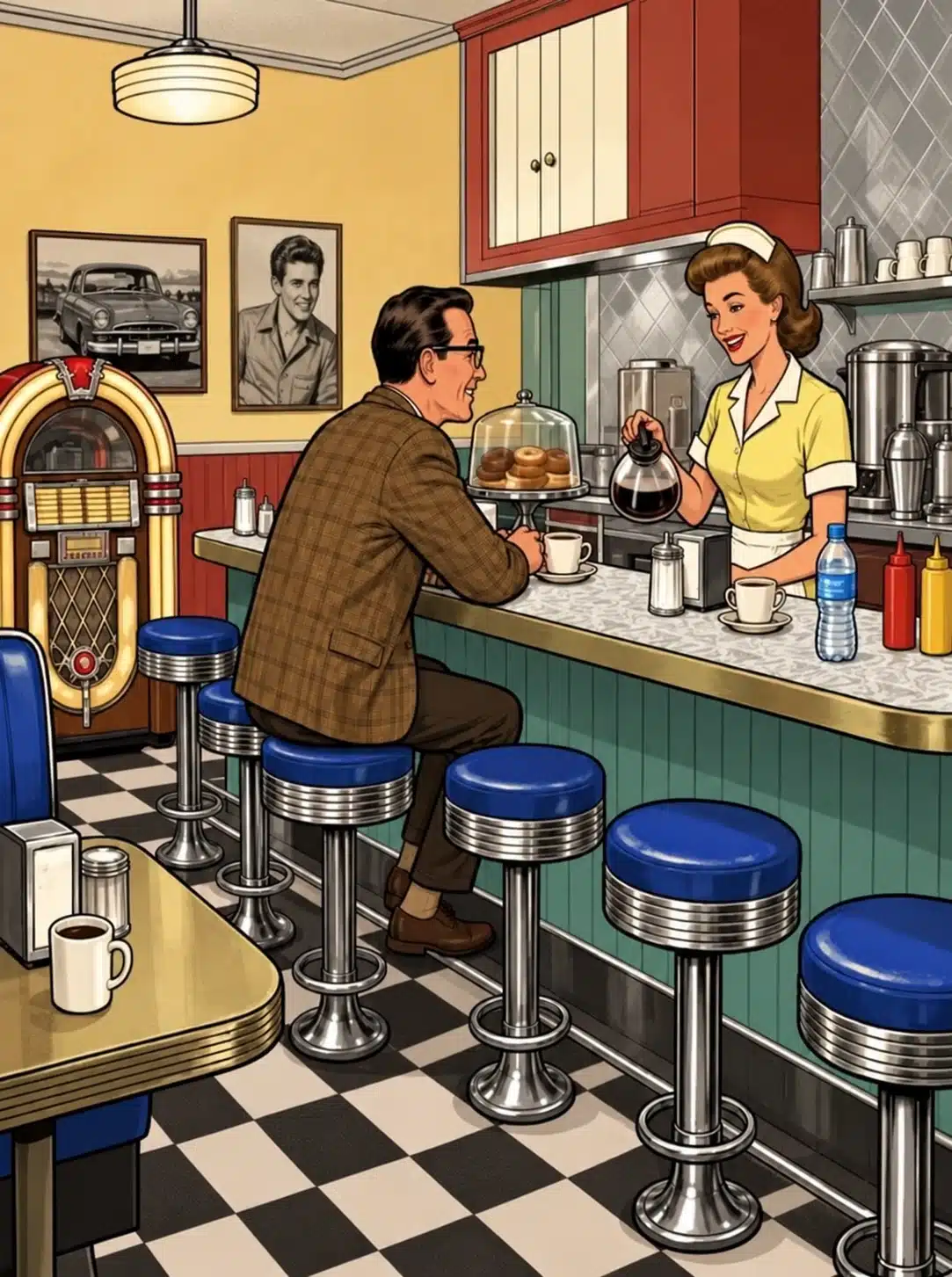
At first glance, this charming 1960s diner puzzle looks exactly the way you would expect a nostalgic American diner to look. There is a colorful jukebox in the corner, shiny chrome stools lined up along the counter, black-and-white floor tiles, a waitress serving hot coffee, vintage wall pictures, and a customer sitting comfortably at the counter.
Everything seems to fit.
But one small detail does not belong.
It is not immediately obvious because the object looks perfectly normal to modern eyes. In fact, that familiarity is exactly what makes this visual challenge interesting. Your brain accepts the object without questioning whether it actually belongs in the decade represented by the scene.
Before reading any further, study the picture carefully.
Can you identify the strange detail?
Take your time.
The answer is revealed later in the article.
Quick Puzzle Overview
| Puzzle Detail | Information |
|---|---|
| Puzzle | Something Is Wrong in This 1960s Diner |
| Category | Spot the Mistake / Observation Puzzle |
| Setting | Vintage American Diner |
| Claimed Era | 1960s |
| Difficulty | Medium |
| Main Challenge | Find the modern object |
| Best Strategy | Examine small counter items |
| Answer Location | Near the waitress |
| Puzzle Type | Historical Anachronism |
Look at the Whole Scene First
The easiest mistake when solving visual puzzles is immediately focusing on one tiny area.
Instead, begin by looking at the entire picture.
Ask yourself what makes the scene feel like the 1960s.
Several details immediately establish the retro atmosphere.
There is a large jukebox standing beside the wall.
The diner stools have shiny metal bases and padded blue seats.
The floor has a classic checkerboard pattern.
The customer is sitting at a long lunch counter.
The waitress is dressed in a vintage-inspired uniform while pouring coffee from a glass pot.
Even the colors of the room contribute to the old-fashioned diner atmosphere.
All of those details encourage your brain to accept the scene as historically consistent.
That is when the hidden mistake becomes easier to overlook.
Don’t Look for Something Huge
This is not the kind of puzzle where an obvious smartphone is sitting in the middle of the table.
There is no laptop glowing beside the coffee cup.
There is no modern television mounted on the wall.
The mistake is much more subtle.
The object blends into the scene because it is something people see regularly today.
That means you need to stop looking only at the major objects and begin examining the smaller details.
Look at the counter.
Look at the items beside the cups.
Look at what is sitting near the waitress.
One object should begin to feel suspicious.
First Clue: The Jukebox Is Probably Not the Problem
The colorful jukebox immediately attracts attention because it is one of the largest objects in the image.
That makes it an easy suspect.
But the jukebox actually fits the retro setting very well.
Jukeboxes became strongly associated with restaurants, cafés, diners, bars, and social gathering places during the middle decades of the twentieth century.
The rounded design in the picture helps establish the vintage atmosphere rather than breaking it.
So if the jukebox was your first guess, keep searching.
Second Clue: Look at the Coffee Service
The waitress is holding a glass coffee pot.
There are cups sitting on the counter.
Coffee service is one of the most recognizable traditions associated with classic diners.
Nothing about a waitress walking behind the counter pouring coffee should immediately seem out of place.
The ceramic cups also fit the overall setting.
So the mistake is probably not the coffee pot.
But you are getting closer.
Look at the objects next to the coffee area.
Third Clue: Focus on the Counter Near the Waitress
The hidden detail is sitting in one of the busiest parts of the image.
That is a clever place to hide it.
The counter contains several ordinary restaurant objects.
You can see cups.
You can see condiments.
You can see containers associated with food service.
And because everything is grouped together, the brain tends to process all of those objects as one familiar restaurant scene.
But one item represents a much more modern habit.
Take another look before continuing.
Have You Found It Yet?
If you want another chance to solve the puzzle yourself, stop here and examine the picture again.
Pay attention to the right side of the counter.
Look near the waitress.
Ask yourself this question:
Which item would feel completely ordinary in a restaurant today but much less natural in a diner presented as being from the 1960s?
That question usually makes the answer much easier to spot.
The Answer: The Modern Plastic Water Bottle
The intended mistake appears to be the modern-style disposable plastic water bottle sitting on the counter near the waitress.
Once you notice it, the object suddenly feels much more obvious.
It blends into the scene because bottled water is so common today that most of us barely notice it anymore.
We see plastic bottles in restaurants, offices, cars, gyms, schools, airports, and homes.
Our brains therefore classify the bottle as an ordinary object rather than stopping to ask whether that particular kind of packaging belongs in a vintage diner scene.
That is what makes the puzzle effective.
Why the Water Bottle Feels Out of Place
A diner presented as being from the 1960s would more naturally be associated with reusable drinking glasses, pitchers, fountain drinks, coffee cups, and similar table service.
The clear disposable bottled-water format shown in the illustration feels much more characteristic of later everyday consumer culture.
That does not mean no plastic containers of any kind existed during the period.
The issue is the specific modern-looking individual bottled-water presentation and how familiar it is in contemporary restaurants.
Placed beside a waitress, coffee pot, vintage stools, and jukebox, it creates the visual contradiction the puzzle is asking you to identify.
Why the Mistake Is Surprisingly Easy to Miss
The bottle is hidden in plain sight.
That is often more effective than hiding something behind another object.
When people first see the picture, their attention usually goes toward the largest visual elements.
The waitress.
The man at the counter.
The jukebox.
The bright diner stools.
The checkerboard floor.
The wall decorations.
Small objects are processed more quickly.
Because the water bottle itself does not look strange to a modern viewer, there may be no immediate reason for your brain to examine it.
Only after you start thinking about the time period does the problem become noticeable.
Your Brain Sees the Scene Before the Details
Observation puzzles work because the brain is very good at identifying scenes quickly.
You do not normally look at a restaurant and consciously analyze every spoon, cup, stool, bottle, and wall decoration.
Instead, your brain rapidly builds a general interpretation.
In this picture, the interpretation is something like:
Vintage diner. Customer. Waitress. Coffee. Jukebox.
Once that overall conclusion feels correct, your attention becomes less suspicious of individual details.
That is exactly where the puzzle creator has an advantage.
A modern object can be inserted into an otherwise convincing historical scene and still go unnoticed.
What Is an Anachronism?
The technical idea behind this puzzle is an anachronism.
An anachronism is an object, idea, style, person, or technology placed in a time period where it does not properly belong.
For example:
A smartphone in a medieval castle.
Wireless earbuds in a Victorian street.
A modern laptop on a desk in a 1940s office.
An electric scooter in a scene supposedly taking place in the 1920s.
The object itself is not strange.
Its relationship to the historical setting is what creates the mistake.
This diner puzzle works on the same principle.
Why Anachronism Puzzles Are More Difficult Than Ordinary Hidden-Object Games
In a traditional hidden-object puzzle, you already know what you are trying to find.
You might be told to locate a key, a cat, or a pair of glasses.
This kind of puzzle is different.
You first need to notice an object.
Then you need to decide whether it belongs in the time period.
That means the challenge combines observation with general historical reasoning.
The visual object alone is not enough.
Context matters.
That extra layer makes anachronism puzzles particularly satisfying once the answer finally becomes clear.
Other Details That Make the Scene Feel Convincing
The reason the modern bottle works so well as the hidden mistake is that the rest of the picture strongly reinforces the vintage theme.
The Chrome Counter Stools
The stools have shiny metal bases and padded seats.
Their design immediately suggests the classic diner aesthetic seen in mid-century restaurant imagery.
They help anchor the entire picture in a retro visual style.
The Checkerboard Floor
Black-and-white tiled floors have become strongly associated with vintage diners in movies, television, advertising, and nostalgic design.
Even though real diners came in many different styles, the pattern instantly tells viewers what kind of atmosphere the illustration is trying to create.
The Waitress Uniform
The waitress is shown in a classic service uniform with a neat retro appearance.
That visual choice strongly supports the historical theme.
The Coffee Cups
Simple cups on a diner counter look completely natural.
Coffee is one of the most enduring symbols of American diner culture.
The Condiments
The red and yellow condiment containers also fit the setting well enough that they do not attract immediate suspicion.
The Wall Photographs
The framed black-and-white images help reinforce the idea that the scene belongs to an earlier period.
Taken together, these elements create a convincing visual story.
That makes the one inconsistent object easier to hide.
Could the Condiment Bottles Be the Mistake?
Some viewers may wonder about the ketchup and mustard containers.
That is a reasonable guess.
Packaging and container styles certainly change over time.
However, condiment containers themselves are not unusual enough to clearly break the scene.
The disposable bottled water is the stronger intended clue because it visually resembles the kind of bottle commonly carried and sold today.
Could the Coffee Maker Be Wrong?
Commercial coffee equipment has changed dramatically over the decades.
But coffee service itself is completely appropriate for a diner scene.
The glass coffee pot shown in the image does not create the same obvious modern-versus-vintage contradiction as the water bottle.
So it is probably not what the puzzle creator intended you to notice.
Could the Customer’s Glasses Be the Mistake?
The customer’s glasses may catch your attention because fashion changes over time.
However, glasses with dark frames have existed in many forms for decades.
Unless the puzzle specifically depended on a very distinctive modern eyewear design, the glasses would be a much weaker answer.
The water bottle is clearer.
Why Familiar Objects Make the Best Puzzle Traps
A truly strange object would be easy to detect.
Imagine if there were a bright smartphone sitting beside the coffee cup.
Almost everyone would notice it instantly.
A water bottle works better because it is familiar enough to disappear into the background.
This illustrates an interesting principle of attention:
The more ordinary something feels, the less likely we are to question it.
That is why many successful visual puzzles hide errors inside routine objects.
Try the Puzzle on Someone Else
This image works well as a quick challenge for friends, family, or social-media groups.
Show the picture without revealing the answer.
Ask:
“Something is wrong in this 1960s diner. Can you find it?”
Give them 10–20 seconds.
If they struggle, offer the first clue:
“Look at the counter.”
If they still cannot find it, offer another:
“Look near the waitress.”
And the final clue:
“One object feels completely normal today.”
That usually narrows the search quickly.
How to Get Better at Spot-the-Mistake Puzzles
There is a simple strategy that works especially well with historical scenes.
Instead of scanning randomly, divide the image into categories.
Technology
Look for:
- Phones
- Screens
- Cameras
- Headphones
- Computers
- Appliances
Technology usually changes quickly, so it often provides the easiest clues.
Packaging
Look at:
- Plastic bottles
- Food wrappers
- Cans
- Labels
- Disposable containers
Packaging is one of the most common sources of historical mistakes.
Clothing
Check:
- Shoes
- Watches
- Eyewear
- Hairstyles
- Accessories
Fashion details can reveal a modern item hiding in an old scene.
Transportation
Look for:
- Cars
- Bicycles
- Road signs
- Vehicle features
Large historical mismatches often appear here.
Furniture and Interior Design
Examine:
- Chairs
- Lamps
- Flooring
- Appliances
- Decorative objects
Sometimes the hidden mistake is not technological at all but stylistic.
Why Social Media Loves These Puzzles
Images like this naturally encourage participation.
A person sees the challenge and immediately wants to test themselves.
Then they want to compare their answer with everyone else’s.
That leads to comments such as:
“I found it!”
“Is it the bottle?”
“I thought it was the coffee pot.”
“I didn’t see it until someone mentioned the counter.”
Unlike a long trivia question, the challenge is instantly understandable.
You do not need instructions.
You simply look at the picture and search.
That makes these puzzles especially shareable.
Observation Challenges Can Be More Difficult on Small Screens
If you are viewing this puzzle on a phone, the small details may be harder to inspect.
That can make the challenge more difficult.
On a larger screen, objects along the counter become easier to distinguish.
Still, the modern bottle can remain surprisingly easy to ignore because the issue is not only visibility.
You also have to connect the bottle to the historical setting.
Seeing it and recognizing it as the mistake are two different things.
The Difference Between Seeing and Noticing
This puzzle demonstrates something important about perception.
You may have looked directly at the bottle during your first scan.
Your eyes saw it.
But your brain did not treat it as important.
That is different from never seeing it at all.
We constantly filter visual information so we can focus on what seems relevant.
In everyday life, that filtering is extremely useful.
In observation puzzles, it works against us.
Why the Answer Seems Obvious After the Reveal
Once somebody tells you the answer, the bottle suddenly stands out.
It becomes difficult to understand how you missed it.
That is common with visual puzzles.
Before the answer, the object belongs to the background.
After the answer, it becomes the most important object in the entire image.
Your attention has changed.
The picture has not.
That shift is one reason these puzzles are so satisfying.
Frequently Asked Questions
What is wrong in the 1960s diner picture?
The intended mistake appears to be the modern-style disposable plastic water bottle sitting on the counter.
Where is the bottle?
It is on the counter near the waitress.
Why is the bottle considered incorrect?
The individual disposable bottled-water style looks much more modern than the other objects in a scene presented as a 1960s diner.
Is the jukebox the mistake?
No. The jukebox fits the vintage diner atmosphere.
Is the coffee pot wrong?
No. Coffee service is completely consistent with the diner setting.
Are the condiment bottles the answer?
They may look somewhat modern depending on their design, but the water bottle is the clearest intended anachronism.
Is the customer’s clothing wrong?
Nothing about it stands out as clearly as the bottle.
What kind of puzzle is this?
It is a spot-the-mistake puzzle based on a historical anachronism.
What does “anachronism” mean?
It describes something placed in a historical period where it does not properly belong.
Why are these puzzles difficult?
Because modern viewers often ignore familiar objects even when those objects do not fit the historical setting.
How can I solve them faster?
Start by checking technology, packaging, clothing, vehicles, and small accessories.
Why should I examine the edges of the image?
Puzzle designers often place mistakes away from the visual center because people naturally focus on central subjects first.
Final Answer
The hidden mistake is the modern-looking plastic water bottle on the counter near the waitress.
The rest of the image is designed to convince you that you are looking at a vintage diner.
The jukebox, checkerboard floor, chrome stools, coffee service, waitress uniform, and wall decorations all support that idea.
Then one familiar modern object is placed quietly among them.
Because bottled water looks so ordinary to us today, the brain may accept it automatically.
That is what makes the puzzle effective.
So, did you find the bottle before the reveal?
Or were you searching the jukebox, clothing, and coffee equipment first?