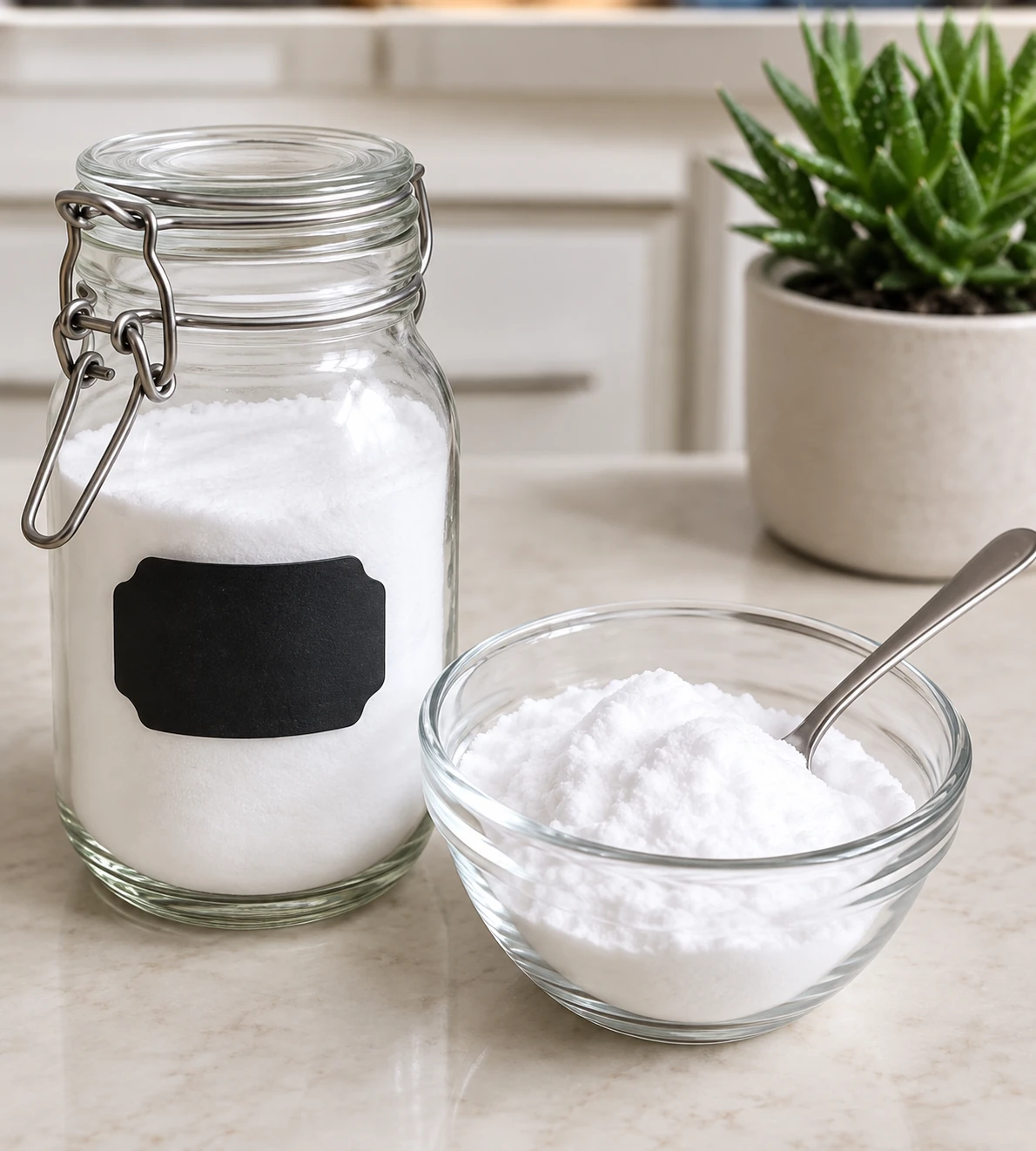
The image suggests that baking soda can remove dark spots, wrinkles, and dark circles from the face, but that claim is misleading. Baking soda is useful in the kitchen and for household cleaning, yet it is not a proven treatment for wrinkles, pigmentation, or under-eye circles, and applying it repeatedly to facial skin can cause dryness, irritation, burning, and damage to the skin barrier.
That does not mean you have to give up on inexpensive skincare. There are much gentler ways to support smoother, brighter-looking skin, including daily sunscreen, moisturizers, niacinamide, vitamin C, retinoids when appropriate, and careful exfoliation.
This guide explains what baking soda actually does, why viral “before and after” claims should be viewed cautiously, what causes dark spots and dark circles, and which safer ingredients may help improve their appearance over time.
Quick Overview
| Skin Concern | Does Baking Soda Treat It? | Better Approach |
|---|---|---|
| Dark Spots | No proven benefit | Sunscreen, niacinamide, vitamin C |
| Wrinkles | No proven benefit | Sunscreen, moisturizer, retinoids |
| Dark Circles | No proven benefit | Sleep, allergy care, caffeine products, sunscreen |
| Uneven Texture | May temporarily exfoliate but can irritate | Gentle chemical exfoliation |
| Oily Skin | May remove oil temporarily | Gentle cleanser |
| Acne | Not recommended as routine treatment | Salicylic acid or benzoyl peroxide |
| Dry Skin | Can make it worse | Ceramide moisturizer |
Why Baking Soda Became Popular in DIY Skincare
Baking soda is inexpensive, widely available, and has a gritty texture.
That combination makes it tempting to use as a homemade facial scrub.
When rubbed onto the skin, it can remove surface oils and dead skin cells temporarily. This may leave the skin feeling smoother immediately afterward.
That short-term sensation is probably one reason baking soda appears in so many viral beauty recipes.
But smoother-feeling skin does not mean wrinkles, pigmentation, or dark circles have actually been treated.
The problem is that facial skin is much more delicate than kitchen surfaces.
What Baking Soda Actually Is
Baking soda is sodium bicarbonate.
It is alkaline, while healthy facial skin naturally maintains a mildly acidic surface environment.
That acidic environment helps support the skin barrier and protects against excessive water loss and irritation.
Repeatedly applying alkaline products can disturb that balance.
For some people, one brief exposure may cause little noticeable trouble.
For others, even a single application may trigger:
- Burning
- Redness
- Tightness
- Dryness
- Peeling
- Itching
Using it repeatedly increases the chance of irritation.
Why the Skin Barrier Matters
Your skin barrier is the outer protective layer of the skin.
It helps keep moisture inside while keeping irritants outside.
When that barrier becomes damaged, skin can become more sensitive and dehydrated.
You may notice:
- Tightness after washing
- Flaking
- Stinging when products are applied
- Increased redness
- Rough texture
- More visible fine lines
Ironically, damaging the skin barrier can make some of the concerns people are trying to treat appear worse.
Dryness can make fine lines look more obvious.
Inflammation can also worsen certain types of pigmentation.
Can Baking Soda Remove Dark Spots?
There is no good evidence that baking soda safely removes facial dark spots.
Dark spots generally involve excess pigment deeper than the loose dead skin sitting on the surface.
Scrubbing the top of the skin cannot simply erase that pigment.
Aggressive rubbing may actually irritate the skin.
In people prone to post-inflammatory hyperpigmentation, irritation itself can sometimes leave behind more discoloration.
That means a harsh DIY treatment can potentially make the problem you are trying to solve more noticeable.
What Causes Dark Spots?
Dark spots can develop for many reasons.
Common causes include:
- Sun exposure
- Previous acne
- Skin irritation
- Hormonal changes
- Melasma
- Age-related sun spots
- Previous injury
- Certain medications or medical conditions
Because the causes are different, one treatment does not work for every type of discoloration.
Sun protection is usually one of the most important steps regardless of the cause.
The Most Important Step for Dark Spots
Daily sunscreen is often overlooked because people want an ingredient that actively “removes” pigmentation.
But preventing additional ultraviolet exposure is essential.
UV exposure can darken existing pigmentation and encourage new spots to form.
Use a broad-spectrum sunscreen with SPF 30 or higher on exposed skin.
Apply it every morning.
Reapply when spending extended time outdoors.
Without consistent sun protection, even good brightening products may produce disappointing results.
Better Ingredients for Dark Spots
Several skincare ingredients are more appropriate than baking soda.
Niacinamide
Niacinamide is a form of vitamin B3 commonly used in moisturizers and serums.
It can support the skin barrier and may gradually improve the appearance of uneven pigmentation.
Products containing around 2–5% niacinamide are often enough for everyday skincare.
Higher concentrations are not automatically better.
Vitamin C
Vitamin C is commonly used in morning skincare.
It acts as an antioxidant and may help improve the appearance of uneven tone over time.
Because vitamin C products vary widely in formulation and stability, choose one from a reputable skincare brand rather than attempting to create your own concentrated vitamin C mixture at home.
Azelaic Acid
Azelaic acid is another ingredient commonly used for uneven pigmentation and acne-related discoloration.
It can be especially useful when pigmentation occurs after breakouts.
Start slowly because even gentle active ingredients can sometimes irritate sensitive skin.
Retinoids
Retinoids are vitamin A derivatives.
They can help improve:
- Fine lines
- Skin texture
- Uneven pigmentation
- Acne
Retinoids work gradually.
They can also cause irritation when first introduced, so starting with a low-strength product a few nights per week is often easier than using it every night immediately.
Pregnant or breastfeeding people should ask a qualified clinician before using retinoid products.
Can Baking Soda Remove Wrinkles?
No.
Wrinkles form because of complex changes involving:
- Collagen
- Elastin
- Repeated facial movement
- Sun exposure
- Age-related changes
- Skin hydration
- Genetics
Baking soda cannot rebuild collagen simply by sitting on the skin.
A scrub may temporarily make the skin feel smoother, but that is very different from treating wrinkles.
In fact, drying or irritating the skin may temporarily make fine lines look more noticeable.
What Actually Helps Fine Lines?
The most useful everyday strategies are much less dramatic than viral social-media remedies.
Protect the skin from UV exposure.
Use moisturizer regularly.
Avoid smoking.
Introduce retinoids carefully when appropriate.
Use gentle skincare rather than repeatedly irritating the skin.
Long-term consistency matters more than aggressive short-term treatments.
Why Moisturizer Can Make Fine Lines Look Better
Dehydrated skin tends to look rougher.
Fine lines can become more noticeable when the outer layer of the skin lacks water.
Moisturizers containing ingredients such as:
- Glycerin
- Hyaluronic acid
- Ceramides
- Squalane
help support hydration.
This does not permanently erase wrinkles, but properly hydrated skin generally looks smoother and plumper.
Can Baking Soda Remove Dark Circles?
No reliable evidence shows that baking soda removes under-eye dark circles.
Dark circles are especially complicated because several different factors can cause them.
Sometimes the darkness comes from pigment.
Sometimes it comes from visible blood vessels.
Sometimes it comes from shadows caused by tear troughs or loss of facial volume.
And sometimes multiple causes are present at the same time.
A kitchen ingredient cannot correct all of these possibilities.
Common Causes of Dark Circles
Dark circles may be related to:
- Genetics
- Thin under-eye skin
- Allergies
- Frequent eye rubbing
- Lack of sleep
- Sun exposure
- Pigmentation
- Facial anatomy
- Age-related volume loss
- Dehydration
That is why one person may improve with allergy management while another sees very little change.
Why Baking Soda Is Especially Risky Near the Eyes
The skin around the eyes is thin and sensitive.
Baking soda can easily cause irritation there.
If the powder gets into the eye, it can cause significant discomfort.
For this reason, putting a baking soda paste directly beneath the eyes is not a good skincare strategy.
Choose products designed specifically for the eye area instead.
Better Options for Dark Circles
Depending on the cause, helpful approaches can include:
- Daily sunscreen
- Adequate sleep
- Treating allergies appropriately
- Avoiding frequent eye rubbing
- Gentle moisturizers
- Caffeine-containing eye products
- Niacinamide
- Vitamin C products designed for the face or eye area
Persistent or sudden under-eye changes can also be discussed with a dermatologist or healthcare professional.
A Safer Morning Routine for Uneven Tone
A simple routine does not need ten products.
A basic morning routine can look like this:
- Gentle cleanser
- Optional antioxidant or niacinamide serum
- Moisturizer
- Broad-spectrum SPF 30 or higher
Sunscreen should be the final skincare step before makeup.
A Safer Evening Routine
A simple evening routine can include:
- Gentle cleanser
- Optional treatment product
- Moisturizer
Treatment products might include niacinamide, azelaic acid, or a retinoid depending on your skin and goals.
Avoid introducing several strong active ingredients at the same time.
If irritation occurs, it can become difficult to determine which product caused it.
Simple Beginner Routine for Dark Spots
| Time | Product |
|---|---|
| Morning | Gentle cleanser |
| Morning | Niacinamide or vitamin C |
| Morning | Moisturizer |
| Morning | SPF 30+ sunscreen |
| Evening | Gentle cleanser |
| Evening | Azelaic acid or mild retinoid |
| Evening | Moisturizer |
You do not need every active ingredient simultaneously.
One well-tolerated treatment used consistently is usually more practical than combining multiple aggressive products.
How Long Does It Take for Dark Spots to Fade?
Pigmentation usually does not disappear overnight.
Depending on the cause and depth, improvement can take weeks or months.
This is another reason viral promises such as “remove dark spots instantly” or “erase wrinkles in days” should be treated skeptically.
Skin changes gradually.
Consistency and sun protection matter.
Why Viral Before-and-After Photos Can Be Misleading
Images can be affected by:
- Lighting
- Camera angle
- Filters
- Makeup
- Facial expression
- Distance from the camera
- Skin hydration
- Editing
A brighter image does not prove that an ingredient reversed aging.
Before-and-after photos should be treated as illustrations rather than scientific evidence unless the conditions were carefully controlled.
Is Baking Soda Ever Useful for Skin?
Baking soda may be present in certain professionally formulated personal-care products, but that does not mean homemade baking soda paste is appropriate for facial skincare.
Formulated products are designed with:
- Specific concentrations
- Controlled pH
- Other ingredients that affect performance
- Safety testing
A spoonful of baking soda mixed with water at home is a very different formulation.
What If You Already Put Baking Soda on Your Face?
If your skin feels normal afterward, wash gently and return to your usual moisturizer.
If the skin feels tight, irritated, or dry, stop using baking soda.
Use:
- A gentle cleanser
- Fragrance-free moisturizer
- Sunscreen during the day
Avoid strong acids, scrubs, or retinoids until the irritation settles.
If you develop significant swelling, blistering, persistent pain, or severe eye irritation, seek medical care.
How to Repair an Irritated Skin Barrier
For several days, keep your routine simple.
Use a mild cleanser.
Apply a plain moisturizer containing ingredients such as ceramides or glycerin.
Use sunscreen.
Avoid:
- Scrubs
- Strong acids
- Retinoids
- Fragranced treatments
- Baking soda
- Harsh soaps
Once the skin feels normal again, active ingredients can be reintroduced gradually.
Better Gentle Exfoliation Options
If your goal is smoother-looking skin, aggressive scrubbing is unnecessary.
Gentle exfoliating ingredients include:
Lactic Acid
Usually milder than many stronger acids and can be suitable for people who also want hydration.
Mandelic Acid
Has a relatively large molecular size and is often used when a gentler acid is desired.
Salicylic Acid
Oil-soluble and particularly useful for clogged pores and acne-prone skin.
You do not need to exfoliate every day.
For many people, one to three times per week is plenty.
Physical Scrubs vs. Chemical Exfoliation
Physical scrubs remove cells through friction.
Chemical exfoliants loosen dead cells through ingredients such as acids.
Neither method needs to hurt.
Burning and intense stinging are not signs that a product is “working harder.”
They can be signs of irritation.
Gentle skincare usually produces better long-term results than repeatedly damaging the surface.
Why More Exfoliation Is Not Always Better
People sometimes assume that if a little exfoliation brightens the skin, frequent exfoliation will brighten it faster.
That approach can backfire.
Over-exfoliation can lead to:
- Redness
- Dryness
- Burning
- Increased sensitivity
- Roughness
- Breakouts
- More visible pigmentation after irritation
Give the skin time to recover between exfoliating treatments.
A Simple Brightening Routine for Sensitive Skin
If your skin is sensitive, start with the basics.
Morning
Gentle cleanser.
Moisturizer.
SPF 30+ sunscreen.
Evening
Gentle cleanser.
Niacinamide product.
Moisturizer.
Use this simple routine consistently before adding stronger products.
Sometimes reducing irritation alone makes the skin look noticeably healthier.
A Routine for Dry or Mature Skin
Mature skin often benefits from extra hydration.
Try:
Morning
Gentle cream cleanser.
Antioxidant serum.
Rich moisturizer.
SPF 30+ sunscreen.
Evening
Gentle cleanser.
Low-strength retinoid a few nights per week if tolerated.
Ceramide-rich moisturizer.
On nights without the retinoid, focus on hydration.
A Routine for Oily or Acne-Prone Skin
Use:
Morning
Gentle foaming cleanser.
Niacinamide.
Lightweight moisturizer.
Sunscreen.
Evening
Cleanser.
Salicylic acid on selected nights.
Moisturizer.
If persistent acne is present, benzoyl peroxide or a retinoid may also be useful depending on the individual.
Avoid drying the skin aggressively because oily skin still needs a functioning barrier.
Can Turmeric Remove Dark Spots?
Turmeric frequently appears in viral skincare recipes too.
Some compounds in turmeric are being studied for anti-inflammatory and antioxidant effects, but kitchen turmeric is not a proven way to erase dark spots or wrinkles.
It can also temporarily stain the skin yellow.
If you want turmeric-based skincare, a professionally formulated product is generally easier to use consistently than raw kitchen spice.
Can Lemon Juice Remove Dark Spots?
Applying lemon juice directly to the face is not recommended.
It is acidic and can cause irritation.
Citrus exposure combined with sunlight can also create skin reactions in some situations.
Vitamin C skincare products are formulated very differently from rubbing lemon juice onto the skin.
The two should not be treated as equivalent.
Can Toothpaste Remove Dark Spots?
No.
Toothpaste is designed for teeth, not facial skin.
It may contain ingredients that cause:
- Dryness
- Burning
- Irritation
The same principle applies to many viral hacks.
Something being safe for one purpose does not automatically make it suitable for facial skincare.
Can Apple Cider Vinegar Brighten Skin?
Applying undiluted apple cider vinegar to the face can cause irritation or even chemical burns.
It is not necessary for treating pigmentation.
If you want chemical exfoliation, use a product formulated specifically for skin with a known concentration and pH.
What About Homemade Masks?
A homemade mask can feel relaxing, but it should not be expected to cure pigmentation or reverse wrinkles.
If you enjoy DIY skincare, keep ingredients gentle.
Simple options such as plain colloidal oatmeal products can be more appropriate than strongly alkaline or acidic kitchen ingredients.
Avoid homemade mixtures that burn, sting, or aggressively exfoliate.
When Dark Spots Should Be Checked
Most facial dark spots are harmless pigmentation, but not every dark mark should automatically be treated as a cosmetic issue.
Consider professional evaluation when a spot:
- Changes rapidly
- Bleeds
- Becomes painful
- Develops irregular borders
- Has several unusual colors
- Looks significantly different from your other spots
A dermatologist can determine whether a mark is ordinary pigmentation or something requiring further assessment.
When Dark Circles May Need Medical Attention
Dark circles are usually harmless.
However, sudden swelling, significant discoloration around one eye, pain, vision changes, or signs of infection should not be treated with home remedies.
Those symptoms deserve appropriate medical evaluation.
Common DIY Skincare Mistakes
| Mistake | Potential Result | Better Approach |
|---|---|---|
| Scrubbing with baking soda | Irritation | Gentle exfoliation |
| Using lemon juice | Burning/sensitivity | Vitamin C skincare product |
| Applying toothpaste | Dryness and irritation | Acne-specific treatment |
| Using too many acids | Barrier damage | Introduce one active at a time |
| Skipping sunscreen | Dark spots worsen | SPF 30+ daily |
| Expecting overnight results | Disappointment | Allow weeks to months |
| Rubbing under the eyes | More irritation | Gentle eye-area care |
| Using very hot water | Dryness | Lukewarm water |
| Constant exfoliation | Sensitivity | Limit frequency |
How to Patch Test a New Product
Before putting a new active product all over your face, try it on a small area.
Apply a small amount according to the product directions.
Watch for excessive:
- Burning
- Itching
- Swelling
- Rash
A patch test cannot predict every possible reaction, but it can help identify obvious irritation.
Do Expensive Products Work Better?
Not necessarily.
Price does not automatically determine effectiveness.
A simple routine containing a gentle cleanser, moisturizer, sunscreen, and one appropriate active ingredient can often be more sensible than an expensive routine containing many products.
Look at ingredients and formulation rather than price alone.
The Importance of Sunscreen for Anti-Aging
If your goal is preventing premature skin aging, sunscreen is one of the most important daily products.
Sun exposure contributes to:
- Fine lines
- Uneven pigmentation
- Rough texture
- Loss of elasticity
A complicated nighttime routine cannot fully compensate for repeated unprotected UV exposure during the day.
Consistency matters more than buying the most expensive sunscreen available.
Choose one you are willing to use regularly.
Nutrition and Skin Health
Skincare products are only part of the picture.
A generally balanced diet supports overall health, including skin.
Useful nutrients include:
- Protein
- Vitamin C
- Zinc
- Essential fatty acids
- Vitamin A
- Vitamin E
No single food, spice, or supplement can guarantee wrinkle-free skin.
The body relies on many nutrients simultaneously.
Does Collagen Help Wrinkles?
Collagen supplements are heavily marketed for skin.
Some studies suggest certain hydrolyzed collagen supplements may modestly improve skin hydration or elasticity in some people, but results vary and they do not produce instant facial transformation.
Dietary protein, vitamin C, sun protection, and overall health also matter.
A supplement should not replace basic skincare or medical evaluation when needed.
Hydration and Skin Appearance
Drinking adequate fluids supports normal body function, but drinking huge amounts of water will not erase wrinkles or dark circles.
Topical moisturizers are particularly important for maintaining hydration in the outer skin layer.
A good strategy combines normal hydration with appropriate topical skincare.
Sleep and Skin Appearance
Poor sleep can make the face look tired and may make under-eye shadows more noticeable.
Aim for a consistent sleep routine when possible.
However, genetic dark circles will not necessarily disappear simply because someone sleeps longer.
Again, the cause matters.
Frequently Asked Questions
Does baking soda remove dark spots?
There is no good evidence that baking soda safely removes facial pigmentation.
Can baking soda remove wrinkles?
No. Baking soda does not rebuild collagen or reverse established wrinkles.
Does baking soda remove dark circles?
No reliable evidence supports using baking soda for under-eye dark circles.
Why does baking soda make skin feel smooth?
Its gritty texture can remove surface oil and dead cells temporarily.
Is baking soda too harsh for the face?
It can be irritating because it is alkaline and may disturb the skin barrier.
Can I use baking soda once a week?
Routine facial use is generally unnecessary when gentler, purpose-formulated options exist.
Can baking soda lighten skin?
Temporary surface changes should not be confused with safely treating pigmentation.
Can baking soda help acne?
It is not a recommended routine acne treatment. Salicylic acid, benzoyl peroxide, and retinoids have better-established uses.
Can baking soda shrink pores?
Pores do not permanently open and close. Keeping them clear can make them look less noticeable.
Can baking soda exfoliate?
Yes, physically, but it can be too abrasive and alkaline for routine facial use.
What should I use instead for dark spots?
Daily sunscreen plus ingredients such as niacinamide, vitamin C, azelaic acid, or appropriate retinoids may be more useful.
What is best for wrinkles?
Sun protection, moisturizer, retinoids when appropriate, and professional treatments can help.
What is best for dark circles?
It depends on the cause. Sun protection, sleep, allergy management, gentle eye products, and professional evaluation may help.
Can I apply lemon and baking soda together?
That combination is not recommended for facial skincare because it can irritate the skin.
Can I mix baking soda with honey?
Honey does not eliminate the potential irritation caused by baking soda.
Can I mix baking soda with coconut oil?
Oil does not correct the alkaline nature of baking soda.
Is tingling normal?
Mild sensations can occur with some skincare products, but strong burning is not something to ignore.
What should I do if my face burns after baking soda?
Rinse gently, stop using it, apply a bland moisturizer, and avoid irritating actives until the skin recovers.
How long do dark spots take to fade?
Often weeks to months, depending on the cause and depth.
Does sunscreen really matter?
Yes. UV exposure can worsen both pigmentation and visible skin aging.
What SPF should I use?
A broad-spectrum SPF 30 or higher is a practical everyday choice.
Can older adults improve their skin?
Yes. Hydration, sun protection, and appropriate skincare can improve appearance and support skin health at any age.
Should I see a dermatologist?
Persistent pigmentation, significant irritation, changing spots, or concerns that do not improve with basic care are good reasons to seek professional advice.
A Simple Safe Routine to Start With
If you are overwhelmed by skincare advice, keep things simple.
Morning: gentle cleanser, moisturizer, sunscreen.
Evening: gentle cleanser, one targeted treatment if needed, moisturizer.
Stay consistent for several weeks before deciding that a routine does not work.
Avoid changing several products every few days.
Your skin needs time to respond.
Final Thoughts
The claim that baking soda can remove dark spots, wrinkles, and dark circles sounds appealing because baking soda is cheap and already available in most homes.
But simple availability does not make an ingredient an effective facial treatment.
Baking soda is alkaline and can disturb the skin barrier, especially when it is repeatedly rubbed onto delicate facial or under-eye skin. The temporary smoothness someone feels after using it is not evidence that pigmentation has been erased or collagen has been restored.
For dark spots, think about consistent sun protection and gentle brightening ingredients.
For fine lines, focus on sunscreen, hydration, and evidence-based anti-aging products such as retinoids when appropriate.
For dark circles, remember that pigmentation is only one possible cause. Genetics, allergies, thin skin, facial anatomy, and sleep can all contribute.
The best skincare routine is rarely the harshest one.
Gentle, consistent care usually makes much more sense than repeatedly experimenting with strong kitchen ingredients.
If your skin becomes irritated, stop the irritating product and focus on barrier repair. And if a dark spot changes in appearance, becomes painful, bleeds, or concerns you for any other reason, have it evaluated rather than trying to scrub it away at home.