Introduction
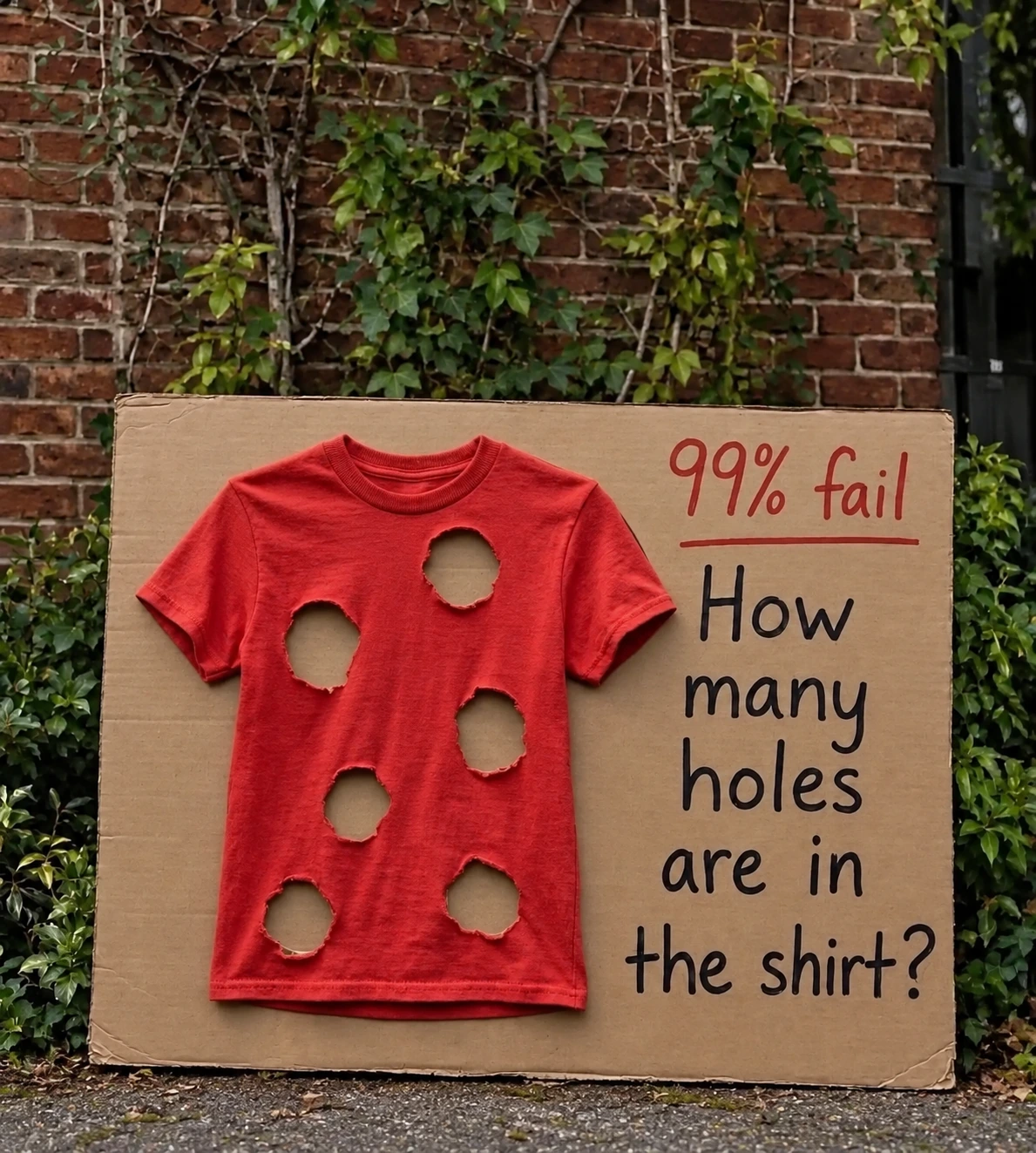
At first glance, this “How Many Holes Are in the Shirt?” puzzle looks incredibly simple. A red T-shirt has several large holes cut into it, and the challenge asks viewers to count how many openings the shirt really has.
But this is exactly why the puzzle catches so many people.
Most viewers immediately count only the obvious holes visible on the front of the shirt. Others remember the normal openings that every T-shirt already has. Then another question appears: if the large cutout holes go through both the front and back of the shirt, should each one count twice?
That small detail completely changes the answer.
The image even claims that “99% fail,” which encourages people to answer quickly before checking every possibility. The real challenge is not difficult mathematics. It is careful observation and understanding exactly what the word “hole” means in the puzzle.
So, how many holes are really in this shirt?
Let’s break the image down carefully.
The Puzzle at a Glance
The red shirt in the image appears to have six obvious cutout holes on its body.
Most people see those six circles and immediately answer:
6 holes.
However, that ignores the normal openings that are already part of a T-shirt.
A normal T-shirt has:
- One neck opening
- Two sleeve openings
- One opening at the bottom
That already gives us 4 natural openings before counting any damage to the shirt.
First Possible Answer: 10 Holes
If the six visible damaged areas are holes only through the front layer of the shirt, then the calculation is simple.
| Type of Opening | Number |
|---|---|
| Cutout holes on front | 6 |
| Neck opening | 1 |
| Left sleeve opening | 1 |
| Right sleeve opening | 1 |
| Bottom opening | 1 |
| Total | 10 |
So under this interpretation, the answer is:
10 holes.
This is already more than the obvious answer of six because the shirt itself contains four regular openings.
But There Is Another Detail
Look carefully at the large damaged holes.
Through several of them, you appear to see the brown cardboard behind the shirt rather than another layer of red fabric.
If the shirt is lying or mounted against the cardboard and you can see directly through the cutouts, then those damaged areas may pass through both the front and back layers of the shirt.
That changes everything.
Each visible cutout would create:
- One hole in the front
- One matching hole in the back
Six visible damaged areas would therefore represent:
6 × 2 = 12 damaged holes
Then we still need to add the shirt’s normal openings.
The 16-Hole Answer
If every cutout goes completely through both layers of the shirt:
| Type of Opening | Number |
|---|---|
| Six front cutouts | 6 |
| Six corresponding back cutouts | 6 |
| Neck opening | 1 |
| Two sleeve openings | 2 |
| Bottom opening | 1 |
| Total | 16 |
Under that reading, the answer is:
16 holes.
And this is usually the trickiest interpretation of the puzzle.
Why So Many People Answer 6
The brain naturally focuses on whatever the puzzle emphasizes visually.
In this image, the large circular cutouts are the most noticeable objects.
The viewer sees six damaged areas and immediately counts them.
This is known as a kind of attention bias: obvious visual features receive attention while familiar background features are ignored.
Everyone knows a shirt has a neck, sleeves, and a bottom opening, but because those openings are normal, the brain often does not think of them as “holes.”
That is what makes the puzzle effective.
Why Some People Answer 10
People who notice the normal T-shirt openings often calculate:
6 cutouts + 4 regular openings = 10.
That is a reasonable answer if the damage only affects the front layer.
In fact, without additional information about the back of the shirt, 10 can be defended logically.
The image itself does not physically show the back layer separately, which creates some ambiguity.
Why 16 Is Often Considered the Trick Answer
The largest answer comes from treating each cutout as a hole through both layers.
There are six visible damaged areas.
If each one passes through the entire shirt:
6 front holes + 6 back holes = 12.
Then add:
- 1 neck
- 2 sleeves
- 1 bottom
That gives:
12 + 4 = 16.
This is the answer many viral puzzle creators are aiming for.
Is 16 Definitely Correct?
Not completely.
That is what makes the puzzle more interesting than it first appears.
From a single photograph, we cannot know with absolute certainty whether every visible cutout goes through both layers of the shirt.
If only the front has been cut, the answer is 10.
If all six cutouts pass through the front and back, the answer is 16.
So the puzzle really has two reasonable answers depending on the assumption being made.
The Most Defensible Explanation
A careful response would be:
There are at least 10 holes, and potentially 16 if all six cutouts go through both the front and back of the shirt.
That explanation accounts for the ambiguity rather than pretending the photograph proves something it does not.
Breaking Down Every Opening
1. The Neck
Every T-shirt has an opening for the head.
That counts as one hole.
Running total:
1
2. The Left Sleeve
One arm passes through the left sleeve.
That is another opening.
Running total:
2
3. The Right Sleeve
The other arm passes through the right sleeve.
Running total:
3
4. The Bottom
The bottom of a T-shirt is open so the body can pass through.
Running total:
4
5–10. The Six Visible Cutouts
The shirt has six large damaged areas visible on the front.
Add those six.
Running total:
10
This gives the minimum straightforward answer.
11–16. Possible Back-Layer Holes
If all six cutouts also continue through the back of the shirt, add another six.
Final total:
16
Why the Word “Hole” Causes Confusion
The puzzle depends heavily on how people define a hole.
Some people only count damage.
Others count every opening.
For example, is the neck opening really a hole?
In normal conversation, we might call it a neckline rather than a hole. But geometrically and physically, it is still an opening through the fabric.
The same applies to the sleeves and bottom.
So the puzzle quietly switches between everyday language and literal counting.
The Normal Openings People Forget
A standard T-shirt normally contains four major openings:
| Opening | Purpose |
|---|---|
| Neck | Head |
| Left sleeve | Left arm |
| Right sleeve | Right arm |
| Bottom | Torso |
These are easy to overlook because they are intentional.
But an intentional opening is still an opening.
Why the Bottom Counts
One of the most commonly forgotten parts is the bottom of the shirt.
People tend to think of holes as small enclosed gaps.
But the bottom opening is necessary for putting the shirt on.
Without it, the shirt would essentially be a sealed fabric bag.
So if neck and sleeve openings count, the bottom logically counts too.
Does Each Sleeve Count as One Hole?
Yes.
There are two sleeves and therefore two separate openings.
That contributes two holes to the base count.
Does the Neck Count?
Yes, under the literal interpretation used by these puzzles.
The neck is one opening through the fabric.
Does the Bottom Count?
Yes.
It is another separate opening.
Do the Front Cutouts Count Once or Twice?
This depends entirely on whether they also penetrate the back.
If you cut a shirt while it is laid flat and the cutting tool goes through both layers, then one visible circular cut creates two physical holes:
- One in the front
- One in the back
If the shirt was being worn or the front was separated from the back while being cut, then only the front would be damaged.
The photograph does not fully prove which process occurred.
Why Viral Puzzles Use Ambiguity
A puzzle becomes more shareable when people disagree about the answer.
If everyone immediately agreed that the answer was six, there would be very little discussion.
But with possible answers such as:
- 6
- 10
- 16
people begin debating.
That creates comments, shares, and conversations.
The ambiguity is often part of the design.
The Three Most Common Answers
| Answer | Reasoning |
|---|---|
| 6 | Counts only the visible damage |
| 10 | Six damaged holes + four normal openings |
| 16 | Six cutouts through front and back + four normal openings |
Of these, 6 is clearly incomplete if normal shirt openings count.
The real debate is between 10 and 16.
What Answer Should You Give?
For the typical viral-puzzle interpretation:
16 holes
is probably the intended answer.
However, a more precise answer is:
10 confirmed openings, or 16 if each of the six cutouts passes through the back as well.
That is the strongest logical explanation.
Why This Puzzle Is Harder Than It Looks
The challenge is not arithmetic.
Even a child can calculate 6 + 4 or 12 + 4.
The difficulty comes from observation and assumptions.
You have to ask:
- What counts as a hole?
- Are normal openings included?
- Does the damage pass through one layer or two?
- What can actually be proven from the image?
Those questions turn a simple counting exercise into a small logic puzzle.
Observation vs. Assumption
This puzzle is also a good example of an important reasoning habit.
Separate what you can observe from what you are assuming.
What we can observe:
- Six obvious cutouts appear on the shirt.
- The shirt has a neck.
- The shirt has two sleeves.
- The bottom is open.
What we infer:
- The six cutouts may continue through the back.
That distinction matters.
Could the Answer Be More Than 16?
Under ordinary interpretation, probably not.
Someone could create more complicated arguments about seams or microscopic gaps in the fabric, but that would move far beyond the intended puzzle.
The reasonable interpretations are 10 or 16.
Could the Answer Be Only 6?
Only if the puzzle creator means “How many accidental cut holes are visible?”
But the wording simply asks how many holes are in the shirt.
That broader wording makes the ordinary neck, sleeve, and bottom openings relevant.
Why People Enjoy Visual Counting Puzzles
Puzzles like this are popular because they require almost no special knowledge.
Anyone can participate.
You simply need to look carefully.
They also create a satisfying moment when someone realizes they forgot an obvious detail.
That makes them ideal for:
- Social media posts
- Family games
- Classroom activities
- Brain teasers
- Party conversations
A Simple Way to Solve Similar Puzzles
When you encounter another visual counting puzzle, use this approach:
- Count the obvious items.
- Look for normal or hidden items.
- Ask whether objects have front and back layers.
- Check the edges of the image.
- Question the wording.
- Separate visible facts from assumptions.
- Recount before answering.
This simple method helps prevent quick mistakes.
What the “99% Fail” Text Does
The phrase “99% fail” is designed to create pressure.
It encourages viewers to prove that they are part of the small percentage who can solve the puzzle.
That often causes people to answer quickly.
Ironically, rushing makes them more likely to miss the normal openings in the shirt.
The better approach is to ignore the challenge language and inspect the image carefully.
Quick Answer
If you just want the viral-puzzle answer:
16 holes
That assumes the six visible cutouts continue through both the front and back of the shirt.
If they only pass through the front:
10 holes
Frequently Asked Questions
How many visible cutouts are on the shirt?
There are six obvious damaged cutouts visible on the front.
How many normal openings does a T-shirt have?
Four major openings:
- One neck
- Two sleeves
- One bottom
Why isn’t the answer simply 6?
Because the shirt already has openings even before it is damaged.
Why do some people say 10?
They count six visible cutouts plus the four normal T-shirt openings.
Why do some people say 16?
They assume the six cutouts go through both the front and back layers.
That creates 12 damaged holes plus four regular openings.
Which answer is most likely intended?
The typical trick-puzzle answer is 16.
Is 10 also reasonable?
Yes.
If only the front of the shirt was cut, 10 is logically correct.
Can we see the back of the shirt?
Not clearly enough to independently count the back-layer holes.
That is why there is some ambiguity.
Does the neck count as a hole?
Under the literal puzzle interpretation, yes.
Do both sleeves count?
Yes.
Each sleeve has one opening.
Does the bottom count?
Yes.
The lower opening is another way into the shirt.
Is this a math puzzle?
Not really.
It is mostly an observation and logic puzzle.
Why are there multiple possible answers?
Because the image does not fully establish whether the six cutouts pass through both layers.
What’s the safest answer?
At least 10; 16 if the cutouts pass through the back.
Final Thoughts
The “How Many Holes Are in the Shirt?” puzzle is a great example of how an apparently easy question can become surprisingly tricky once you pay attention to definitions and hidden assumptions.
The image clearly shows six damaged areas, but a T-shirt already has four regular openings: the neck, two sleeves, and the bottom. That means simply answering six overlooks a major part of the puzzle.
If the six cutouts only affect the front layer, the shirt has 10 holes.
If those six cuts pass through both the front and back layers, they create 12 damaged holes. Add the four normal openings, and the total becomes 16 holes.
That is why 16 is most likely the intended viral-puzzle answer, while 10 remains a reasonable answer if the back was not cut.
The real lesson is simple: before answering a visual puzzle, count everything—not just the objects the image wants you to notice first.