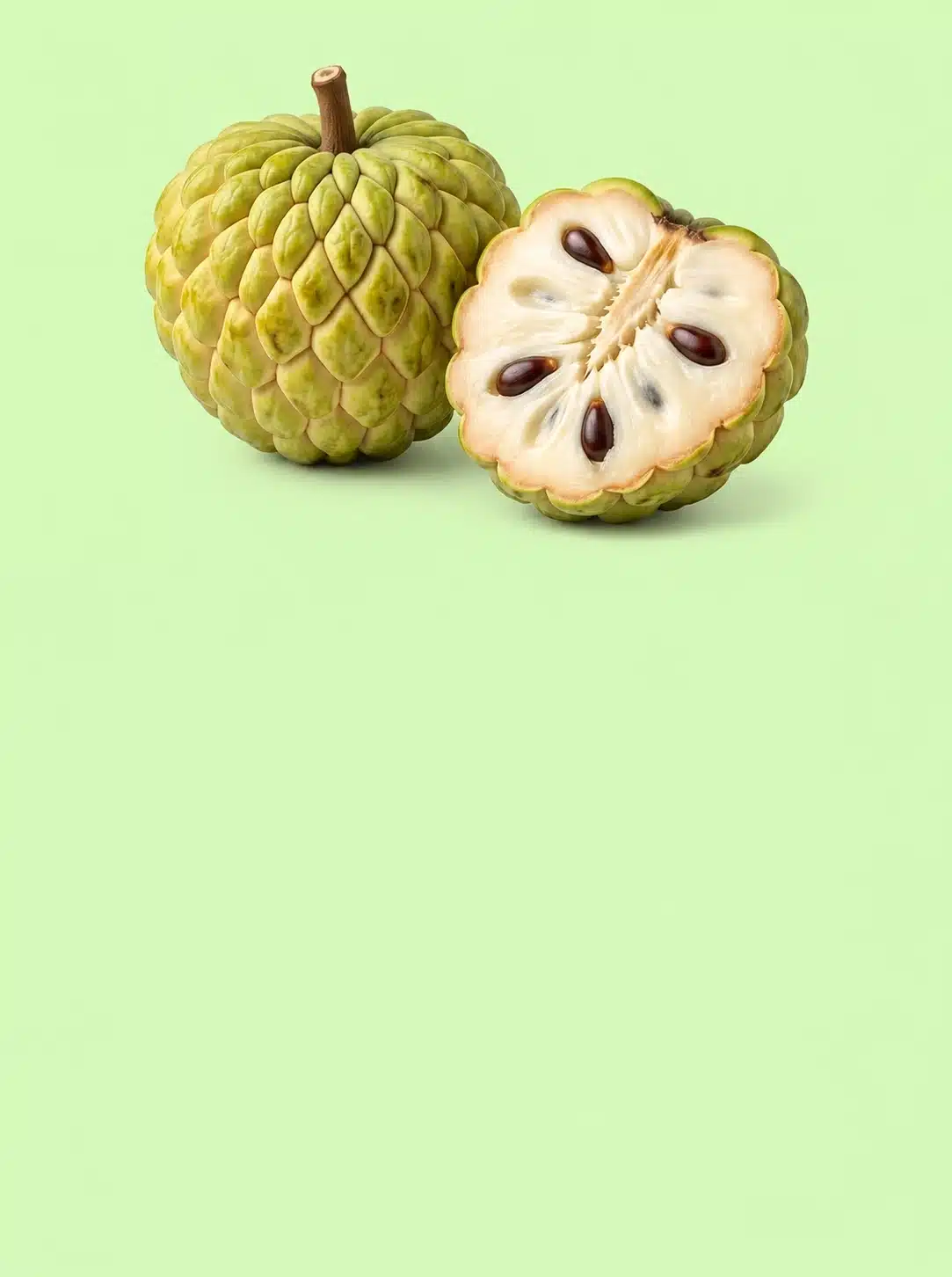
The fruit shown in the image appears to be a sugar apple (Annona squamosa), also known in many places as sweetsop or custard apple. Beneath its distinctive green segmented skin is soft, creamy-white flesh with a naturally sweet flavor and several large dark seeds.
Sugar apple can be enjoyed fresh with nothing more than a spoon, but it also works beautifully in smoothies, yogurt bowls, chilled desserts, fruit salads, and breakfast recipes. Its naturally creamy texture is one reason many people describe its flavor as somewhere between vanilla custard and tropical fruit.
From a nutritional perspective, sugar apple provides carbohydrates, dietary fiber, vitamin C, potassium, magnesium, and several B vitamins. Food-composition data list roughly 96 calories, 4.4 grams of fiber, and 247 mg of potassium per 100 grams of edible pulp, although exact values can vary by fruit and growing conditions.
The important part is to enjoy the ripe flesh while discarding the seeds. Sugar apple seeds contain biologically active compounds and should not be eaten or deliberately crushed into food. Research has documented toxic compounds in the seeds, and direct seed material can also seriously irritate the eyes.
Sugar Apple Quick Overview
| Fruit Details | Information |
|---|---|
| Common Name | Sugar Apple / Sweetsop / Custard Apple |
| Scientific Name | Annona squamosa |
| Fruit Type | Tropical fruit |
| Flavor | Sweet, creamy, fragrant |
| Texture | Soft and custard-like when ripe |
| Edible Part | White or cream-colored pulp |
| Seeds | Do not eat |
| Best Served | Fresh, chilled |
| Main Nutrients | Fiber, vitamin C, potassium |
| Calories | About 96 kcal per 100 g edible pulp |
| Best For | Snacks, breakfast, smoothies, desserts |
What Is Sugar Apple?
Sugar apple is a tropical fruit from the Annona genus. Its appearance is easy to recognize because the outside is covered with overlapping rounded or scale-like green segments.
When unripe, the fruit is relatively firm.
As it ripens, the fruit softens and the sections of the skin become easier to separate. Inside is sweet creamy flesh surrounding glossy dark seeds.
The edible pulp is the part people traditionally enjoy.
Sugar apple should not be confused completely with every fruit sold under the broad name “custard apple.” Different Annona species may be called custard apple depending on the country, including cherimoya and related fruits.
For this article, sugar apple refers specifically to Annona squamosa.
Sugar Apple Nutrition
Sugar apple is primarily a carbohydrate-rich fruit but also provides fiber and micronutrients.
A food-composition database for raw Annona squamosa pulp reports approximately the following values per 100 grams of edible fruit
| Nutrient | Approximate Amount per 100 g |
|---|---|
| Calories | 96 kcal |
| Water | 73.4 g |
| Protein | 1.8 g |
| Fat | 0.3 g |
| Available carbohydrates | 19.3 g |
| Dietary fiber | 4.4 g |
| Calcium | 28 mg |
| Magnesium | About 21 mg* |
| Potassium | About 247 mg* |
| Vitamin C | Around 36 mg in some food-composition data* |
*Values vary somewhat among food-composition sources and fruit samples.
That combination makes sugar apple a flavorful way to add fruit, fiber, and several micronutrients to an otherwise balanced diet.
Potential Health Benefits of Sugar Apple
Sugar apple should be treated as a nutritious food rather than medicine. Eating it can contribute useful nutrients, but it should not be promoted as a cure for cancer, diabetes, heart disease, or other medical conditions.
1. Provides Vitamin C
Sugar apple contains vitamin C.
Vitamin C is an essential nutrient that the body needs for collagen production, normal immune function, antioxidant activity, and improved absorption of non-heme iron from plant foods.
This does not mean eating one fruit “boosts immunity” instantly or prevents infections.
The useful takeaway is that vitamin-C-containing fruits can contribute to meeting normal daily nutritional needs as part of a varied diet.
2. Provides Dietary Fiber
Around 4.4 grams of dietary fiber per 100 grams has been reported for sugar apple pulp in food-composition data.
Fiber contributes to normal digestive function and makes whole fruit nutritionally different from heavily strained fruit juice.
Eating the pulp whole also tends to be more satisfying than drinking a sweetened beverage made from the fruit.
3. Contains Potassium
Sugar apple contributes potassium.
Potassium is an essential mineral involved in normal kidney and heart function, muscle contraction, and nerve transmission.
One fruit by itself will not determine your potassium status, but fruit can contribute to overall dietary intake alongside vegetables, legumes, dairy products, nuts, fish, and other potassium-containing foods.
4. Naturally Low in Fat
Sugar apple pulp contains relatively little fat.
That makes most of its calories come from carbohydrates rather than fat.
Because the fruit is naturally sweet, portion size may still matter for people who are monitoring carbohydrate intake.
5. Provides Several B Vitamins and Minerals
Food-composition sources report thiamine, riboflavin, niacin, vitamin B6, folate, magnesium, phosphorus, calcium, and manganese in sugar apple.
No single fruit provides every nutrient you need.
The best approach is variety: different fruits, vegetables, whole grains, protein foods, healthy fats, and other nutrient-rich foods throughout the week.
Does Sugar Apple Strengthen the Immune System?
Sugar apple contains vitamin C, and vitamin C is required for normal immune function. ODS
However, that does not mean eating sugar apple prevents every cold or infection.
NIH guidance emphasizes that the immune system depends on multiple nutrients and that eating a variety of nutritious foods is generally the best way to meet those needs.
A better way to describe sugar apple is:
It provides nutrients that participate in normal immune function.
That is more accurate than calling it an “immune-system cure.”
Can Sugar Apple Cure Cancer?
No fruit has been established as a cancer cure.
Laboratory researchers have studied compounds from Annona plants, including highly biologically active compounds in the seeds. Some of these substances show cytotoxic effects in laboratory cells, but that does not mean eating sugar apple seeds or fruit cures cancer.
In fact, the strong biological activity of compounds found in Annona seeds is one of the reasons the seeds should not be casually consumed.
Similarly, NIH notes that evidence around vitamin C and cancer prevention is complex and that vitamin C supplementation has not consistently been shown to reduce cancer risk in randomized trials.
Enjoy sugar apple as food—not as a replacement for cancer treatment.
Are Sugar Apple Seeds Edible?
The safest answer is no—discard the seeds.
The shiny dark seeds are not the same as edible nuts or seeds such as sunflower or pumpkin seeds.
Research on Annona squamosa seeds has identified annonaceous acetogenins, including compounds with substantial biological and toxic activity. A 2026 toxicology study identified squamocin as a major toxic seed constituent in experimental testing.
There are also published reports of serious eye irritation after exposure to crushed custard-apple seed material.
So when eating the fruit:
- Eat only the ripe flesh.
- Remove the black seeds.
- Do not chew or crush the seeds.
- Do not blend whole seeded fruit.
- Keep crushed seed material away from the eyes.
- Do not use seed preparations as homemade medicines.
How to Tell When Sugar Apple Is Ripe
An unripe sugar apple is normally firm and green.
As it ripens, it becomes noticeably softer when gently pressed.
The spaces between the skin segments may become more pronounced, and the fruit often develops a stronger sweet aroma.
A ripe fruit should feel soft but not completely collapsed.
Avoid fruit that smells strongly fermented, has extensive mold, or is leaking excessively.
How to Ripen Sugar Apple at Home
If your fruit is still firm, leave it at room temperature.
Do not refrigerate a very hard unripe sugar apple if you want it to ripen quickly.
Check it daily.
Once it becomes soft enough to eat, refrigerate it if you are not eating it immediately.
Ripe sugar apple is delicate and does not store nearly as long as apples, oranges, or other firm fruits.
How to Cut and Eat Sugar Apple
Preparing the fruit is extremely simple.
Step 1: Wash the Outside
Rinse the fruit thoroughly under clean running water.
Dry the outside.
Step 2: Cut It Open
Slice the ripe fruit in half.
A very soft fruit may also pull apart naturally with your hands.
Step 3: Scoop Out the Flesh
Use a spoon to remove the creamy pulp.
Step 4: Remove Every Seed
Separate and discard the black seeds while eating.
Do not blend the fruit until the seeds have been completely removed.
Step 5: Serve
Eat the pulp immediately or chill it first.
A squeeze of lime can balance the natural sweetness beautifully.
What Does Sugar Apple Taste Like?
The flavor is sweet, tropical, floral, and creamy.
Its texture is soft enough that “custard-like” is a reasonable description.
Depending on ripeness, you may notice flavors reminiscent of vanilla, pear, pineapple, or banana.
Fruit allowed to ripen fully generally tastes sweeter and develops a much softer texture than fruit eaten too early.
Easy Sugar Apple Breakfast Bowl
One of the simplest ways to use the fruit is in a yogurt bowl.
Ingredients
- 1/2 cup ripe sugar apple pulp, seeds removed
- 3/4 cup plain Greek yogurt
- 1/2 banana, sliced
- 1/4 cup fresh berries
- 1 tablespoon chopped walnuts or almonds
- 1 teaspoon chia seeds
- Fresh lime juice, optional
- Cinnamon, optional
Instructions
Spoon the Greek yogurt into a bowl.
Add the sugar apple pulp, banana, and berries.
Top with nuts and chia seeds.
Finish with a little lime juice or cinnamon.
Because sugar apple is already naturally sweet, added sugar is usually unnecessary.
Creamy Sugar Apple Smoothie
Ingredients
- 1 cup sugar apple pulp, all seeds removed
- 1/2 banana
- 3/4 cup milk or plain yogurt
- 1/2 cup ice
- Pinch of cinnamon
- 1 teaspoon lime juice
- Vanilla, optional
Instructions
Inspect the pulp carefully and make sure every seed has been removed.
Add the pulp, banana, milk or yogurt, ice, cinnamon, and lime to a blender.
Blend until completely smooth.
Serve immediately.
Never place whole sugar apple—including its seeds—into the blender.
Sugar Apple Serving Ideas
| Serving Idea | How to Use It |
|---|---|
| Fresh | Scoop directly from ripe fruit |
| Chilled | Refrigerate before serving |
| Yogurt bowl | Combine with yogurt and berries |
| Smoothie | Blend seed-free pulp |
| Fruit salad | Add mango, banana and berries |
| Oatmeal | Spoon pulp over cooked oats |
| Pancakes | Use as a fresh topping |
| Ice cream | Spoon fresh pulp over vanilla |
| Chia pudding | Add chilled fruit pulp |
| Dessert parfait | Layer with yogurt and granola |
Sugar Apple and Blood Sugar
Sugar apple is naturally sweet and contains carbohydrates.
That does not automatically make the fruit “bad,” but portion size matters, particularly for someone who monitors blood glucose or carbohydrate intake.
Eating a moderate portion alongside protein or other balanced foods may be more practical than consuming very large quantities of the fruit at once.
People with diabetes should follow their individual nutrition plan rather than relying on claims that sugar apple can lower or “cure” blood sugar.
There is not enough evidence to recommend sugar apple as a diabetes treatment.
Is Sugar Apple Good for Weight Loss?
No individual fruit causes weight loss on its own.
Sugar apple can fit into a weight-management eating pattern because it is a whole fruit containing water and fiber, but it is also relatively carbohydrate-rich and energy-dense compared with some watery fruits.
Weight changes depend on overall calorie intake, food choices, activity, sleep, health conditions, medications, and many other factors.
A sensible portion of sugar apple can be part of the diet without turning it into a “fat-burning” food.
Sugar Apple vs. Cherimoya
These fruits are related, but they are not necessarily the same species.
| Feature | Sugar Apple | Cherimoya |
|---|---|---|
| Scientific name | Annona squamosa | Annona cherimola |
| Exterior | Distinct segmented scales | Smoother or lightly patterned |
| Flesh | Creamy white | Creamy white |
| Seeds | Large dark seeds | Large dark seeds |
| Flavor | Very sweet | Sweet and aromatic |
| Family | Annonaceae | Annonaceae |
Both have seeds that should be discarded rather than eaten.
Best Ways to Store Sugar Apple
Unripe fruit is best kept at room temperature until it softens.
Once ripe, transfer it to the refrigerator to slow further ripening.
Cut fruit should be refrigerated in a sealed container.
Because the flesh oxidizes and softens rapidly, it is best eaten reasonably soon after cutting.
If you remove the seeds first, the pulp can also be frozen for smoothies.
Can You Freeze Sugar Apple Pulp?
Yes.
Remove the peel and every seed.
Place the edible pulp into a freezer-safe container or freezer bag.
Freeze in small portions so you can remove only what you need.
Frozen pulp is especially useful in smoothies because it naturally creates a thick, creamy texture.
The texture may become softer after thawing, so frozen pulp is usually better for blended recipes than for elegant fresh-fruit presentation.
Common Mistakes to Avoid
Eating the Seeds
The dark seeds should be discarded.
Do not chew, grind, or intentionally consume them.
Blending the Whole Fruit
Always remove every seed before placing sugar apple into a blender.
Eating the Fruit Too Early
Hard unripe fruit does not have the soft, creamy texture sugar apple is known for.
Let it ripen first.
Adding Too Much Sugar
Ripe sugar apple is naturally very sweet.
Taste smoothies and desserts before adding honey, syrup, or sugar.
Believing Extreme Health Claims
Sugar apple is nutritious, but phrases such as “cures cancer,” “reverses diabetes,” or “heals every disease” are not supported by reliable clinical evidence.
Frequently Asked Questions
What fruit is shown in the picture?
It appears to be a sugar apple (Annona squamosa), commonly called sweetsop or custard apple in many regions.
Is sugar apple the same as custard apple?
Sugar apple is often called custard apple, but the term “custard apple” can also refer to other related Annona fruits depending on location.
Is sugar apple healthy?
It can be part of a healthy diet and provides fiber, vitamin C, potassium, and other nutrients.
How many calories are in sugar apple?
Food-composition data report about 96 calories per 100 grams of edible pulp.
Is sugar apple high in fiber?
About 4.4 grams of dietary fiber per 100 grams has been reported.
Does sugar apple contain vitamin C?
Yes. Food-composition sources report meaningful vitamin C content in the pulp.
What does vitamin C do?
Vitamin C contributes to collagen formation, antioxidant functions, immune function, and absorption of non-heme iron.
Does sugar apple contain potassium?
Yes. Around 247 mg per 100 grams is reported in some nutritional data.
What does potassium do?
Potassium is needed for normal nerve transmission, muscle contraction, and kidney and heart function.
Can I eat sugar apple seeds?
They should be discarded rather than eaten.
Why shouldn’t I eat the seeds?
Annona squamosa seeds contain biologically active acetogenins and other compounds with toxic potential.
Can the seeds damage the eyes?
Published cases describe toxic keratoconjunctivitis following ocular exposure to custard-apple seed material.
Can I blend sugar apple?
Yes, but remove every seed first.
Can I juice sugar apple?
You can make drinks from the seed-free pulp, although its thick creamy texture usually works better in smoothies.
How do I know when sugar apple is ripe?
It should become noticeably softer and more fragrant.
Can I refrigerate sugar apple?
Yes. Refrigerate it once ripe.
Can I freeze it?
Yes. Remove the skin and seeds first and freeze the pulp.
Can I eat sugar apple every day?
For most people, it can be enjoyed as one of many fruits in a varied diet. Portion needs differ according to total diet and health needs.
Can people with diabetes eat sugar apple?
Individual carbohydrate needs vary. People managing diabetes should account for the fruit’s carbohydrates as part of their overall eating plan.
Does sugar apple cure diabetes?
No reliable clinical evidence establishes sugar apple as a diabetes cure.
Does sugar apple cure cancer?
No. Laboratory studies of Annona compounds should not be confused with evidence that eating the fruit treats cancer.
Is sugar apple good for immunity?
It provides vitamin C and other nutrients involved in normal body functions, but it should not be presented as a treatment for infection.
Can children eat sugar apple?
The soft ripe pulp can be food, but the large hard seeds need to be completely removed because they present both safety and choking concerns.
What can I make with sugar apple?
Smoothies, yogurt bowls, fruit salads, parfaits, chilled desserts, oatmeal toppings, and fresh fruit plates are all easy options.
Final Thoughts
Sugar apple, also known as sweetsop or custard apple, is a unique tropical fruit with sweet creamy flesh, a distinctive segmented green exterior, and several large dark seeds.
Its edible pulp provides fiber, vitamin C, potassium, and additional micronutrients. These nutrients contribute to normal nutrition, but the fruit should not be promoted as a miracle medicine.
The easiest way to enjoy it is also one of the best: allow the fruit to ripen, cut it open, remove the seeds, and eat the creamy flesh chilled.
From there, it can be transformed into smoothies, yogurt bowls, fruit salads, oatmeal toppings, breakfast parfaits, and naturally sweet desserts.
The main safety rule is simple: eat the pulp and discard the seeds. Research shows that Annona squamosa seeds contain potent biologically active compounds, so they should not be treated as edible seeds or homemade medicine.
Enjoy sugar apple for what it genuinely is—a delicious tropical fruit that can add variety, flavor, fiber, and nutrients to a balanced diet.