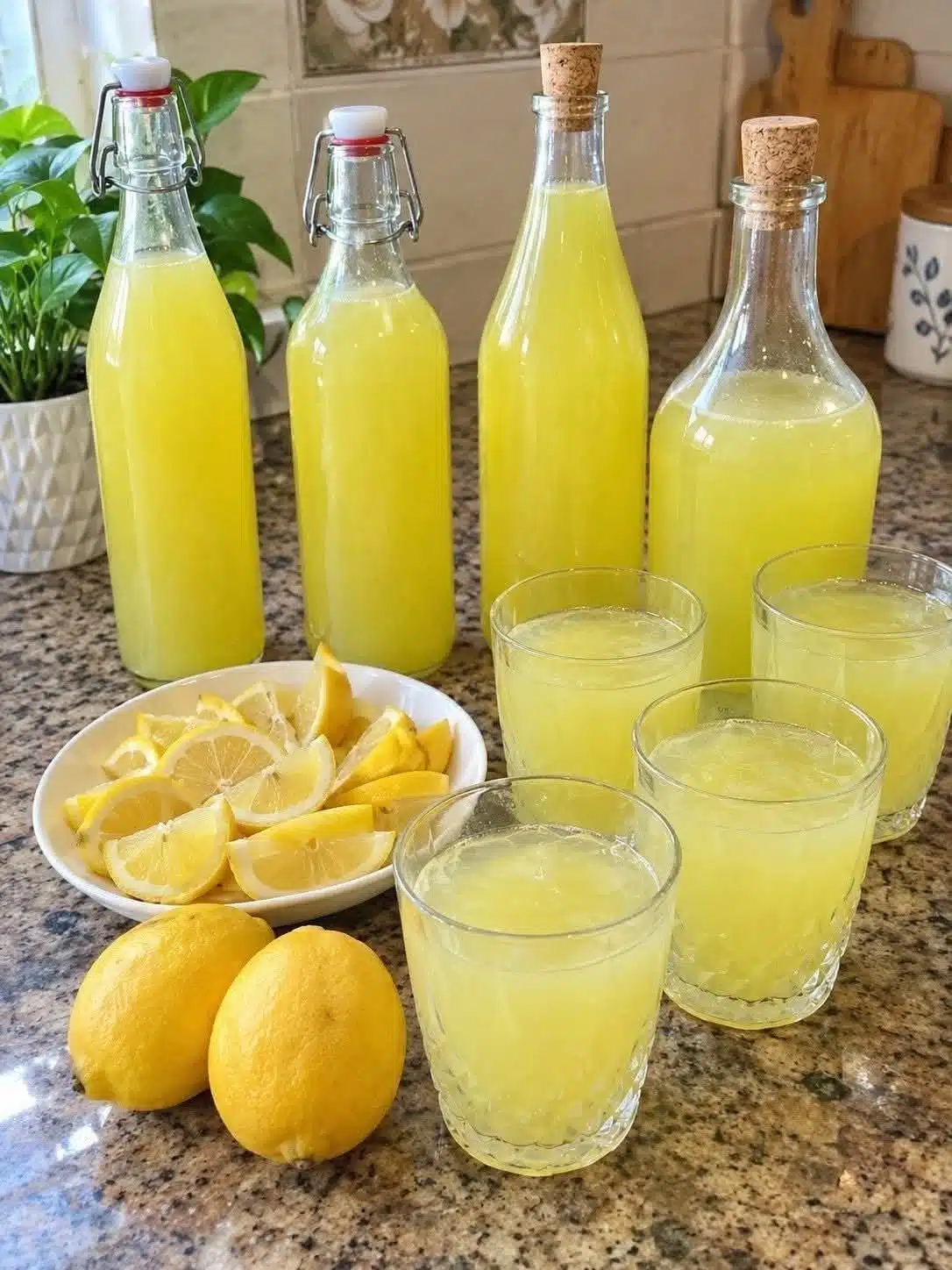
This Fresh Homemade Lemonade Recipe is bright, refreshing, and packed with real lemon flavor. Made with freshly squeezed lemon juice, water, and a simple homemade syrup, it delivers the ideal balance between tart citrus and sweetness without relying on bottled lemonade concentrate.
Inspired by the bottles and glasses of golden lemonade in the image, this recipe is designed for making a generous batch that can be chilled in bottles or pitchers and served throughout the week. Fresh lemons give the drink a noticeably cleaner, brighter flavor than powdered mixes, while simple syrup makes sure the sugar dissolves completely.
Homemade lemonade is perfect for summer afternoons, BBQs, picnics, birthday parties, family gatherings, brunches, potlucks, and everyday hydration when you want something more interesting than plain water. You can serve it over ice, add sparkling water, mix in berries, or infuse it with mint, ginger, cucumber, or fresh herbs.
The recipe is also easy to scale. Make one pitcher for the family or prepare several bottles for a larger gathering. Because fresh lemonade contains no commercial preservatives, keep it refrigerated rather than treating filled bottles as shelf-stable.
Recipe Overview
| Recipe Details | Information |
|---|---|
| Recipe Name | Fresh Homemade Lemonade |
| Focus Keyword | Homemade Lemonade Recipe |
| Prep Time | 15 minutes |
| Syrup Time | 5 minutes |
| Chilling Time | 1 hour |
| Total Time | About 1 hour 20 minutes |
| Yield | About 8 cups |
| Servings | 8 |
| Course | Beverage |
| Cuisine | American / Homemade |
| Difficulty | Easy |
| Main Ingredient | Fresh lemons |
| Flavor | Sweet, tart, refreshing |
| Best Served | Ice cold |
| Make-Ahead Friendly | Yes |
| Refrigerator Friendly | Yes |
Why You’ll Love This Homemade Lemonade
Fresh lemonade has a flavor that is difficult to duplicate with bottled juice or powdered drink mixes. Freshly squeezed lemons provide both bright acidity and the fragrant citrus aroma that makes homemade lemonade taste especially refreshing.
Using simple syrup instead of stirring plain sugar directly into cold water makes a noticeable difference. The sugar dissolves evenly, so you do not end up with overly sweet lemonade at the bottom of the pitcher and sour lemonade at the top.
The sweetness is also easy to customize. If you prefer a tart lemonade, use less syrup. For a sweeter party-style version, add a little more until the balance tastes right to you.
Another advantage is that this recipe becomes the base for many other drinks. Strawberry lemonade, raspberry lemonade, sparkling lemonade, mint lemonade, ginger lemonade, and peach lemonade can all begin with the same basic recipe.
Complete Grocery List
| Ingredient | Amount | Purpose |
|---|---|---|
| Fresh lemons | 8–10 medium | Fresh lemon juice |
| Granulated sugar | 1 cup | Sweetness |
| Water for syrup | 1 cup | Dissolves sugar |
| Cold water | 5 cups | Dilutes lemonade |
| Ice | As needed | Serving |
| Lemon slices | Optional | Garnish |
| Fresh mint | Optional | Fresh flavor |
Ingredients
For the Lemonade
- 1½ cups freshly squeezed lemon juice
- 1 cup granulated sugar
- 1 cup water for simple syrup
- 5 cups cold water
- 1 to 2 cups ice, optional for serving
Optional Garnishes
- Fresh lemon slices
- Lemon wedges
- Fresh mint leaves
- Fresh basil
- Rosemary sprigs
- Cucumber slices
- Fresh berries
Ad Placement 4 – After Ingredients
How Many Lemons Do You Need?
The exact number of lemons depends on their size, variety, and juiciness. For approximately 1½ cups fresh lemon juice, you will generally need around 8 to 10 medium lemons.
Some lemons may produce significantly more juice than others. Lemons that feel heavy for their size usually contain more juice than lightweight fruit.
If you are preparing lemonade for a party, buy a few extra lemons. They can be used for garnish even if you do not need all of them for juice.
How to Choose the Best Lemons
Look for lemons with bright yellow skin and a fresh citrus aroma. They should feel firm but not rock hard.
A lemon that feels heavy relative to its size usually contains plenty of juice. Smooth, thinner-skinned lemons often yield more juice than extremely thick-skinned fruit.
Avoid lemons with large soft spots, mold, or signs of significant drying.
You do not need perfect-looking lemons if you are only juicing them, but fresh fruit produces the best-tasting lemonade.
The Secret to Better Homemade Lemonade
The biggest secret is balancing three things: fresh lemon juice, sweetness, and dilution.
Too much lemon juice without enough water creates a harsh, mouth-puckering drink. Too much sugar masks the natural citrus flavor.
A good starting ratio is approximately 1½ cups lemon juice, 1 cup sugar, and 6 cups total water including the syrup water.
From there, adjust according to your lemons and personal taste.
The second secret is chilling the lemonade before serving. A fully chilled pitcher tastes smoother and more refreshing than lemonade served immediately at room temperature.
Why Simple Syrup Works Better Than Plain Sugar
Granulated sugar does not dissolve particularly well in ice-cold water.
Simple syrup solves that problem by heating sugar with water until the crystals disappear.
Once the syrup cools, it blends immediately into lemon juice and water.
This gives you much more consistent sweetness throughout the pitcher.
You can also prepare the syrup ahead and keep it refrigerated for several days.
Kitchen Equipment
| Equipment | Purpose |
|---|---|
| Citrus juicer | Extracting lemon juice |
| Fine-mesh strainer | Removing seeds and excess pulp |
| Small saucepan | Making simple syrup |
| Large pitcher | Mixing lemonade |
| Measuring cups | Accurate ratios |
| Wooden spoon | Stirring |
| Funnel | Filling bottles |
| Glass bottles or jars | Refrigerator storage |
Step-by-Step Instructions
Step 1: Wash the Lemons
Rinse the lemons thoroughly under running water.
Even though you are mainly using the juice, clean lemons are important if you plan to add slices or zest to the finished lemonade.
Dry them with a clean kitchen towel.
Step 2: Roll the Lemons
Place each lemon on the countertop.
Press gently with the palm of your hand and roll it back and forth several times.
This helps loosen the inside membranes and can make the fruit easier to juice.
Step 3: Make the Simple Syrup
Combine 1 cup sugar and 1 cup water in a small saucepan.
Place over medium heat.
Stir until the sugar completely dissolves.
You do not need to boil the syrup for a long time.
Once the liquid is clear and no sugar crystals remain, remove the saucepan from the heat.
Step 4: Cool the Syrup
Set the syrup aside while you juice the lemons.
Allowing it to cool slightly prevents the fresh lemon juice from being heated when everything is mixed.
For faster cooling, transfer the syrup to a heat-safe bowl.
Step 5: Juice the Lemons
Cut the lemons in half.
Use a handheld citrus juicer, electric juicer, or reamer to extract the juice.
Continue until you have approximately 1½ cups of fresh lemon juice.
Step 6: Strain the Juice
Pour the lemon juice through a fine-mesh strainer.
This removes seeds and excess pulp.
If you enjoy pulp in your lemonade, strain only enough to remove the seeds.
Step 7: Combine Lemon Juice and Syrup
Pour the fresh lemon juice into a large pitcher.
Add the cooled simple syrup.
Stir thoroughly.
Step 8: Add Cold Water
Pour in 5 cups cold water.
Stir again until evenly combined.
At this stage, taste the lemonade.
Step 9: Adjust the Flavor
If the lemonade tastes too sour, add a little more simple syrup.
If it tastes too sweet, add additional cold water or lemon juice.
Make small adjustments rather than dramatically changing the recipe all at once.
Step 10: Chill
Cover the pitcher.
Refrigerate for at least 1 hour.
Chilling allows the flavors to blend and produces a more refreshing drink.
Step 11: Fill Bottles if Desired
Use a clean funnel to transfer the chilled lemonade into clean bottles or jars.
Leave some room at the top rather than filling completely to the rim.
Seal and refrigerate immediately.
These bottles are intended for refrigerated storage, not room-temperature pantry storage.
Step 12: Serve
Fill glasses with ice.
Pour the cold lemonade over the ice.
Garnish with lemon slices, wedges, mint, or fresh berries if desired.
Serve immediately.
Ad Placement 8 – After Complete Instructions
How to Make Lemonade Less Sour
If your finished lemonade is too tart, do not immediately add large amounts of granulated sugar directly to the pitcher.
Prepare a small amount of extra simple syrup instead.
Mix equal parts sugar and warm water until dissolved, let it cool, then add it gradually.
Taste after each addition.
Another option is simply to add more cold water, especially if the lemonade already tastes sweet enough.
How to Make Lemonade Less Sweet
If you accidentally added too much syrup, fresh lemon juice is the easiest correction.
Add a few tablespoons at a time.
You can also increase the amount of cold water.
For a party pitcher, adding sparkling water just before serving can lighten overly sweet lemonade while creating a refreshing bubbly version.
How to Get Stronger Lemon Flavor Without Making It Too Sour
Adding more lemon juice increases acidity as well as flavor.
For extra lemon aroma without dramatically increasing sourness, use a small amount of finely grated lemon zest.
Only use the yellow outer portion of the peel.
Avoid grating deeply into the white pith because it can taste bitter.
Add the zest while the simple syrup is warm, steep for several minutes, then strain before mixing the lemonade.
Pro Tips for the Best Homemade Lemonade
Use fresh lemon juice whenever possible because bottled juice generally lacks some of the bright aroma of freshly squeezed lemons. Roll the lemons before juicing and choose heavy fruit for a better yield.
Make simple syrup instead of trying to dissolve sugar in cold water. Add the syrup gradually if you prefer a tart drink because you can always make lemonade sweeter later.
Chill the drink thoroughly before judging the final flavor. Cold temperatures can change how sweetness and acidity are perceived.
If you are serving lemonade over lots of ice, make it slightly stronger because melting ice will dilute it.
For parties, keep the pitcher or bottles refrigerated until close to serving time.
Delicious Lemonade Variations
Strawberry Lemonade
Blend 1½ cups fresh strawberries with a little prepared lemonade.
Strain if you prefer a smoother drink.
Stir the strawberry puree into the pitcher.
The result is naturally pink, fruity, and excellent for summer parties.
Raspberry Lemonade
Mash or blend fresh raspberries.
Strain the puree to remove seeds, then stir it into the lemonade.
Raspberries add tart berry flavor without making the drink excessively sweet.
Mint Lemonade
Add a generous handful of fresh mint leaves.
Lightly bruise the leaves before adding them to release their aroma.
Refrigerate for approximately 30 minutes, then strain or leave the mint in for presentation.
Ginger Lemonade
Add several slices of fresh ginger while making the simple syrup.
Allow them to steep as the syrup cools.
Strain before mixing.
This creates a bright lemonade with a gentle warming finish.
Cucumber Lemonade
Add thinly sliced cucumber to the finished lemonade.
Refrigerate for 30 to 60 minutes.
The cucumber creates a light, refreshing flavor that works especially well during hot weather.
Sparkling Lemonade
Prepare the lemon-syrup base as usual.
Instead of adding all the plain cold water, substitute chilled sparkling water.
Add the sparkling water shortly before serving so the drink remains fizzy.
Peach Lemonade
Blend ripe peaches with a little water.
Strain if desired.
Stir the puree into the lemonade for a sweet summer variation.
Honey Lemonade
Replace part of the sugar with honey.
Dissolve the honey in warm water before mixing because honey can be difficult to incorporate evenly into an ice-cold drink.
What to Serve with Homemade Lemonade
| Food | Why It Works |
|---|---|
| BBQ chicken | Bright acidity balances smoky flavors |
| Burgers | Classic summer pairing |
| Grilled chicken | Refreshing contrast |
| Sandwiches | Easy lunch combination |
| Pasta salad | Excellent for picnics |
| Potato salad | Cuts through richness |
| Fried chicken | Tart drink balances fried food |
| Fruit salad | Fresh summer combination |
| Cookies | Sweet snack pairing |
| Cake | Lemonade keeps dessert refreshing |
Homemade Lemonade for Parties
For gatherings, make the lemonade several hours ahead so it has plenty of time to chill.
Keep ice separate instead of filling the main pitcher with ice early. Otherwise, the ice will melt and gradually dilute the entire batch.
Place lemon slices and mint in a separate serving pitcher if you want an attractive presentation.
For a self-serve beverage station, offer plain lemonade alongside sparkling water, berries, lemon wedges, and mint so guests can customize their drinks.
How to Make a Large Batch
To make approximately 1 gallon, use roughly:
- 3 cups fresh lemon juice
- 2 cups sugar
- 2 cups water for syrup
- 10 cups additional cold water
Prepare the syrup first.
Combine with lemon juice and cold water, then taste before serving.
Because lemons vary in acidity, you may need slightly more sugar or water.
A one-gallon batch is useful for BBQs, birthdays, family reunions, picnics, and holiday gatherings.
Make-Ahead Instructions
Homemade lemonade is ideal for preparing ahead.
Make the simple syrup first and allow it to cool.
Juice the lemons, mix everything together, and refrigerate.
Preparing it several hours before serving gives the lemonade plenty of time to become completely cold.
If using sparkling water, do not add it until shortly before serving.
Storage
Store homemade lemonade in a tightly covered pitcher or clean bottle in the refrigerator.
For the best fresh flavor, enjoy it within approximately 3 to 5 days.
The lemon juice and pulp may naturally separate while the drink sits.
Simply shake the bottle gently or stir the pitcher before serving.
Do not treat this recipe as a shelf-stable bottled beverage.
Fresh homemade lemonade should remain refrigerated.
Can You Freeze Homemade Lemonade?
Yes.
Pour lemonade into freezer-safe containers, leaving enough room for expansion.
Freeze for approximately 2 to 3 months for best quality.
You can also freeze lemonade in ice cube trays.
Those cubes are particularly useful because they chill fresh lemonade without watering it down.
Frozen lemonade can also be partially thawed and blended for a slushy summer drink.
Lemonade Concentrate Option
You can prepare a concentrated lemon base and dilute it later.
Combine fresh lemon juice with cooled simple syrup but leave out most of the extra water.
Refrigerate the concentrate in a tightly sealed container.
When ready to serve, combine one portion concentrate with cold water according to taste.
This method is convenient when refrigerator space is limited or when you want to prepare individual glasses later.
Common Mistakes and How to Avoid Them
Using Too Much Sugar
Start with less sweetness and add more as needed.
Lemons vary considerably in acidity.
Using Only Bottled Lemon Juice
Bottled juice works in an emergency, but fresh lemons produce a much brighter drink.
Adding Sugar Directly to Ice-Cold Water
The sugar may settle at the bottom.
Prepare simple syrup first.
Adding Too Much Ice Too Early
Ice gradually dilutes the pitcher.
Add it to individual glasses or shortly before serving.
Forgetting to Strain Seeds
Strain the fresh juice before mixing.
Storing Homemade Lemonade at Room Temperature
Fresh lemonade is not commercially preserved.
Keep it refrigerated.
Adding Sparkling Water Too Early
Carbonation disappears as the drink sits.
Add sparkling water immediately before serving.
Troubleshooting Guide
| Problem | Likely Cause | Solution |
|---|---|---|
| Too sour | Not enough sweetness | Add simple syrup |
| Too sweet | Excess sugar | Add lemon juice or water |
| Too weak | Too much water | Add lemon juice |
| Bitter flavor | Too much pith/zest | Use yellow zest only |
| Sugar at bottom | Sugar wasn’t dissolved | Use simple syrup |
| Cloudy lemonade | Natural pulp | Strain more thoroughly |
| Flavor becomes weak | Ice dilution | Serve ice separately |
| Flat sparkling lemonade | Added too early | Add sparkling water last |
Nutrition Estimate
| Nutrition | Approximate Amount |
|---|---|
| Calories | 100–130 per serving |
| Carbohydrates | 28–34 g |
| Protein | Less than 1 g |
| Fat | 0 g |
| Sugar | 24–30 g |
| Fiber | Less than 1 g |
| Sodium | Minimal |
| Serving Size | About 1 cup |
Nutrition varies depending on the amount of sugar, dilution, and optional ingredients.
Frequently Asked Questions
What is homemade lemonade made of?
Classic homemade lemonade contains fresh lemon juice, sugar, and water.
How many lemons do I need?
Approximately 8 to 10 medium lemons usually produce enough juice for this recipe.
Can I use bottled lemon juice?
Yes, but freshly squeezed lemon juice gives a much brighter flavor.
Why should I make simple syrup?
Simple syrup makes sure the sugar dissolves evenly throughout the lemonade.
How do I make simple syrup?
Heat equal parts sugar and water until the sugar completely dissolves.
Does the syrup need to boil?
No. It only needs enough heat to dissolve the sugar.
Can I make lemonade without sugar?
You can use another sweetener according to its recommended conversion and your dietary needs, although flavor will change.
Can I use honey?
Yes. Dissolve honey in warm water first.
Can I make lemonade with sparkling water?
Yes. Add sparkling water shortly before serving.
Can I add mint?
Yes. Fresh mint is excellent with lemonade.
Can I add ginger?
Yes. Infuse fresh ginger into the simple syrup.
Can I add cucumber?
Yes. Thin cucumber slices create a refreshing variation.
Can I add strawberries?
Yes. Strawberry lemonade is one of the easiest variations.
Why is my lemonade bitter?
Too much white pith or heavily crushed lemon peel may create bitterness.
Why is my lemonade cloudy?
Fresh lemon pulp can make lemonade cloudy. This is normal.
Can I strain the lemonade?
Yes. Use a fine-mesh strainer for a smoother drink.
Should lemonade be refrigerated?
Yes. Fresh homemade lemonade should be kept refrigerated.
How long does homemade lemonade last?
For the best flavor and quality, enjoy it within approximately 3 to 5 days.
Can I keep the bottles in the pantry?
Not with this refrigerator-style recipe. The bottles shown are useful for refrigerated storage, not proof of shelf stability.
Can I freeze lemonade?
Yes. Freeze it in containers or ice cube trays.
Can I prepare it the night before?
Yes. Lemonade is excellent when prepared ahead and chilled overnight.
How can I make lemonade stronger?
Add additional fresh lemon juice.
How can I make it less sour?
Add cooled simple syrup gradually.
How can I make it less sweet?
Add more cold water or fresh lemon juice.
Can I make a gallon at once?
Yes. Double the recipe approximately to create a large party batch.
Can children help make lemonade?
Children can help with measuring and stirring under appropriate supervision, while an adult should handle knives, hot syrup, and other potentially hazardous steps.
Final Thoughts
This Fresh Homemade Lemonade Recipe proves that one of the most refreshing drinks can also be one of the simplest to prepare. Fresh lemons, sugar, and water are all you need to create a bright homemade drink that tastes much better than many powdered mixes.
The biggest improvement comes from using freshly squeezed juice and simple syrup. Fresh lemons provide the tart citrus flavor and aroma, while dissolved syrup gives you even sweetness without sugar collecting at the bottom of the pitcher.
Once you master the basic ratio, you can easily customize the recipe. Add strawberries, raspberries, peaches, mint, ginger, cucumber, honey, or sparkling water to create a completely different drink from the same basic formula.
The lemonade can also be prepared in advance and stored in attractive glass bottles like those shown in the image. Just remember that homemade lemonade is a fresh refrigerated beverage rather than a shelf-stable canned drink.
Serve it ice cold at BBQs, summer parties, picnics, family dinners, birthdays, brunches, or whenever you want an easy homemade drink with bright citrus flavor.