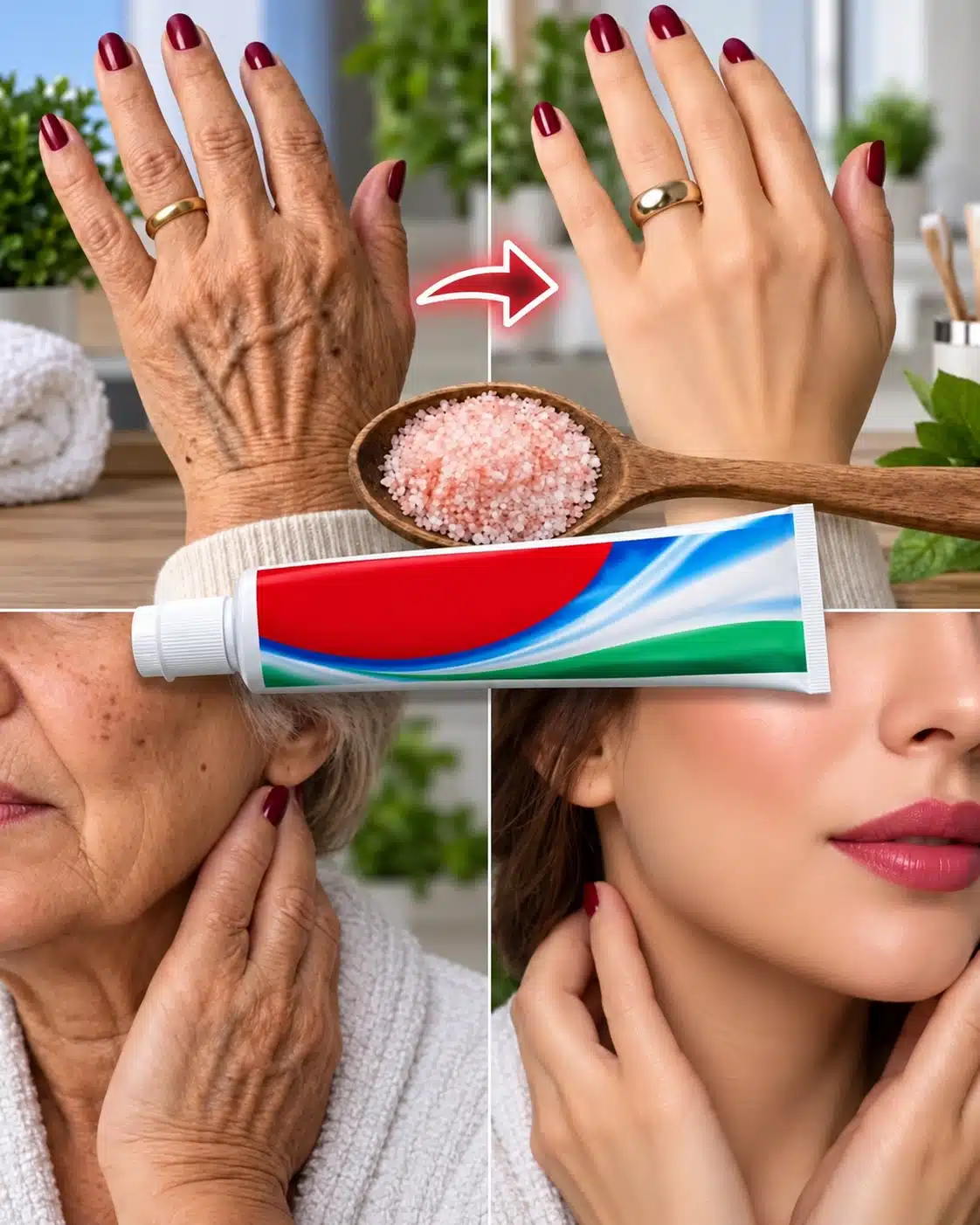
The toothpaste and salt beauty trick has become popular on social media, often accompanied by dramatic before-and-after photos showing wrinkled or uneven-looking hands suddenly appearing smoother, brighter, and younger. The image suggests that mixing ordinary toothpaste with salt can create a powerful anti-aging treatment for both the hands and face.
The idea sounds appealing because both ingredients are inexpensive and already available in most homes. However, toothpaste is formulated for teeth—not facial or hand skin—and salt is a strong physical abrasive. Mixing the two may leave the skin feeling temporarily smoother, but it can also cause irritation, excessive dryness, redness, and damage to the skin barrier.
The good news is that you do not need an aggressive homemade mixture to improve dry, rough-looking hands. Gentle exfoliation, consistent moisturizing, sun protection, and appropriate skincare ingredients can make the skin look softer, smoother, and more even over time without relying on a viral trick that may do more harm than good.
This guide explains what toothpaste and salt can actually do to the skin, why the dramatic “instant anti-aging” effect is misleading, and how to create a safer routine for softer hands and healthier-looking skin.
Quick Overview
| Beauty Question | Practical Answer |
|---|---|
| Can toothpaste remove wrinkles? | No |
| Can salt tighten loose skin? | No |
| Can the mixture brighten skin temporarily? | Possibly through exfoliation, but irritation can occur |
| Is toothpaste designed for facial skin? | No |
| Can salt damage sensitive skin? | Yes |
| Can harsh scrubbing worsen dark marks? | Yes |
| Better approach | Gentle exfoliation + moisturizer + SPF |
| Best for dry hands | Thick fragrance-free hand cream |
| Best anti-aging step | Daily sun protection |
| Suitable for the face? | Not recommended |
| Instant permanent results possible? | No |
Why This Toothpaste and Salt Trick Became Popular
DIY beauty treatments spread quickly because they promise dramatic results using ordinary household ingredients.
Toothpaste seems especially attractive because it feels fresh, can contain whitening agents, and often produces a cooling sensation. Salt is associated with exfoliation because the crystals physically remove dead surface skin when rubbed.
When combined, the mixture may leave skin feeling smoother immediately after rinsing.
That temporary change can look dramatic under different lighting, especially if the “before” skin was very dry and the “after” photo was taken after washing and moisturizing.
But smoother-looking skin for a short time is very different from reversing wrinkles or rejuvenating aging skin.
What Toothpaste Is Actually Designed to Do
Toothpaste is formulated for cleaning teeth.
Depending on the product, it may contain ingredients such as:
- Fluoride
- Hydrated silica or other abrasives
- Detergents
- Flavoring agents
- Menthol
- Whitening ingredients
- Sweeteners
- Preservatives
- Thickening agents
These ingredients are chosen for oral care, not for maintaining the delicate moisture barrier of facial skin.
A toothpaste that feels completely normal inside your mouth can still be irritating when left on the skin.
Some people experience burning, redness, itching, dryness, or peeling after using toothpaste as a DIY skincare product.
What Salt Does to the Skin
Salt crystals act as a physical exfoliant.
When rubbed across the skin, they can remove some of the dry cells sitting on the surface.
That is why the skin may feel smoother afterward.
The problem is that salt particles can be quite rough.
Aggressive scrubbing may cause tiny areas of irritation, particularly on the face, around the eyes, or on already dry hands.
Salt can also draw moisture from the skin, making dryness worse.
If the skin barrier becomes irritated, the area can look red, flaky, uncomfortable, or even darker after healing.
Can Toothpaste and Salt Remove Wrinkles?
No household paste can erase established wrinkles instantly.
Wrinkles develop through a combination of factors such as:
- Natural aging
- Repeated facial movement
- Collagen changes
- Sun exposure
- Genetics
- Smoking
- Environmental stress
- Skin dehydration
Surface exfoliation can temporarily make skin look a little smoother because rough dead cells are removed.
Moisturizing also plumps the outer layers of skin, which can temporarily soften the appearance of fine lines.
Neither effect means the wrinkle itself has disappeared.
A dramatic transformation like the one suggested in viral before-and-after images should therefore be viewed cautiously.
Why Hands Can Suddenly Look Younger After Moisturizing
Hands often look older when they are dry.
Dryness makes fine lines, texture, and creases more visible.
Apply a rich moisturizer and the outer layer of skin holds more water, which makes it appear plumper and smoother.
That is one reason quick before-and-after photos can be misleading.
A hand photographed before moisturizing may appear rough and creased.
The same hand photographed shortly after applying moisturizer, under softer lighting and from a slightly different angle, may look dramatically younger.
The difference does not necessarily mean wrinkles disappeared.
Why You Should Be Careful Using Toothpaste on Your Face
Facial skin is generally more sensitive than the skin on many other parts of the body.
Toothpaste may be particularly irritating around:
- The eyes
- The nose
- The lips
- Areas affected by acne
- Eczema-prone skin
- Rosacea-prone skin
- Recently exfoliated skin
Harsh irritation can weaken the skin barrier.
Once that happens, skin may become more sensitive to skincare products that previously caused no problems.
If you already have acne, irritation can also make redness and post-inflammatory marks more noticeable.
Can Toothpaste Lighten Dark Spots?
Toothpaste is not a reliable treatment for pigmentation.
Some ingredients may temporarily dry or exfoliate the outer layer of skin, creating the appearance of slight brightness.
But established dark spots usually involve excess pigment deeper within the epidermis.
Effective management often focuses on ingredients such as:
- Sunscreen
- Vitamin C
- Niacinamide
- Azelaic acid
- Retinoids
- Other dermatologist-recommended treatments
The correct option depends on the cause of pigmentation.
Using irritating DIY mixtures can actually make some dark spots worse, especially in skin that develops pigmentation easily after inflammation.
Does Salt Make Skin White?
No.
Salt does not permanently lighten natural skin color.
It may remove surface debris and dead skin, making skin temporarily look cleaner or smoother.
But that should not be confused with changing skin tone.
Excessive scrubbing may actually produce the opposite effect by causing irritation.
After inflammation, some people develop darker marks that can persist much longer than the original dryness.
A Safer Routine for Softer-Looking Hands
If your goal is hands that look smoother, younger, and better hydrated, you can get much better results with a gentle routine.
Step 1: Wash Gently
Use lukewarm rather than extremely hot water.
Choose a mild cleanser when possible.
Hot water and strong detergents can strip protective oils from the skin.
Step 2: Pat Dry
Do not aggressively rub wet hands with a rough towel.
Pat gently until slightly damp.
Applying moisturizer while the skin still contains a little moisture can help reduce dryness.
Step 3: Apply a Rich Hand Cream
Look for moisturizing ingredients such as:
- Glycerin
- Ceramides
- Shea butter
- Petrolatum
- Hyaluronic acid
- Urea
- Squalane
A thick hand cream is especially useful after washing.
Apply again before bed.
Step 4: Protect Your Hands from the Sun
The backs of the hands receive substantial UV exposure over a lifetime.
Sun exposure contributes to:
- Uneven pigmentation
- Fine lines
- Loss of elasticity
- Rough texture
- Visible age spots
Use broad-spectrum sunscreen on exposed hands during the day.
Remember to reapply after washing when needed.
Step 5: Exfoliate Gently
If your hands are rough, gentle exfoliation once or twice a week may help.
Avoid aggressive scrubbing.
A mild lotion containing lactic acid or urea can often smooth rough skin more evenly than coarse homemade scrubs.
Simple Gentle Hand Softening Routine
Instead of toothpaste and salt, try a moisture-focused routine.
You Will Need
- Mild hand cleanser
- Lukewarm water
- Thick hand cream
- Plain petrolatum or moisturizing balm
- Cotton gloves, optional
How to Use It
- Wash the hands gently.
- Pat dry.
- Apply a generous layer of hand cream.
- Apply a thin layer of petrolatum over particularly dry areas.
- Put on cotton gloves if desired.
- Leave on overnight.
- Repeat regularly as needed.
This routine does not “erase age,” but it can significantly improve dryness and make the hands feel softer.
Why Moisturizer Often Works Better Than DIY Scrubs
Dry skin does not always need more exfoliation.
Sometimes it simply needs better hydration and barrier support.
If the skin is already flaky, repeated scrubbing can remove protective cells faster than they can recover.
A good moisturizer works differently.
Humectants attract water.
Emollients smooth spaces between surface skin cells.
Occlusives reduce water loss.
Together, these ingredients help the skin become softer and more comfortable without physically grinding away the surface.
A Gentler Homemade Hand Scrub Option
If you enjoy homemade beauty treatments and your skin is not sensitive, use a much gentler approach than toothpaste and salt.
Ingredients
- 1 teaspoon fine sugar
- 1 teaspoon plain moisturizer or a small amount of oil
Directions
Mix into a soft paste.
Massage very gently over the hands for approximately 20–30 seconds.
Rinse with lukewarm water.
Apply hand cream immediately afterward.
Do not use on cracked, inflamed, sunburned, or irritated skin.
Even gentle physical exfoliation should not be performed aggressively or every day.
Why Sugar Is Usually Gentler Than Coarse Salt
Fine sugar crystals dissolve more readily in water than coarse salt.
That can make a carefully prepared sugar scrub somewhat gentler.
Still, sugar can irritate skin if you scrub aggressively.
Pressure matters.
Frequency matters.
Skin condition matters.
If your hands are already dry, cracked, or inflamed, skip the scrub and use moisturizer instead.
Best Ingredients for Aging-Looking Hands
Several skincare ingredients can improve how mature hands look when used consistently.
Retinoids
Retinoids are commonly used in anti-aging skincare because they can support skin renewal and collagen-related processes.
They may cause irritation, so introduce them gradually and use sunscreen.
Niacinamide
Niacinamide can support the skin barrier and may help improve uneven-looking tone.
It is generally well tolerated.
Vitamin C
Vitamin C products are often used for antioxidant support and uneven pigmentation.
Product formulation matters considerably.
Urea
Urea is especially useful for dry or rough hands.
At lower concentrations it acts primarily as a moisturizer, while higher concentrations can also soften thickened skin.
Lactic Acid
Lactic acid can gently exfoliate while also helping hydration.
It can be useful for rough hands when used appropriately.
Sunscreen Is One of the Most Important Anti-Aging Products
Many people carefully apply sunscreen to the face but forget the hands.
The backs of the hands receive UV exposure during:
- Driving
- Walking
- Gardening
- Shopping
- Outdoor work
- Everyday errands
Over many years, this exposure contributes to visible skin aging.
Applying a broad-spectrum SPF 30 or higher to exposed hands is one of the simplest long-term steps for preventing additional sun-related changes.
If you wash your hands frequently, reapplication may be necessary.
What About Age Spots on the Hands?
Brown spots on the hands often become more noticeable with age and accumulated sun exposure.
Daily sunscreen is important because continued UV exposure can make pigmentation harder to manage.
Topical ingredients that may be used for uneven pigmentation include:
- Vitamin C
- Niacinamide
- Retinoids
- Azelaic acid
- Alpha hydroxy acids
Persistent or concerning spots should be evaluated professionally.
Any spot that changes quickly in size, shape, color, border, or symptoms deserves medical attention rather than cosmetic treatment.
Can You Use Toothpaste on Pimples?
This is another common DIY beauty myth.
Toothpaste can dry the surface of a pimple, but irritation can outweigh that temporary effect.
Better acne options include products specifically formulated for skin, such as:
- Benzoyl peroxide
- Salicylic acid
- Adapalene
- Azelaic acid
Different acne types respond to different treatments.
Repeated toothpaste use may leave an irritated red patch that looks worse than the original blemish.
Can Toothpaste Remove Blackheads?
Not reliably.
Blackheads form when pores contain oil and dead cells that become oxidized at the surface.
Toothpaste does not specifically remove that blockage.
Salicylic acid is generally a more logical skincare ingredient because it can penetrate oily pores.
Gentle cleansing and appropriate retinoid use may also help.
Aggressive squeezing or scrubbing can cause irritation and marks.
What About Toothpaste and Baking Soda?
This combination is also popular online.
It is not a good facial treatment.
Both can be drying and irritating.
Adding another abrasive does not transform toothpaste into skincare.
If you want exfoliation, use a product designed for skin and follow its directions rather than mixing several aggressive household ingredients.
What About Toothpaste, Salt and Lemon?
Adding lemon juice can make the mixture even harsher.
Lemon is highly acidic.
On irritated skin, it may sting and further damage the skin barrier.
Citrus exposure combined with sunlight can also create additional skin problems in certain situations.
For that reason, toothpaste + salt + lemon is not a good anti-aging facial mask.
Can You Put This Mixture on Your Neck?
The neck can be even more sensitive than the hands.
Do not assume that because a product seems tolerable on thick hand skin it will be safe on the neck or face.
The neck can react with:
- Redness
- Burning
- Dryness
- Rash
- Peeling
Use skincare specifically formulated for the neck or face instead.
What to Do If Toothpaste Has Irritated Your Skin
If you already tried the mixture and your skin is burning or red, rinse it thoroughly with cool or lukewarm water.
Stop using the mixture.
Avoid additional exfoliating acids, scrubs, retinoids, strong vitamin C products, and fragranced products until the skin calms.
Use a bland moisturizer.
Do not repeatedly scrub the area trying to “remove” the irritation.
Seek medical advice if you develop severe swelling, blistering, intense pain, spreading rash, eye exposure, or symptoms that do not improve.
Simple 7-Day Hand Care Routine
| Day | Routine |
|---|---|
| Day 1 | Gentle wash + rich moisturizer + SPF |
| Day 2 | Moisturize after every hand wash |
| Day 3 | Gentle exfoliation only if skin is not irritated |
| Day 4 | Moisturizer + overnight balm |
| Day 5 | Continue SPF and hand cream |
| Day 6 | Focus on hydration, no aggressive scrubs |
| Day 7 | Overnight cream + optional cotton gloves |
Repeat the routine rather than expecting one dramatic treatment.
Consistency is what makes dry skin look progressively healthier.
Nighttime Hand Treatment
Night is an excellent time to focus on hydration because you will not immediately wash products off.
Before bed:
- Wash and dry the hands.
- Apply a rich moisturizer.
- Add a small amount of petrolatum to especially dry areas.
- Massage gently around the fingers and cuticles.
- Wear clean cotton gloves if desired.
- Leave everything on overnight.
In the morning, hands often feel noticeably softer.
Again, this is hydration—not permanent wrinkle removal.
Protect Your Hands During Cleaning
Cleaning products can dramatically worsen dryness.
Wear protective gloves when:
- Washing dishes
- Cleaning bathrooms
- Using bleach
- Handling strong detergents
- Working with household chemicals
Repeated exposure to water and detergent strips oils from the skin.
If your hands seem constantly dry despite using moisturizer, household cleaning may be one of the reasons.
Common Mistakes That Make Hands Look Older
Washing with Very Hot Water
Hot water can increase dryness.
Skipping Moisturizer
Frequent hand washing without replacing moisture often leads to roughness.
Ignoring Sunscreen
UV exposure contributes significantly to visible aging of the hands.
Scrubbing Every Day
Constant exfoliation can damage the barrier.
Using Harsh DIY Ingredients
Toothpaste, strong acids, and coarse abrasives can irritate the skin.
Forgetting the Cuticles
Dry cuticles can make the entire hand look rough.
Apply hand cream around the nails as well.
Expecting Instant Results
Healthy skin changes gradually.
Frequently Asked Questions
Can toothpaste make hands look younger?
It may temporarily remove some surface oil or dead skin, but it does not reverse skin aging.
Does toothpaste remove hand wrinkles?
No.
Does salt remove wrinkles?
No. Salt is an abrasive, not an anti-wrinkle treatment.
Can toothpaste tighten the skin?
There is no good reason to expect toothpaste to produce meaningful long-term skin tightening.
Can toothpaste lighten hands?
It may temporarily change the surface appearance, but it is not a reliable or safe skin-lightening treatment.
Can salt whiten skin?
No. It does not permanently change natural skin tone.
Can I use toothpaste and salt on my face?
It is better not to. Both can irritate facial skin.
Why does toothpaste sometimes make skin feel tight?
Dryness can create a temporary tight sensation. That should not be confused with genuine skin tightening.
Can this mixture remove age spots?
No. Established pigmentation requires a different approach.
Can it remove dark knuckles?
It is not a reliable treatment and aggressive rubbing may make pigmentation worse.
Can toothpaste remove acne?
It is not recommended as an acne treatment.
What is better for pimples?
Skin-specific products containing ingredients such as salicylic acid or benzoyl peroxide are better-established options.
Can I use lemon with toothpaste?
This can increase irritation and is not recommended for facial skincare.
How can I make my hands softer quickly?
Apply a thick moisturizer after washing and use an occlusive balm overnight.
How can I keep hands looking younger?
Moisturize consistently and protect them from UV exposure.
Should I use sunscreen on my hands?
Yes. The backs of your hands receive regular sun exposure.
What SPF should I use?
Broad-spectrum SPF 30 or higher is a practical everyday choice.
Does hand cream remove wrinkles?
It cannot permanently erase wrinkles, but good hydration can temporarily soften their appearance.
Can retinol help aging hands?
Retinoid-based products may help some signs of photoaging when used properly, but they can cause irritation and require careful sun protection.
What is good for very rough hands?
Creams containing urea, glycerin, ceramides, lactic acid, or petrolatum can be useful depending on the severity.
How often should I exfoliate my hands?
For many people, once or twice weekly is plenty. Very dry or sensitive hands may not need physical exfoliation at all.
Can I use this treatment every day?
Toothpaste-and-salt scrubbing is not recommended as a daily skincare routine.
What if my hands crack and bleed?
Stop abrasive treatments and focus on barrier repair. Persistent, painful, or infected-looking cracks should be professionally evaluated.
Can mature skin become smoother?
Yes. Hydration, sun protection, and appropriate skincare can improve texture and appearance, although normal aging cannot be completely erased.
Final Thoughts
The viral toothpaste and salt beauty trick may look impressive in before-and-after images, but toothpaste was designed for teeth and salt is a strong abrasive. Neither ingredient has been shown to erase wrinkles, reverse skin aging, or permanently lighten mature hands.
At most, scrubbing can remove some dry surface cells, and the skin may look temporarily smoother afterward.
That temporary effect comes with a tradeoff: dryness and irritation are possible, especially when the mixture is used repeatedly or applied to sensitive facial skin.
A better anti-aging hand routine is much simpler.
Wash gently, moisturize frequently, use a rich cream at night, protect the backs of your hands from sunlight, and use skincare ingredients designed specifically for skin when additional treatment is needed.
You may not get the dramatic overnight transformation suggested by a viral image, but you are much more likely to protect the skin barrier and achieve healthier-looking hands over time.