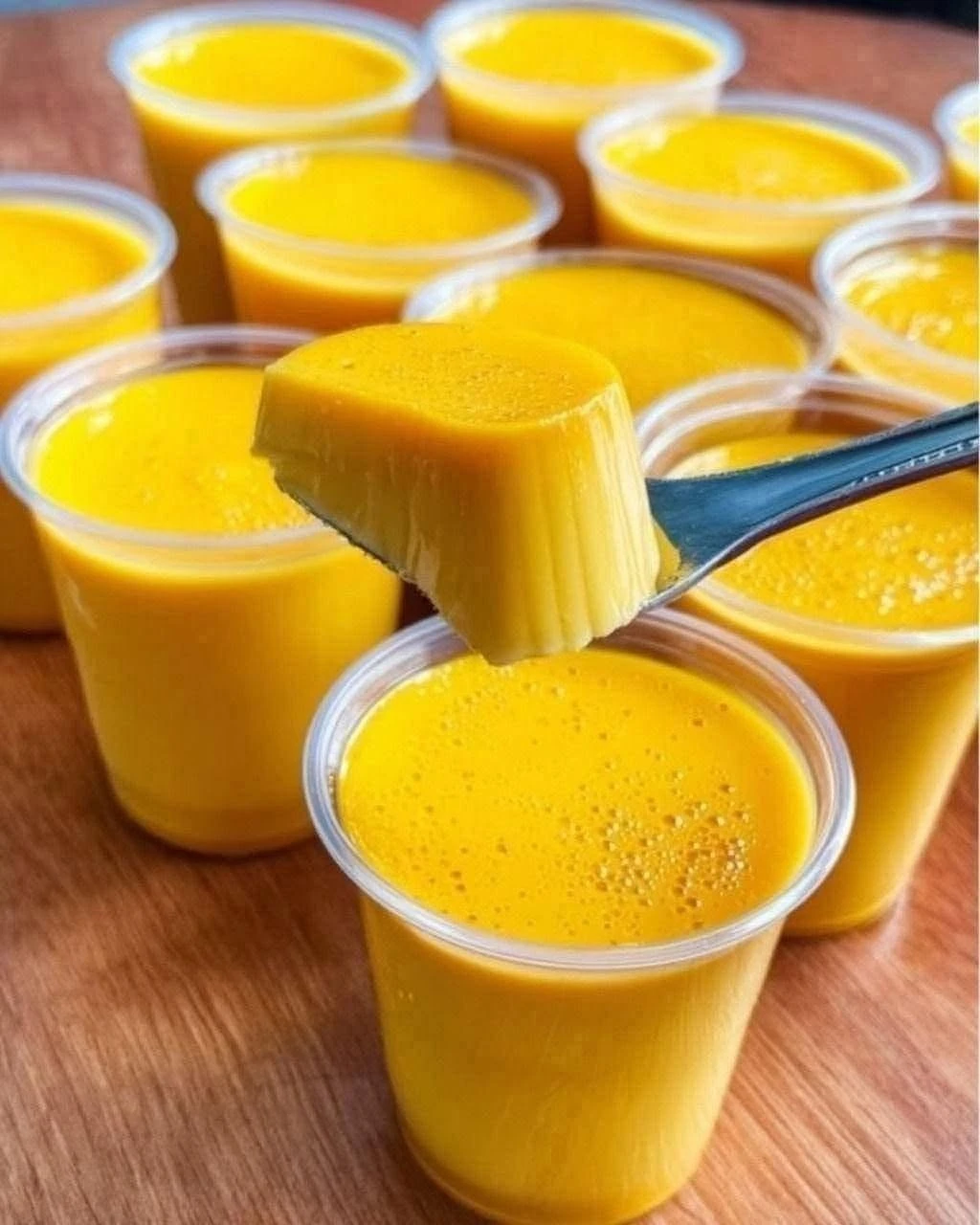
These Creamy Mango Pudding Cups are a smooth, refreshing dessert made with ripe mango, creamy milk, a touch of sugar, and just enough gelatin to create that beautiful soft-set texture. Each little cup is cool, silky, brightly colored, and full of tropical mango flavor.
Inspired by the golden-yellow pudding cups in the image, this version is designed to give you a dessert that is firm enough to hold its shape on a spoon while still melting softly in your mouth. There is no complicated baking, no cake batter, and no special decorating required.
The secret is getting the balance right. Too much gelatin produces a rubbery pudding, while too little leaves the dessert too loose. Using ripe mango puree with milk or cream gives you a rich texture without hiding the fruit flavor.
These individual mango pudding cups are perfect for summer gatherings, birthday parties, family dinners, potlucks, baby showers, Ramadan desserts, holiday tables, or simply keeping in the refrigerator when you want something cold and sweet.
Recipe Overview
| Recipe Details | Information |
|---|---|
| Recipe Name | Creamy Mango Pudding Cups |
| Focus Keyword | Creamy Mango Pudding Cups |
| Prep Time | 15 minutes |
| Cooking Time | 5 minutes |
| Chilling Time | 4 hours |
| Total Time | About 4 hours 20 minutes |
| Servings | 10–12 small cups |
| Course | Dessert |
| Cuisine | Tropical / Asian-Inspired |
| Difficulty | Easy |
| Main Ingredient | Mango |
| Texture | Silky, Creamy & Soft-Set |
| Cooking Method | No-Bake / Stovetop |
| Best Served | Cold |
| Make Ahead | Yes |
| Refrigerator Life | 3–4 days |
Why You’ll Love These Mango Pudding Cups
This dessert looks impressive even though the preparation is extremely simple.
You get the bright color of mango without artificial-looking layers or complicated decoration.
The individual cups are also practical for entertaining because there is nothing to slice at serving time. Guests can simply pick up a cup and spoon.
Another advantage is that you can make the entire batch the night before.
Once the pudding is poured into cups, the refrigerator does the rest of the work.
The finished dessert is:
- Creamy without being overly heavy
- Fruity and refreshing
- Easy to portion
- Naturally colorful
- Make-ahead friendly
- Perfect for warm weather
- Easy to customize
What Does Mango Pudding Taste Like?
The flavor should be unmistakably mango.
Ripe mango brings natural sweetness and a slightly floral tropical flavor.
Milk softens the fruit and gives the pudding a creamy consistency.
Heavy cream makes it richer.
Vanilla adds warmth.
And a little lemon or lime juice can brighten the mango flavor without making the dessert sour.
The result is lighter than cheesecake but richer than fruit gelatin.
Think of it as something between a mango custard, panna cotta, and creamy fruit mousse.
Ingredients
For the Mango Pudding
- 3 cups ripe mango chunks
- 1 cup whole milk
- 1 cup heavy cream
- 1/2 cup granulated sugar
- 2½ teaspoons unflavored gelatin
- 1/4 cup cold water
- 1 teaspoon vanilla extract
- 1 tablespoon fresh lemon or lime juice
- Small pinch of salt
Optional Garnishes
- Fresh mango cubes
- Whipped cream
- Toasted coconut
- Mint leaves
- Lime zest
- Chopped pistachios
Ingredient Guide
| Ingredient | Purpose |
|---|---|
| Mango | Main fruit flavor and color |
| Whole Milk | Creates creamy texture |
| Heavy Cream | Adds richness |
| Sugar | Balances fruit acidity |
| Gelatin | Sets the pudding |
| Vanilla | Adds warmth |
| Lemon or Lime Juice | Brightens mango flavor |
| Salt | Enhances sweetness |
Best Mangoes for Mango Pudding
The better the mango, the better the pudding.
Use mangoes that are fully ripe, fragrant, and naturally sweet.
The flesh should be soft enough to blend easily but should not smell fermented or overly sour.
Fresh mango gives the best flavor when it is in season.
Frozen mango is an excellent alternative and makes this recipe available year-round.
Let frozen mango thaw before blending so you can measure the puree accurately.
Can You Use Frozen Mango?
Absolutely.
Frozen mango works very well in pudding.
Thaw it first.
Drain away excessive watery liquid if necessary.
Then blend until completely smooth.
Frozen mango is especially convenient because it is already peeled and chopped.
If the fruit is tart, you may need slightly more sugar.
Always taste the mango puree before deciding how sweet the pudding should be.
Can You Use Canned Mango Pulp?
Yes.
Canned mango pulp is one of the easiest shortcuts.
Use approximately 2½ to 3 cups mango pulp in place of fresh mango puree.
Some canned mango pulps already contain sugar, so reduce the added sugar.
Taste first.
Sweetened mango pulp may need very little additional sugar.
How Much Mango Puree Do You Need?
After blending, you want approximately 2½ cups thick mango puree.
Different mango varieties produce different amounts of flesh, so measuring after blending is more reliable than counting whole mangoes.
If the puree is very fibrous, pass it through a fine-mesh strainer.
This extra step creates an exceptionally smooth pudding.
Why Gelatin Is Important
Gelatin creates the soft-set structure visible in the dessert.
Without gelatin, mango puree mixed with cream would remain closer to a thick smoothie.
The key is using only enough gelatin to hold the pudding together.
Too much gives you a stiff, bouncy texture.
For this recipe, approximately 2½ teaspoons gives you a soft pudding that can hold its shape on a spoon.
How to Bloom Gelatin Correctly
Place the cold water in a small bowl.
Sprinkle the gelatin evenly over the surface.
Do not dump it into one large pile.
Let it stand for approximately 5 minutes.
The gelatin will absorb the water and swell.
This is called blooming.
Once bloomed, it dissolves much more evenly when added to warm liquid.
Can You Make Mango Pudding Without Gelatin?
Yes.
There are several alternatives.
Cornstarch can produce a cooked pudding texture.
Agar-agar can create a vegetarian set pudding.
Chia seeds can create a completely different breakfast-style pudding.
For the smooth dessert shown in the image, gelatin or agar is the easiest way to create the clean, firm shape.
Agar-Agar Version
To make the recipe vegetarian, use agar-agar instead of gelatin.
Agar sets more firmly than gelatin, so it should not be substituted in equal quantities without adjustment.
Follow the amount recommended on your agar product for approximately 4–5 cups of liquid mixture.
Agar usually needs to be boiled briefly to activate properly.
Once activated, mix it with the mango mixture and pour immediately because agar starts setting at a warmer temperature than gelatin.
Equipment Needed
You only need basic kitchen equipment:
- Blender or food processor
- Small saucepan
- Mixing bowl
- Whisk
- Measuring cups
- Measuring spoons
- Fine-mesh strainer, optional
- Small dessert cups
Clear cups are especially attractive because they show off the bright mango color.
How to Make Creamy Mango Pudding Cups
Step 1: Prepare the Mango
Peel the mangoes.
Remove the flesh from the pits.
Cut into chunks.
Measure approximately 3 cups.
Place the mango pieces in a blender.
Step 2: Blend Until Smooth
Blend the mango until completely smooth.
Add the lemon or lime juice.
Blend again.
If the puree has noticeable fibers, pour it through a fine-mesh strainer.
Set aside.
Step 3: Bloom the Gelatin
Pour 1/4 cup cold water into a small bowl.
Sprinkle the gelatin over the surface.
Allow it to sit for about 5 minutes.
Do not stir aggressively.
The gelatin should absorb the water and become thick.
Step 4: Warm the Milk and Cream
Place the milk, heavy cream, sugar, and salt in a saucepan.
Heat over medium-low heat.
Stir until the sugar dissolves.
Do not bring the dairy to a vigorous boil.
You only need it warm enough to dissolve the gelatin.
Step 5: Add the Gelatin
Remove the saucepan from the heat.
Add the bloomed gelatin.
Whisk until completely dissolved.
Look carefully to make sure no gelatin pieces remain.
Step 6: Add Vanilla
Stir in the vanilla extract.
Let the mixture cool for several minutes.
It should be warm, not extremely hot, before adding the mango.
Step 7: Combine with Mango Puree
Slowly whisk the mango puree into the warm cream mixture.
Continue whisking until the color is completely uniform.
The mixture should look smooth, creamy, and bright yellow-orange.
Step 8: Taste Before Chilling
Taste a small spoonful.
Adjust if necessary.
If it needs sweetness, add a little sugar while the mixture is still warm.
If it tastes overly sweet, add a small amount of lemon or lime juice.
Remember that cold desserts often taste slightly less sweet than warm mixtures.
Step 9: Pour Into Cups
Arrange small dessert cups on a tray.
Pour the mango mixture evenly among them.
Leave a small amount of space at the top if you plan to garnish later.
The tray makes it easier to move all the cups to the refrigerator at once.
Step 10: Chill Until Set
Refrigerate for at least 4 hours.
Overnight chilling is even better.
Do not disturb the cups while the pudding is setting.
Once ready, the center should feel soft but firm when gently touched.
How to Know When Mango Pudding Is Ready
Tilt one cup gently.
The pudding should stay mostly in place.
The surface should look smooth.
When you scoop it with a spoon, it should hold its shape briefly before becoming creamy in your mouth.
If it pours like a sauce, it needs more chilling time.
The Secret to Silky Mango Pudding
The biggest secret is controlling the temperature.
Do not aggressively boil the milk.
Do not boil the mango puree.
And do not pour boiling cream directly into fresh mango.
Gentle heating preserves both texture and flavor.
Straining the puree also makes a noticeable difference when using fibrous mango varieties.
Why Your Mango Pudding Might Not Set
Several things can cause soft pudding.
The gelatin may not have been measured correctly.
It may not have been bloomed.
The gelatin may not have fully dissolved.
The overall amount of liquid may have been increased.
Or the dessert simply may not have chilled long enough.
Give the cups at least four hours before deciding they failed.
Overnight chilling provides the most reliable texture.
How to Make Firmer Mango Pudding
If you want a pudding that can be unmolded onto a plate, increase the gelatin slightly.
Use approximately 3 teaspoons instead of 2½.
Do not add dramatically more.
The goal is a smooth dessert, not a rubbery jelly.
How to Make Softer Mango Pudding
For a more spoonable custard texture, reduce the gelatin slightly.
Use about 2 teaspoons.
Serve directly inside cups because the pudding may not hold up well when unmolded.
Mango Coconut Pudding
Replace part of the dairy with coconut milk.
Use:
- 1 cup coconut milk
- 1 cup whole milk
- 1/2 cup heavy cream
The coconut adds a tropical flavor without completely overpowering the mango.
Finish with toasted coconut.
Mango Coconut Milk Version
For a stronger coconut flavor, use full-fat canned coconut milk.
You can replace most or all of the dairy.
Because coconut milk is naturally rich, the finished pudding remains creamy.
Vanilla and lime work especially well with this version.
Mango Cream Cheese Pudding
For a cheesecake-style variation, blend 4 ounces softened cream cheese with the mango puree.
Continue with the recipe normally.
The cream cheese creates a richer texture and subtle tang.
You may need a little extra sugar depending on your mango.
Mango Cheesecake Cups
Add crushed graham crackers to the bottom of each cup.
Prepare the cream cheese mango pudding.
Pour over the crumbs.
Chill.
Finish with:
- Mango cubes
- Whipped cream
- Additional graham cracker crumbs
This turns the simple pudding into individual no-bake mango cheesecake cups.
Mango Vanilla Pudding
Increase vanilla to 2 teaspoons.
Use very ripe mango.
Keep the lemon juice minimal.
This produces a mild, creamy version where vanilla and mango share the flavor.
Mango Lime Pudding
Use lime juice instead of lemon.
Add 1 teaspoon finely grated lime zest.
Mango and lime are especially good together because the sharp citrus balances the sweet fruit.
Finish with additional lime zest before serving.
Mango Orange Pudding
Add 1 teaspoon fresh orange zest.
Replace a few tablespoons of milk with orange juice.
Do not add excessive juice because too much acidity can affect dairy texture.
The result has a bright tropical flavor.
Mango Passion Fruit Pudding
Add passion fruit pulp either to the mango puree or as a topping.
Passion fruit is much more tart than mango.
Its acidity creates an excellent contrast with the creamy pudding.
For presentation, spoon a small amount over each set cup immediately before serving.
Mango Pineapple Pudding
Blend some mango with pineapple.
Use mostly mango so the texture remains creamy.
A good ratio is:
- 2 cups mango puree
- 1/2 cup pineapple puree
The finished dessert tastes extremely tropical.
Mango Banana Pudding
Blend one ripe banana into the mango puree.
Banana makes the mixture naturally thicker and sweeter.
Reduce the sugar slightly.
This version is especially popular with children.
Mango White Chocolate Pudding
Melt about 4 ounces white chocolate into the warm milk-and-cream mixture.
Reduce the added sugar.
White chocolate makes the pudding richer and gives it a luxurious texture.
Mango and white chocolate work surprisingly well together.
Layered Mango Pudding Cups
For a more impressive presentation, create layers.
Prepare mango pudding.
Pour half into the cups.
Chill until partially set.
Add a layer of:
- Vanilla panna cotta
- Coconut pudding
- Yogurt cream
- Mango puree
Then add another mango layer.
The clear cups show the different colors beautifully.
Mango Yogurt Pudding
Replace part of the heavy cream with thick Greek yogurt.
Allow the cooked milk-and-gelatin mixture to cool before whisking in yogurt.
Do not add yogurt while the mixture is extremely hot.
The finished pudding has a pleasant tang and lighter texture.
How to Make Mango Pudding More Luxurious
Several small changes can make the dessert richer.
Use heavy cream.
Use very ripe mango.
Add a little white chocolate.
Use vanilla bean paste instead of ordinary vanilla.
Serve with fresh mango on top.
Add toasted pistachios.
A small amount of whipped cream also makes the presentation feel more elegant.
Best Toppings for Mango Pudding
| Topping | What It Adds |
|---|---|
| Fresh Mango | More fruit flavor |
| Whipped Cream | Light creaminess |
| Toasted Coconut | Crunch and tropical flavor |
| Pistachios | Color and texture |
| Mint | Fresh appearance |
| Lime Zest | Bright citrus |
| Passion Fruit | Tart contrast |
| White Chocolate | Extra richness |
| Berries | Fresh color |
| Chia Seeds | Texture |
How to Make the Cups Look Professional
Use clear dessert cups of the same size.
Fill each one to the same level.
Wipe away any drips around the rim before chilling.
After the pudding has completely set, add a small garnish rather than covering the whole surface.
For example:
Three small mango cubes.
One mint leaf.
A little toasted coconut.
Or chopped pistachios.
Simple garnishes keep the bright yellow pudding as the focus.
Make-Ahead Instructions
Mango pudding is an excellent make-ahead dessert.
Prepare the cups one day before serving.
Cover each one after the pudding has set.
Refrigerate overnight.
Add fresh garnishes just before serving.
This prevents fruit and herbs from drying out or releasing liquid onto the pudding.
Perfect Party Dessert
Individual pudding cups work especially well for parties.
They are already portioned.
Guests do not need plates or knives.
And you can prepare dozens ahead of time.
Use small cups for larger events.
For dinner parties, slightly larger glass dessert dishes look more elegant.
How Many Cups Does This Recipe Make?
The exact number depends on cup size.
| Cup Size | Approximate Yield |
|---|---|
| 2 oz mini cups | 18–20 |
| 3 oz cups | 12–14 |
| 4 oz cups | 10–12 |
| 6 oz dessert cups | 6–8 |
For parties where several desserts are available, smaller cups are usually enough.
How to Double the Recipe
This recipe doubles easily.
Use:
- 6 cups mango
- 2 cups milk
- 2 cups heavy cream
- 1 cup sugar
- 5 teaspoons gelatin
- 1/2 cup cold water
- 2 teaspoons vanilla
Prepare in a larger saucepan.
Divide between cups.
Chilling time remains roughly the same if the individual portion sizes remain unchanged.
Storage
Keep mango pudding refrigerated.
Cover the cups tightly once set.
For best quality, enjoy within 3–4 days.
Fresh mango garnish should ideally be added close to serving time.
Do not leave dairy-based pudding sitting at room temperature for extended periods.
Can Mango Pudding Be Frozen?
Freezing is not ideal.
Gelatin-set dairy desserts can change texture after thawing.
The pudding may release liquid or become slightly grainy.
For best results, make only what you can refrigerate and eat within several days.
Common Mistakes to Avoid
| Common Mistake | Result | Better Method |
|---|---|---|
| Using unripe mango | Weak or sour flavor | Use ripe sweet fruit |
| Too much gelatin | Rubbery pudding | Measure carefully |
| Too little gelatin | Pudding stays loose | Use proper ratio |
| Not blooming gelatin | Uneven setting | Bloom in cold water |
| Boiling gelatin mixture aggressively | Texture problems | Heat gently |
| Adding mango to boiling dairy | Flavor/texture may suffer | Cool slightly first |
| Too much citrus juice | Overly tart dessert | Add gradually |
| Not chilling long enough | Soft pudding | Chill at least 4 hours |
| Using fibrous puree | Rough texture | Strain puree |
| Adding garnish too early | Watery surface | Garnish before serving |
Troubleshooting Guide
My Mango Pudding Did Not Set
Give it more time first.
If it remains liquid after overnight refrigeration, the gelatin amount or activation was probably incorrect.
For the next batch, bloom the gelatin carefully and make sure it dissolves completely.
My Pudding Is Too Firm
Too much gelatin was used.
Reduce the amount slightly next time.
My Pudding Is Grainy
The mango puree may have been fibrous, or dairy may have been overheated.
Strain the mango and keep temperatures moderate.
My Pudding Is Too Sweet
Add a small amount of lemon or lime juice.
My Pudding Is Too Tart
Add a little extra sugar or cream.
My Pudding Has Bubbles on Top
Pour more slowly.
You can also gently tap the cups against the counter immediately after filling.
For a very smooth surface, skim visible foam before pouring.
My Pudding Color Is Pale
The color depends heavily on the mango variety.
Use deeply colored ripe mango or mango pulp for a stronger golden-orange shade.
Pro Tips for the Best Mango Pudding
Use the ripest mangoes you can find.
Taste the fruit before adding sugar.
Blend until completely smooth.
Strain fibrous mango puree.
Bloom gelatin in cold water.
Heat the dairy gently.
Do not boil the mango.
Add citrus gradually.
Use clear cups for presentation.
Chill overnight when possible.
Garnish immediately before serving.
Nutrition Estimate
Approximate values per serving when divided into 12 cups:
| Nutrition | Approximate Amount |
|---|---|
| Calories | 190–240 |
| Protein | 3–4 g |
| Carbohydrates | 24–31 g |
| Fat | 10–14 g |
| Fiber | 1–2 g |
| Sugar | 21–27 g |
| Serving Size | 1 small cup |
Exact values vary according to mango sweetness, cream, sugar, and serving size.
Frequently Asked Questions
What is mango pudding?
Mango pudding is a chilled dessert made with mango puree and a creamy liquid base that is set using gelatin, agar, cornstarch, or another thickening ingredient.
Is this the exact dessert shown in the image?
The image appears to show smooth, yellow-orange individual pudding cups with a soft-set consistency. This recipe is designed to recreate that style rather than claim the exact original formula.
Can I use fresh mango?
Yes. Fresh ripe mango gives excellent flavor.
Can I use frozen mango?
Absolutely.
Can I use canned mango pulp?
Yes.
Do I have to use gelatin?
No. Agar-agar can be used for a vegetarian alternative.
Can I make it without heavy cream?
Yes. Replace it with additional whole milk or coconut milk.
Can I use evaporated milk?
Yes. Evaporated milk gives the pudding a rich texture.
Can I use condensed milk?
Yes, but reduce or eliminate the added sugar because condensed milk is already sweet.
Can I use coconut milk?
Absolutely. Mango and coconut are excellent together.
Can I add cream cheese?
Yes.
Can I add yogurt?
Yes, after the warm mixture has cooled somewhat.
Can I add chia seeds?
Yes, although the texture will no longer be completely smooth.
Can I add lemon?
Yes.
Can I use lime?
Yes. Lime works especially well.
How long does mango pudding need to chill?
At least 4 hours.
Can I chill it overnight?
Yes, and overnight chilling is ideal.
Why is my pudding not firm?
It may need more chilling time or the gelatin may have been measured or prepared incorrectly.
Can I unmold the pudding?
Yes, but use slightly more gelatin if you want a firm unmolded dessert.
Can I make individual cups?
Yes. Individual portions are one of the easiest serving methods.
Can I make one large pudding?
Yes. Pour it into a larger mold, but it will require longer chilling.
How long does mango pudding keep?
Approximately 3–4 days refrigerated.
Can it be frozen?
Freezing is not recommended for the best texture.
What should I serve with mango pudding?
Fresh mango, whipped cream, coconut, pistachios, berries, mint, or passion fruit all work beautifully.
Make It More Budget-Friendly
Use frozen mango when fresh fruit is expensive.
Canned mango pulp can also be economical and saves preparation time.
Replace some heavy cream with whole milk.
Use small serving cups for parties.
Because the pudding is rich, you do not need very large portions.
For a large gathering, a double batch in 2- or 3-ounce cups can provide many servings at a reasonable cost.
Best Occasions for Mango Pudding Cups
These little desserts work especially well for:
- Summer parties
- Birthday celebrations
- Family gatherings
- Potlucks
- Baby showers
- Bridal showers
- Holiday dessert tables
- Ramadan iftar desserts
- Weekend dinners
- BBQ gatherings
Their bright color makes them especially attractive on a large dessert table.
Ad-Friendly Article Structure
| Article Position | Suggested Placement |
|---|---|
| After Introduction | Natural first placement |
| After Recipe Overview | Second placement |
| After Ingredient Guide | Third placement |
| Before Instructions | High-engagement break |
| After Main Instructions | Mid-article placement |
| Before Variations | Natural content break |
| Before Storage | Additional placement |
| Before FAQs | Strong late-article placement |
| Before Final Thoughts | Optional placement |
Keep the core gelatin and mixing instructions together because those are the most important technical steps in the recipe.
Final Thoughts
These Creamy Mango Pudding Cups prove that an impressive dessert does not have to involve complicated baking.
Ripe mango provides the beautiful golden color and naturally fruity flavor.
Milk keeps the pudding light.
Cream gives it richness.
Vanilla rounds everything out.
A little citrus makes the mango taste brighter.
And just enough gelatin gives each cup the silky, soft-set texture that makes the dessert so satisfying.
The recipe is already delicious in its simplest form, but it is also extremely flexible.
Use coconut milk for a tropical version.
Add cream cheese for a cheesecake-style pudding.
Use lime instead of lemon.
Add passion fruit.
Layer it with vanilla pudding.
Top it with white chocolate.
Add toasted coconut or pistachios.
Or keep the cups completely plain and let that beautiful mango color speak for itself.
For the best result, focus on three things: use ripe flavorful mango, measure the gelatin carefully, and give the pudding enough time to chill completely.
Prepare the cups the night before, refrigerate them, add a simple garnish right before serving, and you have an easy make-ahead dessert that looks polished enough for a party while remaining simple enough for an ordinary family dinner.