Introduction
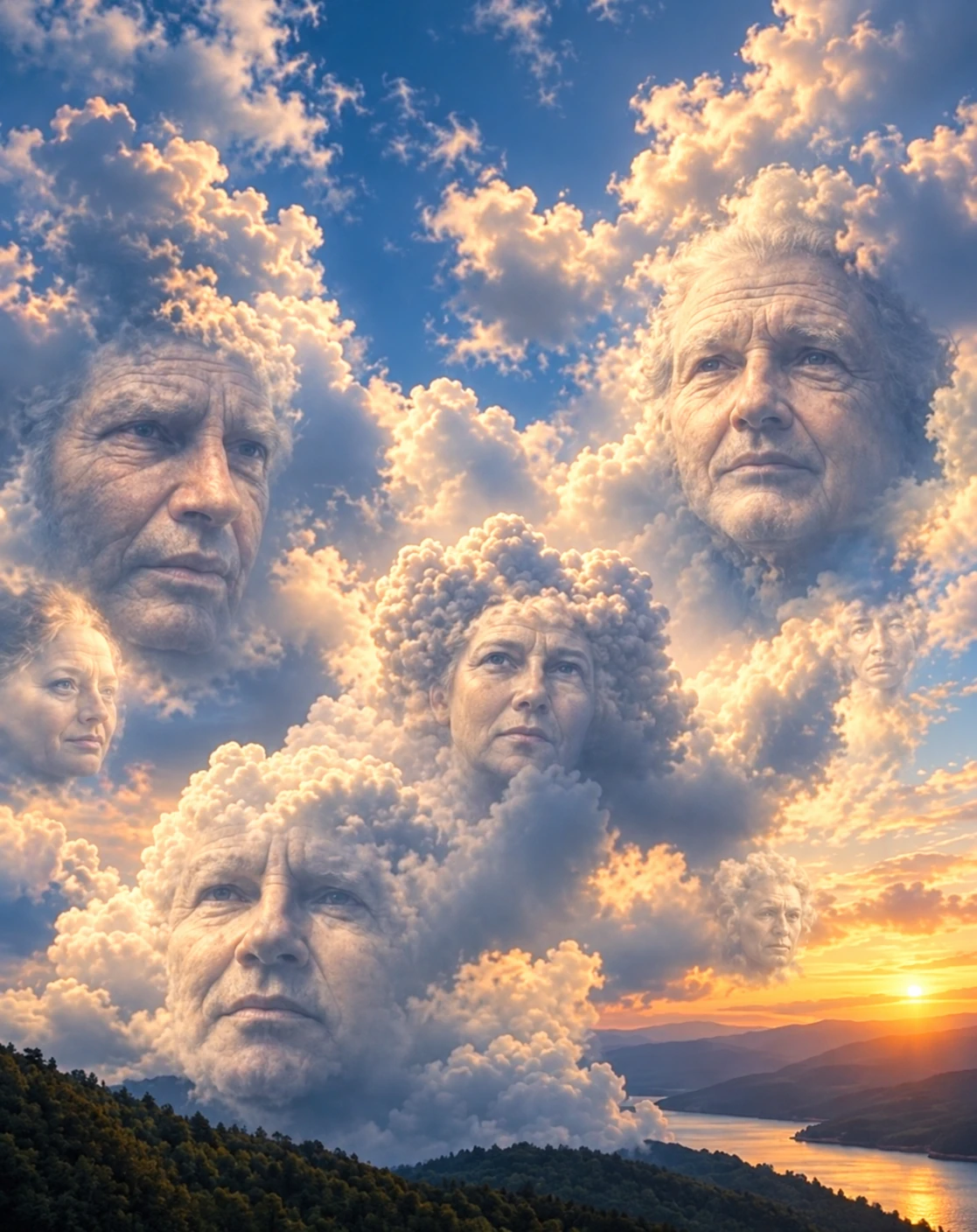
At first glance, this image looks like a peaceful sunset filled with large, dramatic clouds. But after looking for just a few seconds, something unusual begins to happen: human faces start appearing inside the clouds.
The viral image is usually shared with the claim that “the number of faces you see reveals your true personality.” That wording makes the puzzle feel like a personality test, but the real reason it is so interesting is much simpler: the human brain is extremely good at detecting faces, even in random shapes.
Some people immediately notice several large faces.
Others spot smaller faces hidden between the clouds.
And once someone points out another face, it can suddenly become almost impossible not to see it.
That is what makes this illusion so engaging.
It is not really about discovering your “true personality.” Instead, it is a fascinating example of visual perception, pattern recognition, and the way our brains naturally search for familiar shapes.
So, how many faces are actually visible in the image?
Let’s examine it carefully.
The Puzzle at a Glance
The image shows a landscape filled with clouds above a sunset.
Several of those clouds have been shaped or arranged to resemble human faces.
Some faces are very obvious.
Others are much smaller and easier to miss.
A quick glance may reveal only three or four.
A longer inspection may reveal six, seven, or even more depending on what someone decides counts as a separate face.
That ambiguity is part of the puzzle.
How Many Faces Can Be Seen?
The most obvious faces include several large ones spread across the sky.
A careful viewer can generally identify around 7 prominent face-like forms in the image.
Depending on how strictly you count partial or less-defined shapes, someone may report a slightly different number.
The important point is that not every face is equally obvious.
The Most Obvious Faces
1. Large Face in the Upper Left
One of the clearest faces appears near the upper-left portion of the cloud formation.
It has:
- Eyes
- Nose
- Mouth
- A clearly defined head shape
This is usually one of the first faces people notice.
2. Large Face in the Upper Right
Another prominent face appears toward the upper-right side.
It is larger and older-looking, with facial features shaped by light and shadow in the clouds.
This is also one of the easiest to spot.
3. Central Face
Near the middle of the image is another clear face.
It appears to be looking slightly upward.
Because it sits near the center, many viewers notice it quickly.
4. Large Lower-Left Face
A large face also appears lower in the image toward the left side.
This face is particularly noticeable because its shape is surrounded by darker cloud shadows.
Smaller Faces People Often Miss
The more difficult part of the puzzle comes from the smaller faces.
Several are hidden near the larger ones.
These smaller shapes are less detailed, so the brain may not immediately classify them as faces.
Once noticed, however, they become much easier to see.
5. Small Face on the Far Left
Near the left edge, below the large upper-left face, there is a smaller face-like form.
It is partially surrounded by cloud texture.
Because it is smaller and less detailed, many people miss it on the first look.
6. Small Face on the Right
Another smaller face can be seen toward the right-middle area of the cloud formation.
Its features are less pronounced.
This is one of the shapes that may only become obvious after looking at the image for several seconds.
7. Another Subtle Face Among the Clouds
There is at least one more face-like pattern blended into the surrounding cloud structure.
This is where the count becomes more subjective.
Some viewers clearly recognize it as a face.
Others see only ordinary cloud shapes.
So Is the Answer 7?
For the most obvious face-like forms, 7 is a reasonable count.
However, optical illusions like this do not always have one perfectly objective answer.
The image contains many irregular cloud shapes.
If someone treats every vague eye-nose-mouth pattern as a separate face, the number can increase.
That is why comments on viral versions of the image often contain different answers.
Why People See Different Numbers of Faces
People do not all process visual information in exactly the same way.
Some viewers focus on large shapes.
Others scan the image for smaller details.
Some recognize a face only when all major features are obvious.
Others need only two “eyes” and a rough mouth shape before the brain identifies a face.
This difference does not necessarily reveal personality.
It reflects differences in:
- Attention
- Visual scanning
- Pattern recognition
- Expectations
- Image familiarity
What Is Pareidolia?
The phenomenon behind this image is called pareidolia.
Pareidolia happens when the brain sees a familiar pattern in something ambiguous or random.
Faces are the most common example.
People often see faces in:
- Clouds
- Rock formations
- Tree bark
- Electrical outlets
- Car headlights
- Toast
- Buildings
- Shadows
The object does not actually contain a real face.
The brain interprets the pattern as one.
Why Is the Brain So Good at Seeing Faces?
Human brains are highly sensitive to facial patterns.
Recognizing faces quickly is extremely useful in everyday life.
A rough arrangement of:
- Two eye-like shapes
- A nose-like shape
- A mouth-like line
can be enough for the brain to say:
“That looks like a face.”
This happens very quickly and often before we consciously analyze what we are seeing.
Why Faces Appear More Clearly After Someone Points Them Out
This is one of the most interesting parts of visual illusions.
Before someone points out a hidden face, the clouds may look completely random.
But once the face is identified, the brain creates a stable interpretation of the pattern.
After that, it becomes difficult to “unsee” it.
This is because perception is influenced not only by what our eyes receive, but also by what our brain expects to find.
Does the Number of Faces Really Reveal Your Personality?
There is no good scientific basis for saying that the number of faces you notice in this particular viral image reveals your “true personality.”
The claim is mainly designed to make the post more entertaining and shareable.
A person who sees more faces may simply:
- Spend more time looking
- Notice smaller details
- Already expect hidden faces
- Have stronger face-pattern recognition
Someone who sees fewer faces may simply focus first on the larger patterns.
Neither response provides a reliable personality diagnosis.
A Fun Personality-Style Interpretation
If you want to treat the puzzle purely as entertainment, you can use a playful interpretation.
It should not be confused with a psychological assessment.
If You See 3 or Fewer Faces
You may be focusing mostly on the largest and clearest shapes.
In a playful interpretation, this could suggest that you prefer:
- Simple information
- Big-picture thinking
- Clear patterns
- Quick decisions
But again, this is just for fun.
If You See 4–5 Faces
You are probably noticing both obvious shapes and some smaller details.
A playful description might say you balance:
- Overall structure
- Detail
- Observation
- Practical thinking
If You See 6–7 Faces
You are likely scanning the image more carefully.
A fun interpretation might describe you as:
- Detail-oriented
- Curious
- Patient
- Visually observant
But the main reason may simply be that you spent longer inspecting the picture.
If You See More Than 7 Faces
You may be interpreting less-defined cloud shapes as faces as well.
A playful interpretation might call this:
- Imaginative
- Creative
- Pattern-sensitive
In reality, it mostly shows how flexible visual perception can be.
What This Image Actually Tests Better
Instead of personality, this picture is better thought of as a test of:
- Visual attention
- Pattern detection
- Patience
- Interpretation
- Expectations
Even then, it is not a standardized psychological test.
It is simply a fun visual puzzle.
Why Clouds Work So Well for Face Illusions
Clouds are perfect for pareidolia because they contain irregular, soft-edged shapes.
They constantly create combinations of:
- Light
- Shadow
- Curves
- Gaps
- Symmetry
Those patterns can easily resemble eyes, noses, mouths, or entire heads.
Clouds also lack clear boundaries, which gives the brain freedom to interpret them in different ways.
Large Faces vs. Small Faces
The large faces are easier to detect because they have more complete features.
The smaller faces are difficult because their features are created by only a few cloud shadows.
This is why one person may count four while another counts seven.
The second viewer may simply be accepting weaker patterns as valid faces.
Why Some Faces Look Older
Several faces in the image appear to be older adults.
This effect comes from the cloud texture.
Wrinkles, shadows, and uneven edges naturally resemble:
- Forehead lines
- Cheek folds
- Eye shadows
- Facial contours
Cloud texture can therefore make a face seem aged even though it is not actually a real face.
Why the Faces Look Three-Dimensional
Light and shadow give the clouds depth.
Bright areas look raised.
Dark areas look recessed.
When these light patterns line up with expected facial features, the brain interprets them as three-dimensional faces.
That is why the illusion can look surprisingly realistic.
Why the Sunset Makes the Illusion Stronger
The warm lighting near the horizon creates strong contrast between bright and dark cloud areas.
Contrast is important for visual recognition.
It helps the brain separate:
- Eyes from cheeks
- Nose from surrounding cloud
- Mouth from chin
The dramatic sunset lighting makes the faces easier to perceive.
The Role of Expectation
The text above the image says that there are faces hidden inside it.
That immediately tells your brain what to search for.
If the same image were shown without the headline, some people might initially see only clouds.
Once the word “faces” is introduced, the brain begins actively scanning for facial patterns.
This is known as a top-down influence on perception.
What Happens If You Look at the Image Upside Down?
Faces are often harder to recognize when images are rotated.
That is because the brain is strongly adapted to upright facial arrangements.
An upside-down version may make some of the hidden faces disappear temporarily.
Turn it upright again, and they may immediately return.
Why Different People May Never Agree on the Exact Number
The image does not use clearly outlined cartoon faces.
Instead, the faces emerge from irregular cloud patterns.
That creates a subjective boundary.
One person may say:
“That definitely looks like a face.”
Another may say:
“That is just a cloud.”
Neither interpretation necessarily means one person is seeing incorrectly.
A Better Way to Count the Faces
When looking at an illusion like this, use a systematic method.
Start in one corner.
Move across the image slowly.
Then move downward.
Look for:
- Two eye shapes
- Nose
- Mouth
- Overall head outline
Count only distinct face-like patterns.
This prevents counting the same face twice.
Suggested Face-Counting Method
Try scanning in this order:
- Upper left
- Upper center
- Upper right
- Middle left
- Center
- Middle right
- Lower left
- Lower center
- Lower right
This gives your eyes a structured path.
Why We Often Miss Faces Near the Edge
The center of an image naturally receives more attention.
That means faces near the outer edges can be overlooked.
In this image, some of the smaller faces sit closer to the sides.
A second scan focused only on the edges can reveal details missed the first time.
Why Looking Longer Changes Your Answer
Your first answer reflects rapid visual recognition.
Your later answer reflects deliberate search.
These are different processes.
The first may take less than a second.
The second may involve actively checking shadows and cloud shapes.
That is why someone can move from seeing 4 faces to 7 faces without the image changing at all.
Is Seeing More Faces Better?
No.
Seeing more faces does not mean someone is smarter, more creative, or more perceptive overall.
It only means that, in this particular image, they recognized more patterns as face-like.
The result can also change depending on:
- Screen size
- Image quality
- Brightness
- Viewing distance
- Previous hints
Screen Size Can Change the Count
On a small phone screen, tiny faces may be difficult to recognize.
On a larger monitor, those details can become much clearer.
That means two people could look at the same image and get different answers simply because they are using different devices.
Brightness Can Change the Illusion
Increasing or decreasing screen brightness changes cloud contrast.
That can make certain faces:
- More visible
- Less visible
- Completely disappear
This is another reason the puzzle should not be treated as a serious psychological test.
Image Compression Matters Too
Viral images are often copied and reposted many times.
Each copy may lose detail.
Compression can blur:
- Eyes
- Mouths
- Small facial contours
A lower-quality version may contain fewer recognizable faces than the original.
Why These Images Become Viral
Optical illusions work especially well on social media because they create immediate participation.
People want to comment with their number.
Then they compare answers.
Someone says “5.”
Another says “7.”
Someone else claims to see “9.”
That disagreement keeps the conversation going.
The Personality Claim Makes People More Curious
A question like:
“How many faces do you see?”
is interesting.
But:
“The number of faces you see reveals your true personality”
creates much stronger curiosity.
People naturally want to know what the answer supposedly says about them.
That makes the image more clickable and shareable.
The Difference Between a Viral Test and a Psychological Test
A real psychological assessment requires much more than one optical illusion.
Validated tests usually have:
- Standardized questions
- Consistent scoring
- Research evidence
- Reliability testing
- Comparison data
A viral cloud image has none of those features.
So it is best enjoyed as entertainment.
What the Puzzle Can Teach Us About Perception
Even though it is not a personality test, the image demonstrates something real and interesting.
Human perception is active.
The brain does not simply record the world like a camera.
Instead, it constantly interprets what the eyes see.
It looks for familiar objects.
It fills in missing information.
It uses previous knowledge.
That is why the same clouds can appear meaningless one moment and full of faces the next.
Why Humans See Faces Everywhere
Faces are socially important.
Humans use faces to recognize:
- Family
- Friends
- Strangers
- Emotions
- Attention
Because faces carry so much information, the brain has become extremely efficient at detecting them.
The downside is that sometimes it detects faces where none actually exist.
Famous Examples of Pareidolia
Common examples include:
- A face on the Moon
- Faces in rock formations
- Faces in electrical sockets
- Faces on the front of cars
- Faces in tree trunks
- Shapes in clouds
The cloud illusion in this image belongs to the same family of perceptual effects.
Can Children See Different Faces Than Adults?
Yes.
Children may interpret ambiguous images differently because they have different experiences and expectations.
They may also be more willing to describe vague patterns as faces.
Adults may demand clearer facial structure before counting something as a face.
Can Mood Affect What You Notice?
Mood and attention can influence how people process ambiguous information, but this particular image cannot reliably measure that.
Someone who is tired may scan the image less carefully.
Someone who is curious may spend longer searching.
That alone can change the number of faces they report.
Quick Face Count
If you want the short answer:
Around 7 prominent faces can reasonably be identified.
Some viewers may report more or fewer depending on how they interpret the less-defined cloud patterns.
A Fun Challenge to Try
Look at the image for only three seconds.
Count the faces.
Then look again for 20 seconds.
Compare your two answers.
Many people find that the second number is higher.
That demonstrates how attention changes visual perception.
Another Challenge
Show the image to someone without telling them there are faces.
Ask:
“What do you see?”
Then show them the headline.
Ask again.
Often, the hidden faces become much more obvious once the viewer knows what to look for.
Frequently Asked Questions
How many faces are in the image?
Around seven prominent face-like forms can reasonably be identified.
Is seven the only correct answer?
Not necessarily.
Some cloud shapes are ambiguous, so viewers may count slightly more or fewer.
Why do people see different numbers?
People differ in attention, pattern recognition, expectations, and how strict they are when deciding what counts as a face.
Does seeing more faces mean you are smarter?
No.
There is no basis for using this image as an intelligence test.
Does the number reveal your personality?
Not in any scientifically reliable way.
The personality claim is mainly part of the viral entertainment format.
What is pareidolia?
Pareidolia is the tendency to see familiar patterns, especially faces, in ambiguous or random shapes.
Why are faces so easy to see in clouds?
Clouds contain irregular shapes, shadows, and curves that can resemble facial features.
Why can I see a face after someone points it out?
Once your brain learns a pattern, it becomes easier to recognize it again.
Why can’t I unsee the faces afterward?
The brain has formed a stable interpretation of the cloud pattern.
Is this an optical illusion?
Yes.
It is a form of visual illusion based on pattern recognition and pareidolia.
Are the faces real people?
No.
They are face-like forms created within the cloud imagery.
Why do some faces look old?
Cloud shadows and textures resemble wrinkles and facial contours.
Can the number change depending on screen size?
Yes.
Small details may be harder to see on smaller or lower-quality displays.
Does brightness matter?
Yes.
Brightness and contrast can change how visible some facial features appear.
Can someone see more than seven?
Yes.
A person may identify additional vague patterns as faces.
Can someone reasonably see only four or five?
Yes.
The largest faces are much more obvious than the smaller ones.
Is there a scientifically correct personality interpretation?
No.
This image is not a validated personality assessment.
Why do social media posts call it a personality test?
That wording makes the post more engaging and encourages people to comment and share.
Can I use this as a brain teaser?
Absolutely.
It works very well as a visual observation puzzle.
What’s the best way to find all the faces?
Scan the image slowly from left to right and top to bottom instead of looking only at the center.
Final Thoughts
The “How Many Faces Can You See?” cloud illusion is a great example of how powerful human pattern recognition can be.
At first, the image may appear to be nothing more than dramatic clouds above a sunset. But once you begin looking for faces, large and small facial patterns start appearing throughout the scene.
Around seven prominent faces can reasonably be identified, although the exact number may vary depending on how someone interprets the more ambiguous shapes.
The popular claim that your face count reveals your “true personality” should be treated as entertainment rather than science. What the image genuinely demonstrates is something more interesting: our brains constantly search for meaningful patterns, especially human faces, even when looking at something as random as clouds.
The number you see may change if you look longer, change screens, adjust brightness, or simply receive a hint about where another face is hiding.
So the most interesting question may not be what the number says about your personality.
It may be how quickly your brain can turn clouds into people.